
Animal welfare is the part of EU animal law that has moved least in the last two decades and promises to move most in the next two years. The directives on farmed animals date from 1998 to 2008, the transport regulation from 2004. The Commission’s fitness check concluded in 2022 that a revision was needed, EFSA delivered its scientific opinions between 2022 and 2025, and citizens signed two European Citizens’ Initiatives. Yet of the package announced for 2023 only two proposals were tabled, and only one, on dogs and cats, has become law, as Regulation (EU) 2026/1818 of 17 June 2026.
This article completes the Food Times analysis of the Animal Health Law ten years on, which left welfare aside. It follows the same method: the acts in force; the scientific and political groundwork; the reforms announced, now anchored to the EU Livestock Strategy of July 2026; and the practical consequences for operators, from stable to table.
The legal basis, Article 13 TFEU and seven acts
The Treaty sets the principle. Under Article 13 TFEU, ‘the Union and the Member States shall, since animals are sentient beings, pay full regard to the welfare requirements of animals‘, while respecting ‘religious rites, cultural traditions and regional heritage‘ (which balance was defined by EUCJ. Dongo, 2020). Below the Treaty, the acquis on farmed animals is fragmented and old:
- Council Directive 98/58/EC on the protection of animals kept for farming purposes, the general framework (consolidated text: 14/12/2019);
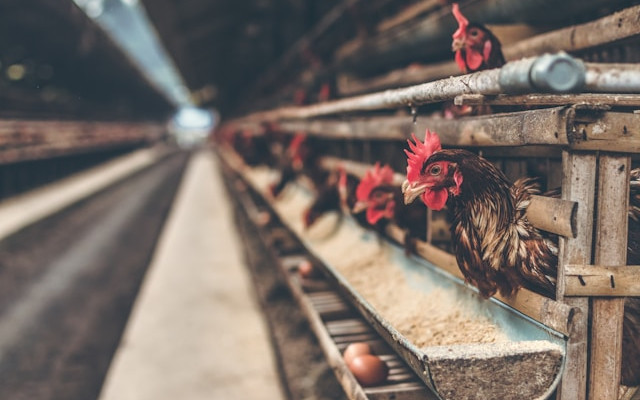
- Council Directive 1999/74/EC on laying hens, which banned conventional cages from 2012 but allows ‘enriched’ cages (consolidated text: 14/12/2019);
- Council Directive 2007/43/EC on chickens kept for meat production, with stocking densities up to 42 kg/m² (consolidated text: 14/12/2019);
- Council Directives 2008/119/EC on calves and 2008/120/EC on pigs, the latter still allowing sow stalls for part of gestation and farrowing crates (consolidated texts: 14/12/2019);
- Council Regulation (EC) No 1/2005 on the protection of animals during transport (consolidated text: 14/12/2019);
- Council Regulation (EC) No 1099/2009 on the protection of animals at the time of killing, whose Annex I was amended on 6 August 2026 by Implementing Regulation (EU) 2026/1734 to authorise non-penetrative captive bolt stunning and nitrogen high expansion foam stunning (consolidated text: 06/08/2026).
Enforcement rests on the Official Controls Regulation (EU) 2017/625. The European Court of Auditors had already flagged uneven controls in 2018, as Food Times noted in its analysis on the role of ‘consumActors’ (Dongo & De Nobili, 2020).
The scientific groundwork, EFSA 2022-2025
The Commission’s fitness check, closed in September 2022, confirmed ‘the need to revise and modernise the EU animal welfare legislation’. EFSA then delivered the evidence base, opinion by opinion:
- pigs on farm (August 2022), with recommendations on space, enrichment, tail docking and the end of confinement of sows;
- five opinions on transport (September 2022), covering temperature thresholds, space allowances, journey times and unweaned animals (Dongo & Torre, 2022);
- laying hens and broilers on farm (February 2023), recommending cage-free housing and a broiler stocking density of 11 kg/m² against the current 33-42 kg/m² (Mei, 2023);
- calves and dairy cows (2023), ducks, geese and quails, and beef cattle, turkeys and equines through 2025;
- animals kept for fur (July 2025), the mink, foxes, raccoon dogs and chinchillas covered by the ‘Fur Free Europe’ initiative.
The gap between science and law is wide. Food Times set it out for poultry, comparing conventional and organic standards on housing, outdoor access, genetics and antibiotic use (Dongo, 2025).
Citizens’ initiatives and public opinion
Two European Citizens’ Initiatives set the political agenda. ‘End the Cage Age‘, registered in 2018 (Dongo & Torre, 2018), collected 1.4 million validated signatures; in June 2021 the Commission committed to propose a phase-out of cages by the end of 2023, a deadline it missed. ‘Fur Free Europe’, registered in 2022 with 1.5 million signatures, obtained on 7 December 2023 a request to EFSA for a scientific opinion and a commitment to decide by March 2026 whether to propose a ban on fur farming and on placing farmed fur on the market. At the time of writing, no legislative proposal has been published.
Public opinion is stable. In Special Eurobarometer 533 (October 2023), 91% of respondents consider the protection of farmed animal welfare important, 84% want better protection in their country, 62% think EU rules should apply to imports and 60% say they are willing to pay more for welfare-friendly products. The 2025 public consultation on the revision drew more than 190,000 contributions, with ‘strong support for transitioning to cage-free farming‘ and for ‘applying equivalent welfare standards to imported food‘ (Strinati, 2025).
December 2023, two proposals out of four
On 7 December 2023 the Commission tabled two of the four proposals announced in the Farm to Fork Strategy. The proposals on cages and on-farm welfare, and on welfare labelling, examined by Food Times in its analysis of the EU labelling project (Dongo & Torre, 2021), never left the Berlaymont.
Transport. The proposal for a regulation replacing Regulation (EC) No 1/2005 (COM(2023) 770) aims to ‘improve the wellbeing of the 1.6 billion animals transported annually‘. Its core rules:
- a maximum journey of 9 hours for animals to slaughter and 21 hours, plus 24 hours of rest, plus 21 hours for other purposes;
- no transport above 30 °C except at night, none below -5 °C without protection;
- larger space allowances;
- journeys under 100 km for unweaned calves, piglets, lambs and kids.
The file is stuck. In Parliament the joint AGRI-TRAN committees, whose draft report dates from 3 March 2025, received more than 3,000 amendments and had still not voted on them when the Cypriot presidency reported to the Council on 17 June 2026: ‘the Joint Committee has not yet voted on the amendments proposed to the report‘. In the Council five presidencies, from the Belgian to the Cypriot, have worked on the text without reaching a general approach, and the Irish presidency took over the file on 1 July 2026 (Council of the European Union, 2026c; The Brussels Times, 2026). Contested points are the mandatory veterinary presence at loading, the combination of shorter journeys and more space, and the treatment of sea journeys.
Dogs and cats. The second proposal (COM(2023) 769) had a smoother path: provisional agreement in November 2025, Parliament vote on 28 April 2026, Council approval on 22 May 2026, adoption on 17 June 2026 as Regulation (EU) 2026/1818 on the welfare of dogs and cats and their traceability. The regulation introduces mandatory microchipping and registration in interoperable national databases, common welfare standards for breeders, sellers, shelters and online platforms, and three rules of direct market relevance:
- ‘cats and dogs with extreme conformational traits will be excluded from taking part in competitions, shows or exhibitions‘;
- ‘online advertisements for cats and dogs will need to include verifiable identification information‘;
- ‘imports from third countries will be subject to equivalent traceability and welfare standards‘.
Transitional periods apply to most obligations.
The Livestock Strategy, dates at last
The EU Livestock Strategy adopted on 7 July 2026 (COM(2026) 576) commits to ‘targeted revisions of animal welfare legislation‘, and the Commission’s animal welfare pages translate the commitment into a calendar:
- By the end of 2026, a proposal on laying hens and broilers focused on ‘phasing out cages, practical on-farm welfare indicators, ending the systematic killing of male chicks, and introducing WTO compliant equivalent import requirements‘;
- in the second quarter of 2027, a proposal on pigs covering the ‘transition from crates to pen systems, practical on-farm welfare indicators, and introducing WTO compliant equivalent import requirements‘;
- transition periods and financial support for the conversion of housing systems, to be financed through the strategy’s risk-management scheme and the next Multiannual Financial Framework;
- ‘targeted labelling in relation to animal welfare‘, announced in the Vision for Agriculture and Food of February 2025 (European Commission, 2025), without a date.
Two elements of the calendar deserve attention:
- the import clause. For the first time the Commission ties on-farm welfare standards to ‘WTO compliant equivalent import requirements‘, the same mirror logic that from 3 September 2026 excludes Brazilian beef and poultry over antimicrobials, examined in the companion article;
- the end of the systematic killing of male chicks, which Italy already anticipated with Legislative Decree 205/2023, applicable from 1 January 2027 (Dongo & Della Penna, 2023).
In parallel, the food and feed safety simplification package of 16 December 2025 touches Directive 98/58/EC. The Council position of 27 May 2026 deletes the farmers’ duty to keep records of medicinal treatments and mortalities under that directive, since ‘similar record-keeping is required by the regulation on veterinary medicinal products and by the regulation on animal health‘.
Practical implications, from stable to table
For operators, the welfare file is a schedule of dated changes rather than a single reform:
- Egg and poultry producers. Enriched cages have a proposal date (end 2026) and, if the co-legislators follow the pattern of 1999, a transition of a decade or more; investment decisions on new housing should already assume cage-free systems. Hatcheries face the end of male chick culling, in Italy from 1 January 2027, EU-wide with the 2026 proposal;
- Pig producers. Farrowing crates and sow stalls are next, with a proposal in the second quarter of 2027; on-farm welfare indicators will become the measure of compliance, in line with the data-based approach of the Animal Health Law;
- Transporters and assembly centres. Regulation (EC) No 1/2005 stays in force until the new regulation is adopted; the direction of travel, shorter journeys, more space and temperature limits, is known, and contracts for long-distance and sea transport should factor it in;
- Slaughterhouses. Since 6 August 2026 two new stunning methods are authorised under Annex I to Regulation (EC) No 1099/2009, non-penetrative captive bolt and nitrogen high expansion foam; standard operating procedures and staff certificates of competence should be updated accordingly;
- Importers and retailers. Equivalent welfare requirements for imports are now official policy for eggs, poultry and pig meat; supplier audits in third countries will need welfare criteria alongside the antimicrobial attestations already required. Welfare claims on labels remain governed by the general rules on fair information, since the EU welfare labelling scheme announced in the Farm to Fork Strategy (Dongo & Torre, 2021) has left the agenda: the Vision for Agriculture and Food of February 2025 only provides that the Commission ‘will consider targeted labelling in relation to animal welfare to address societal expectations‘, and the Livestock Strategy replaces it with two narrower tools, an update of egg marking rules ‘to better inform consumers, including in third countries, about improvements made by farmers‘ and ‘optional reserved terms under the Common Market Organisation‘ for the higher standards of EU livestock production;
- Breeders, pet shops and platforms. Regulation (EU) 2026/1818 brings the dog and cat sector under EU welfare law for the first time, with microchipping, registration, verifiable online advertisements and equivalent standards for imports.
Provisional conclusions
The Union has treated animal welfare as a promise deferred: science delivered in 2022-2023, citizens mobilised in 2018-2023, a legislative package announced for 2023 and reduced to two proposals, one of which is still stuck in Parliament. The Livestock Strategy gives the missing dates, end of 2026 for poultry and mid-2027 for pigs, and adds the import clause that farmers had asked for. With proposals still to come and transition periods likely to run for a decade or more, little will change for operators in the short and medium term; it remains to be seen whether consumer demand, and with it the EU market, will move ahead of the reforms.
Dario Dongo
References
EU legislation
Consolidated version of the Treaty on the Functioning of the European Union, Article 13. OJ C 202, 7.6.2016. https://eur-lex.europa.eu/legal-content/EN/TXT/HTML/?uri=CELEX:12016E013
Council Directive 98/58/EC of 20 July 1998 concerning the protection of animals kept for farming purposes. Consolidated text: 14/12/2019. http://data.europa.eu/eli/dir/1998/58/2019-12-14
Council Directive 1999/74/EC of 19 July 1999 laying down minimum standards for the protection of laying hens. Consolidated text: 14/12/2019. http://data.europa.eu/eli/dir/1999/74/2019-12-14
Council Directive 2007/43/EC of 28 June 2007 laying down minimum rules for the protection of chickens kept for meat production. Consolidated text: 14/12/2019. http://data.europa.eu/eli/dir/2007/43/2019-12-14
Council Directive 2008/119/EC of 18 December 2008 laying down minimum standards for the protection of calves. Consolidated text: 14/12/2019. http://data.europa.eu/eli/dir/2008/119/2019-12-14
Council Directive 2008/120/EC of 18 December 2008 laying down minimum standards for the protection of pigs. Consolidated text: 14/12/2019. http://data.europa.eu/eli/dir/2008/120/2019-12-14
Council Regulation (EC) No 1/2005 of 22 December 2004 on the protection of animals during transport and related operations. Consolidated text: 14/12/2019. http://data.europa.eu/eli/reg/2005/1/2019-12-14
Council Regulation (EC) No 1099/2009 of 24 September 2009 on the protection of animals at the time of killing. Consolidated text: 06/08/2026. http://data.europa.eu/eli/reg/2009/1099/2026-08-06
Regulation (EU) 2017/625 of the European Parliament and of the Council of 15 March 2017 on official controls and other official activities. Consolidated text: 05/01/2025. http://data.europa.eu/eli/reg/2017/625/2025-01-05
Regulation (EU) 2026/1818 of the European Parliament and of the Council of 17 June 2026 on the welfare of dogs and cats and their traceability. http://data.europa.eu/eli/reg/2026/1818/oj
Commission Implementing Regulation (EU) 2026/1734 of 16 July 2026 amending Annex I to Council Regulation (EC) No 1099/2009 on the protection of animals at the time of killing as regards the authorisation of non-penetrative captive bolt stunning and nitrogen high expansion foam stunning. http://data.europa.eu/eli/reg_impl/2026/1734/oj
EU institutional documents
Council of the European Union. (2026a, May 22). Council approves a deal on strengthening the welfare and traceability of cats and dogs [Press release]. https://www.consilium.europa.eu/en/press/press-releases/2026/05/22/council-approves-a-deal-on-strengthening-the-welfare-and-traceability-of-cats-and-dogs/
Council of the European Union. (2026b, May 27). Council agrees position to simplify and strengthen food and feed safety requirements [Press release]. https://www.consilium.europa.eu/en/press/press-releases/2026/05/27/council-agrees-position-to-simplify-and-strengthen-food-and-feed-safety-requirements/
Council of the European Union. (2026c, June 17). Regulation on the protection of animals during transport and related operations: state of play. Information from the Presidency (ST 10390/26). https://data.consilium.europa.eu/doc/document/ST-10390-2026-INIT/en/pdf
European Commission. (2023). Special Eurobarometer 533. Attitudes of Europeans towards animal welfare. https://europa.eu/eurobarometer/surveys/detail/2996
European Commission. (2025). A Vision for Agriculture and Food (COM(2025) 75 final, 19 February 2025). https://eur-lex.europa.eu/legal-content/EN/TXT/HTML/?uri=CELEX:52025DC0075
European Commission. (2026). EU Livestock Strategy (COM(2026) 576, 7 July 2026). https://agriculture.ec.europa.eu/overview-vision-agriculture-food/eu-livestock-strategy_en
European Commission. (n.d.-a). EU animal welfare legislation. https://food.ec.europa.eu/animals/animal-welfare/eu-animal-welfare-legislation_en
European Commission. (n.d.-b). European Citizens’ Initiative ‘Fur Free Europe’. https://food.ec.europa.eu/animals/animal-welfare/eci/eci-fur-free-europe_en
European Commission. (n.d.-c). Revision of EU animal-welfare legislation. https://food.ec.europa.eu/animals/animal-welfare/evaluations-and-impact-assessment/revision-eu-animal-welfare-legislation_en
Scientific publications
EFSA Panel on Animal Health and Welfare (AHAW). (2022). Welfare of pigs on farm. EFSA Journal, 20(8), e7421. https://doi.org/10.2903/j.efsa.2022.7421
EFSA Panel on Animal Health and Welfare (AHAW). (2023a). Welfare of broilers on farm. EFSA Journal, 21(2), e7788. https://doi.org/10.2903/j.efsa.2023.7788
EFSA Panel on Animal Health and Welfare (AHAW). (2023b). Welfare of laying hens on farm. EFSA Journal, 21(2), e7789. https://doi.org/10.2903/j.efsa.2023.7789
EFSA Panel on Animal Health and Welfare (AHAW). (2025). Welfare of American mink, red and Arctic foxes, raccoon dog and chinchilla kept for fur production. EFSA Journal, 23(7), e9519. https://doi.org/10.2903/j.efsa.2025.9519
Press and specialised sources
British Agriculture Bureau. (2025). Progress stalls on welfare during transport proposals. https://www.britishagriculturebureau.co.uk/updates-and-information/progress-stalls-on-welfare-during-transport-proposals/
FACE. (2026, April). New EU rules on animal transport: challenges and perspectives – European Parliament, 21 April 2026. https://www.face.eu/2026/04/new-eu-rules-on-animal-transport-challenges-and-perspectives-european-parliament-21-april-2026/
Intergroup on the Welfare and Conservation of Animals. (2026). EU adopts landmark rules on the welfare and traceability of dogs and cats. https://www.animalwelfareintergroup.eu/news/eu-adopts-landmark-rules-welfare-and-traceability-dogs-and-cats
Previous articles
Dongo, D. (2020, 27 December). Ritual slaughter, EU Court of Justice gives green light to reversible stunning requirement. FT (Food Times). https://www.foodtimes.eu/food-system/ritual-slaughter-eu-court-of-justice-gives-green-light-to-reversible-stunning-requirement/
Dongo, D. (2025, 29 April). EU poultry welfare: call for reform. FT (Food Times). https://www.foodtimes.eu/food-system/eu-poultry-welfare-call-for-reform/
Dongo, D., & De Nobili, M. (2020, July 10). Animal welfare, ad maiora. The role of ConsumAtors. FT (Food Times). https://www.foodtimes.eu/consumers-and-health/animal-welfare-ad-maiora-the-role-of-consumators/
Dongo, D., & Della Penna, A. A. (2023, December 27). Killing of male chicks, banned in Italy only starting from 2027. FT (Food Times). https://www.foodtimes.eu/food-system/killing-of-male-chicks-banned-in-italy-only-starting-from-2027/
Dongo, D., & Torre, G. (2018, September 12). Stop cages, EU citizens’ initiative. FT (Food Times). https://www.foodtimes.eu/consumers-and-health/stop-cages-eu-citizens-initiative/
Dongo, D., & Torre, G. (2021, January 17). Animal welfare, the EU labeling project. FT (Food Times). https://www.foodtimes.eu/planet/animal-welfare-the-eu-labeling-project/
Dongo, D., & Torre, G. (2022, September 8). Animal transport and welfare, 5 EFSA opinions to define new EU rules. FT (Food Times). https://www.foodtimes.eu/planet/animal-transport-and-welfare-5-efsa-opinions-to-define-new-eu-rules/
Mei, A. (2023, March 18). Welfare of chickens and laying hens, new EFSA opinions. FT (Food Times). https://www.foodtimes.eu/food-system/welfare-of-chickens-and-laying-hens-new-efsa-opinions/
Strinati, M. (2025, July 23). Animal welfare: the EU relaunches the long-awaited reform process. FT (Food Times). https://www.foodtimes.eu/planet/animal-welfare-eu-reform/

Dario Dongo, lawyer and journalist, PhD in international food law, founder of WIISE (FARE - GIFT - Food Times) and Égalité.