
How many microplastics on your plate? Up to 120,000 per year, over 200,000 in case we drink only mineral water. We supplement our diet with plastic particles in amounts that are equivalent to ingesting a credit card every week. These are the estimates expressed in two new studies from the Universities of Victoria and Newcastle. From Canada to Australia, the alarm is global but is being ignored by both governments and risk management authorities. A global petition by WWF International.
50 thousand microplastics in the annual diet
Exposure to microplastics can produce serious effects on human health. These are the subject of various studies, pending theEuropean Food Safety Authority (EFSA) being tasked with dutifully assessing the relevant risks. And it is becoming increasingly clear how such particles are ubiquitous. Sources of exposure are diverse, from diet to food contact materials (MOCAs), water and the atmosphere.
The University of Victoria (Canada)-in research published 5.6.19 in the journal Environmental Science & Technology – related food contamination levels to food consumption data coming from the U.S. Health Administration. (1) The analysis considered the amount of microplastics detected in 26 previous studies on fish and shellfish, sugar and salt, beer, and water (both bottled and mains). These amounts were related to the consumption of the relevant foods in the average American diet, based on their recommended daily intakes. The inhalation potentials of microplastics in the atmosphere were also examined.
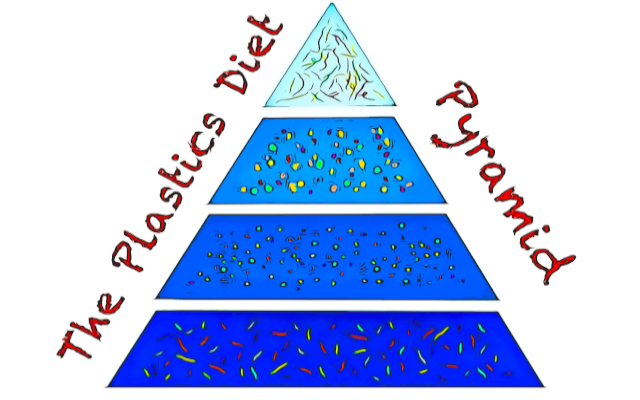
‘We estimate that annual consumption of microplastics ranges from 39,000 to 52,000 particles depending on age and gender. These estimates increase to 74,000 and 121,000 when inhalation is taken into account‘. (1)
These values increase by an additional 86,000 in consumers who drink exclusively bottled water, in addition to the 4,000 estimated for tap water consumption alone (including through other foods. These are estimates subject to great variation, the researchers explain. However, they add that ‘these values are probably underestimated‘.
A credit card on the plate every week. Global petition
Newcastle University (Australia)-in its study commissioned by WWF International-estimates the average individual’s intake of microplastics at 5 grams per week. As if every seven days every human being ingests a credit card, without discounting. (2) The researchers developed a calculation criterion for as exact a quantitative estimate of the mass of microplastic particles as possible.
Based on data offered by 50 studies on the spread of microscopic plastic fragments in the environment, the researchers estimated the average weekly ingestion at about 2,000 small pieces of plastic. 21 grams per month, just over 250 grams per year.
Water is the main source of exposure to microplastics in the diet planet-wide, highlights Australian research. Both bottled and mains water. With significant variations in different areas, to the point that water contamination in the U.S. and India is twice as high as in Europe. Microplastics then come mainly from shellfish, beer and salt, according to Newcastle researchers.
‘The results represent an important step toward understanding the impact of plastic pollution on humans. They also confirm the urgent need to address the plastic system in a way that does not pollute ecosystems first‘. (2)
WWF International,
through the voice of its director general Marco Lambertini, makes a vibrant appeal to the governments of the planet. It is necessary to open their eyes to a reality that is already tragic. ‘Plastics are not only polluting our oceans and waterways and killing marine life, but they are inside us and we cannot escape the consumption of plastics. Global action to address this crisis is urgent and essential. (…) This is a worldwide problem that can only be solved by addressing the root cause of plastic pollution. If we don’t want plastic in our bodies, we must stop the millions of tons of plastic that we continue to spill into nature each year‘.
WWF’s petition-which we urge everyone to sign by following this link-aims to urge all key players in the global plastics crisis. Governments, businesses, and consumers. There is an urgent need to set concrete goals and rules to address plastic pollution.
Governmental response to data on plastic inputs into the ecosystem and food chain has so far been inadequate. Human exposure to toxic particles, moreover, is only one symptom of the ‘plastic crisis,’ the scope and consequences of which are far broader. According to the United Nations Environment Program (UNEP), its total cost on the world economy is no less than US$8 billion/year.
Sabrina Bergamini and Dario Dongo
Notes
(1) Kieran D. Cox, Garth A. Covernton, Hailey L. Davies, John F. Dower, Francis Juanes, Sarah E. Dudas (2019).‘Human Consumption of Microplastics. Environ. Sci. Technol.
https://doi.org/10.1021/acs.est.9b01517
(2) Kala Senathirajah and Thava Palanisami (11.7.19, pending). ‘How Much Microplastics Are We Ingesting? Estimation of the Mass of Microplastics Ingested.’
https://www.newcastle.edu.au/newsroom/featured-news/plastic-ingestion-by-people-could-be-equating-to-a-credit-card-a-week

Journalist. Consumption, rights, nutrition, social, environment. Head of Consumers Help. She collaborated with ResetDOC, Il Riformista, La Nuova Ecologia, IMGPress.

Dario Dongo, lawyer and journalist, PhD in international food law, founder of WIISE (FARE - GIFT - Food Times) and Égalité.