

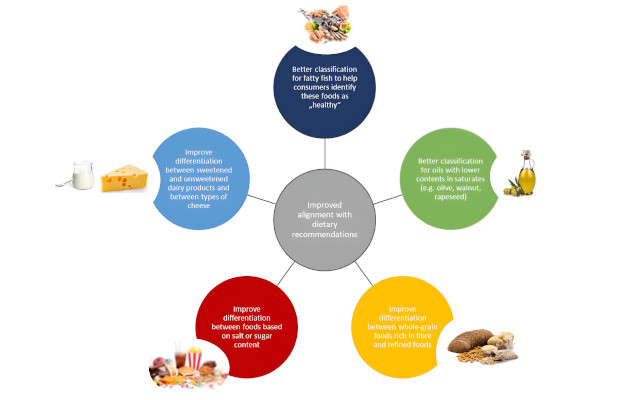
On 6/26/22, the Scientific Committee of independent experts unanimously adopted some proposals for the evolution of the NutriScore algorithm, based on solid scientific evidence and stakeholder requests. (1)
On 7/26/22, the governments of Belgium, France, Germany, Luxembourg, the Netherlands, Spain and Switzerland–participating in the NutriScore Steering Committee–approved the proposed changes, which will therefore be implemented in the 7 countries.
These improvements will make #NutriScore more effective in ranking foods in line with nutritional recommendations, thus offering consumers a simple guide to choosing more balanced foods. (2)
1) NutriScore, governance and evolution of the algorithm.
In February 2021, the seven countries participating in NutriScore established a transnational governance system through aSteering Committee (SC) to coordinate its development and implementation through harmonized procedures and a Scientific Committee (ScC).
Social stakeholders-so-called stakeholders, e.g., consumers, farmers and ranchers, processors, distributors, academia and health authorities-were invited to submit comments and proposals for revision of the Nutri-Score algorithm to the Scientific Committee by 9/15/21.
2) Nutri-Score, the evolution of the algorithm.
In December 2021, the Scientific Committee of independent experts-in confirming the validity of the Nutri-Score approach-considered further enhancing, in certain food groups, those whose consumption is recommended in national healthy nutrition guidelines. The evolution of the algorithm thus also reflects the criteria behind the Mediterranean diet, the elixir of long life. (3)
2.1) Fish and meat
Fish-when also rich in fatty acids (Omega 3, EPA and DHA)-is given a better score, given its role in preventing cardiovascular disease. (4) Provided, of course, that its preparations (e.g., canned fish, smoked fish) do not exceed salt contents.
Poultry and rabbit meat, in addition to fish, are also favored over red meat. With respect to the Mediterranean diet, which stands out favorably in the sporadic consumption of the latter, the excessive consumption of which presents some critical issues. (5)
2.2) Bread, pasta and rice. Integral is better
Experts highlight the need to prioritize the consumption of bread, pasta and brown rice over refined grains and foods derived from or containing them.
NutriScore’s new algorithm therefore looks more favorably on various products-including baked goods and breakfast cereals with a higher content of the ever-valuable dietary fiber. (6)
2.3) Vegetable oils, long live extra virgin olive oil.
Vegetable oils were also reviewed in the albeit complex estimation of the different merits of oleic acid, monounsaturated and polyunsaturated fatty acids.
Extra-virgin olive oil receives the NutriScore palmares, unlike the Italic Nutrinform battery scheme, which instead disqualifies it relative to others. (7) Without detracting from the albeit valuable oils from walnuts, canola and other seeds.
2.4) Added sugars
Added sugars-as highlighted by EFSA after an evaluation lasting years (8)-present a public health risk and their daily intake should be minimized.
Nutri-Score accordingly revises the evaluation criteria for a range of foods, from breakfast cereals to dairy products (9,10). As well as sweets and candies, ça va sans dire.
3) Interim conclusions, petition
WHO Europe
recently highlighted the epidemic prevalence of obesity and overweight, starting as early as childhood age, in the Old Continent. Correcting diet is a compelling necessity to protect people from serious and chronic, often disabling diseases that public health systems cannot even support.
Simple information on the food label front-which is precisely what the NutriScore is-can offer concrete help to consumers to improve their diets. And at the same time stimulate product reformulation by Big Food, which still reaps profits on ultra-processed foods with unbalanced nutritional profiles.
The petition in support of the mandatory introduction of the NutriScore on food product labels, which GIFT supports, can be signed at this
link
.
Dario Dongo
Notes
(1) Update of the Nutri-Score algorithm. Update report from the Scientific Committee of the Nutri-Score 2022.
(2) Dario Dongo, Andrea Adelmo Della Penna. How to solve the nutritional conundrum? News on the label front, review and outlook. FT (Food Times). 29.12.20,
(3) Dario Dongo, Andrea Adelmo Della Penna.
Genetic changes and aging, ultra-processed foods vs. Mediterranean diet.
. FT (Food Times). 12.9.20,
(4) Dario Dongo, Andrea Adelmo Della Penna. Omega-3 and cardiovascular disease prevention. Mayo Clinic Meta-analysis.. FT (Food Times). 3.2.21,
(5) Marta Strinati.
Mediterranean diet, first long-term preclinical study.
. FT (Food Times). 26.4.19,
(6) Dario Dongo, Carlotta Suardi.
Fiber and whole grains, long life in health.
. FT (Food Times). 25.1.19,
(7) Dario Dongo, Andrea Adelmo Della Penna. NutriScore, consumer health prevails over agribusiness lobby. Petition and insights. FT (Food Times). 18.5.22,
(8) Marta Strinati.
The harmful role of sugars in the diet, EFSA opinion.
. FT (Food Times). 1.3.22,
(9) Marta Strinati.
Corn flakes and filled cereals, 24 comparing.
. FT (Food Times). 22.1.22,
(10) Marta Strinati.
Frùttolo and other milk snacks, 10 products compared.
. FT (Food Times). 25.9.21,
(11) Sabrina Bergamini, Dario Dongo. Obesity, childhood obesity, and marketing. WHO Europe 2022 Report. FT (Food Times). 16.6.22,

Dario Dongo, lawyer and journalist, PhD in international food law, founder of WIISE (FARE - GIFT - Food Times) and Égalité.


