


The French National Agency for Health and Food, Environmental and Occupational Safety (ANSES) has published two new nutritional guidelines specifically for vegetarians, who exclude animal meat from their diet, and for vegans, who do not consume any products of animal origin.
The aim is to help vegetarians and vegans meet their nutritional needs while reducing the risk of chronic diseases and exposure to contaminants.
Vegetarians and vegans
ANSES includes two subgroups of ‘veg’ in the ‘vegetarian’ eating style:
– vegetarians who exclude the consumption of any type of animal meat (meat, fish, shellfish, crustaceans, etc.) but consume eggs and dairy products (lacto-ovo vegetarians);
– vegans, who exclude all foods of animal origin.
Effects of vegetarian diets on health
The first ANSES expert review (2024) is dedicated to identifying the epidemiological links between different types of vegetarian diets and health, through a systematic review of scientific publications (a selection of 131 studies, published up to May 2019).
Health benefits
The scientific review under consideration shows that:
– a vegetarian diet is associated with a lower risk of developing type 2 diabetes, compared to a non-vegetarian diet (moderate level of evidence);
– vegetarians, compared to non-vegetarians, have a lower risk of developing certain pathologies such as ischemic heart disease, ovulatory disorders, certain tumors (prostate, stomach, blood) and ophthalmological and gastrointestinal diseases (low level of evidence);
– vegetarian diet is not associated with various negative health indicators (cranial perimeter at birth, some cardiometabolic risk factors, breast, colorectal and urinary tract cancer, some hepatobiliary diseases and premature mortality). Again, with a weak level of evidence.
Health disadvantages
On the other hand, vegetarians have a higher risk of bone fractures and hypospadias (congenital malformation of the urethra), again with low evidence.
Epidemiological studies show that vegetarians have a less favorable nutritional status with regard to iron, iodine, vitamin B12 and vitamin D and a less favorable phosphorus-calcium balance than non-vegetarians.
Furthermore, vegans have a less favorable nutritional status with regard to vitamin B2.
Dietary guidelines to improve the diet of vegetarians
In a second, recent expert report, ANSES (2025) developed dietary guidelines to allow vegetarians to better meet their nutritional needs, without giving up their eating habits.
In this case, as for the general population, researchers used a standardization tool that combines consumption data, nutritional references and data on food contamination.
The consumption data come from the NutriNet-Santé study, a French prospective cohort study launched online in May 2009 (Hercberg et al. 2010) and developed by the Nutritional Epidemiology Research Team (EREN) of Inserm.
Nutritional deficiencies
The result of the analysis highlights some nutritional deficiencies in the vegetarian population. In particular:
– in the majority of vegetarians, the difficulty in meeting the nutritional requirement of some omega-3 fatty acids (EPA, DHA) and vitamin D emerges;
– vegans also have difficulty meeting the nutritional needs of vitamin B12 and zinc in men.
The ideal diet for vegetarians
In light of data on food consumption of vegetarians and the resulting nutritional deficiencies, ANSEN provides a series of recommendations on the ideal diet for different population groups that abstain from meat consumption.
Lacto-ovo-vegetarians
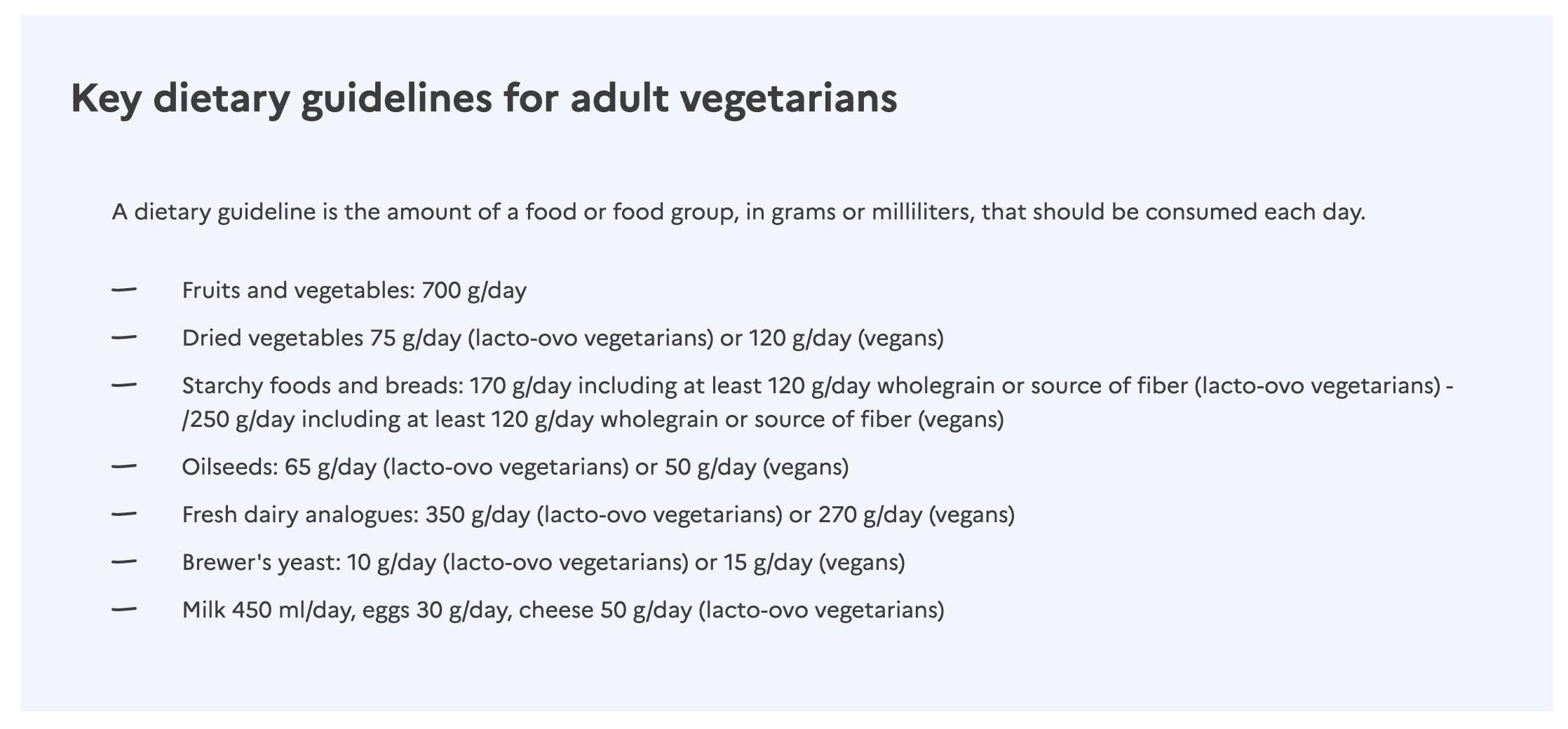
For lacto-ovo-vegetarians, the optimal intake of fruit and vegetables is on average about 700 g/day. Vegetables provide fiber, vitamins A, C, K1, B9 and potassium.
Among lacto-vegetarians, those who limit the consumption of milk and fresh dairy products have a lower intake of vitamin B2. Therefore, vegetables are even more important because they contribute significantly to the intake of vitamin B2 (20%).
The optimal intake of legumes is on average about 75 g/day. Legumes contribute significantly to the intake of fibre, protein and vitamin B9.
For starchy foods and bread the amount is about 170 g/day, including at least 120 g of whole grains or ‘fibre sources’. These contribute to the intake of magnesium, manganese, zinc and vitamin B1.
The group of oilseeds is important for lacto-ovo-vegetarians who limit the consumption of milk and fresh dairy products, as they contribute to the intake of vitamin B2 and calcium, with an optimal intake of 65 g/day.
The optimal oil intake is 35 g/day, of which at least 25 g/day on average are oils rich in alpha-linolenic acid (rapeseed, walnut, soy, flax). In addition to the intake of alpha-linolenic acid, these oils contribute significantly to the intake of vitamin E.
For milk, an average optimal intake of 450 ml/day is indicated. Milk provides calcium and phosphorus, EPA + DHA, iodine, vitamins B12, B2, D and zinc.
In addition to meeting the reference nutritional intakes, the indicated quantities of fruit, vegetables, legumes, fresh dairy products, whole grain products, oils rich in alpha-linolenic acid and oilseeds contribute to achieving the goal of reducing the risk of chronic non-communicable diseases.
The optimal egg intake is on average 30 g/day. These foods provide EPA+DHA and vitamin D to all lacto-ovo vegetarians, although not sufficient in themselves to meet the relevant reference nutrient intakes.
The amount of cheese in the optimised diets averages 50 g/day. The cheese group contributes significantly to the intake of calcium, iodine, vitamin B12, B2 and zinc. However, they can contribute significantly to the intake of saturated fatty acids and salt.
The optimal intake of fresh milk substitutes averages 350 g/day, with unsweetened and calcium-fortified versions being preferred. These contribute to the intake of calcium, iodine and selenium.
For protein-rich meat substitutes, the optimal intake averages 100 g/day. This group contributes to the intake of protein, iron and zinc.
The optimal intake of the food group containing wheat germ, nutritional yeast flakes and yeast extract spread (e.g. Marmite) is around 10g/day. This group, which is highly nutritious, contributes significantly to the intake of vitamins B1, B3, B9 and zinc.
It is important to note that, within the group of sugary starch products, fortified products provide a significant contribution of iron and vitamins B1, B2, B3, B5, B6, B9, B12, D and E. However, this group also contributes significantly to the intake of sodium and total sugars.
Vegan diet
The optimal intake of fruit and vegetables for vegans is on average around 700g/day. This food group provides fibre, calcium, magnesium, potassium and beta-carotene, vitamins B2, B5, B6, B9, C and K1.
For pulses it is on average around 120g/day. Legumes provide a significant contribution of fibre, protein, phosphorus, iron, zinc and vitamin B9.
For starches and bread it is on average around 250 g/day, including at least 120 g of whole grains or ‘fibre sources’. Which contribute to the intake of magnesium and zinc.
The optimal intake of oilseeds is on average around 50 g/day. They contribute to the intake of magnesium, protein, vitamins B1, E and zinc.
For oil it is 30 g/day, including at least half of oil rich in alpha-linolenic acid (rapeseed, walnuts, soya, flax). In addition to their alpha-linolenic acid content, these oils contribute significantly to the intake of vitamin E.
The optimal intake of fresh milk substitutes is on average 270 g/day, giving priority to calcium-enriched versions. These contribute significantly to the intake of calcium, iodine and selenium.
For the yeast group, it is on average about 15 g/day. This group contributes significantly to the intake of vitamins B1, B2, B12, B3, B9 and zinc.
Once again, it is reiterated that, within the group of sugary starch-based products, fortified products contribute to the intake of calcium, iron, vitamins B1, B2, B3, B5, B6, B9, B12, D, E and zinc. However, these foods can significantly affect daily intakes of sugars and sodium.
Food contaminants
The ANSES work also evaluates the impact of food contaminants. With a premise: ‘the presence of contaminants in foods is a major problem that affects all populations, regardless of their diet’. And a call to ‘reduce emissions of anthropogenic contaminants in order to reduce exposure to the most persistent substances in the environment, particularly metals’.
The optimised diets proposed by ANSES do not allow to remain below the maximum exposure limits for 21 contaminants or groups of contaminants.
Most of these are contaminants of anthropogenic origin (for example, the insecticide lindane or certain polybrominated compounds, such as brominated flame retardants, BFRs) or natural substances such as mycotoxins, for which public risk management measures remain a priority (and sometimes, unfortunately, still insufficient to ensure a high level of public health).
In other cases, these are intrinsic substances, such as isoflavones, which are mainly present in soy products. Therefore, the guidelines established for legumes, plant-based drinks and meat and dairy analogues should be accompanied by a recommendation to vary plant sources.
The ANSES nutritional guidelines for vegetarians apply only to the adult population. Consumption data on other vegetarian population groups are therefore needed to establish appropriate guidelines (e.g. children, adolescents, pregnant or breastfeeding women, the elderly and very active populations).
Marta Strinati
References
- Anses. (2024). Établissement de repères alimentaires destinés aux personnes suivant un régime d’exclusion de tout ou partie des aliments d’origine animale – Revue systématique des études sur les liens entre les régimes végétariens et la santé. (saisine 2019-SA-0118). Maisons-Alfort : Anses, 169 p. https://www.anses.fr/fr/system/files/NUT2019-SA-0118-rapport.pdf
- Anses (2025). Avis de l’Agence nationale de sécurité sanitaire de l’alimentation, de l’environnement et du travail relatif à l’établissement de repères alimentaires destinés aux personnes suivant un régime d’exclusion de tout ou partie des aliments d’origine animale. Saisine 2019-SA-0118. Maisons-Alfort : Anses, 46 p. https://www.anses.fr/fr/system/files/NUT2019-SA-0118.pdf

Professional journalist since January 1995, he has worked for newspapers (Il Messaggero, Paese Sera, La Stampa) and periodicals (NumeroUno, Il Salvagente). She is the author of journalistic surveys on food, she has published the book "Reading labels to know what we eat".