

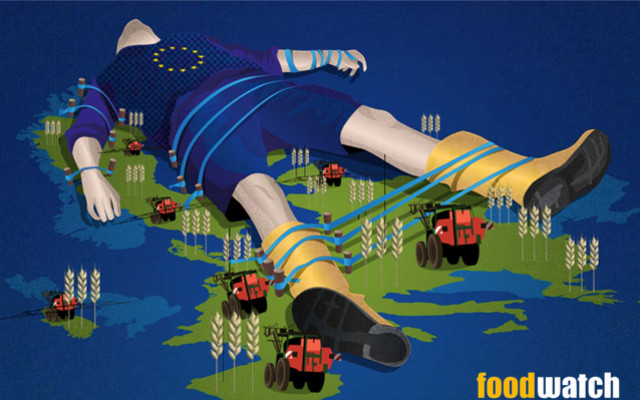
The European Union is one of the largest markets for pesticides globally, with approximately 350,000 tonnes sold annually, accounting for nearly a quarter of global sales. Despite growing evidence of their harmful effects on human health, biodiversity, soil fertility, and the environment, the Commission continues to neglect this pressing issue.
A key flaw in the current plant protection products regulation is the automatic renewal of pesticide authorisations without proper risk reassessment. Foodwatch raised concerns about this practice in 2020, and Pollinis is now challenging the Commission before the Court of Justice of the European Union (CJEU).
1. The EU’s vision for agriculture and the pesticide problem
The new EU’s vision for agriculture and food, presented by Commissioner Christian Hansen on 19 February 2025, has shifted its focus away from public health and environmental concerns linked to pesticide use. This marks a clear reversal of the Farm to Fork strategy, which initially set both general reduction targets and specific objectives to phase out the most dangerous active substances.
‘There is no intention to do anything specific on sustainable pesticides’ in the new EU’s vision for agriculture and food, a Commission official told Euractiv journalist Gerardo Fortuna.
The Sustainable Use of pesticides Regulation (SUR), which aimed to reform the existing framework, was withdrawn in February 2024. This decision followed mounting right-wing opposition to the European Green Deal and the strategic use of farmers’ protests to push back against sustainability measures. It represents a significant victory for the global pesticide and seed monopolies (Big 4) and their allied industrial farming confederations (e.g., Coldiretti, FNSEA, and Copa-Cogeca at the EU level).
2. Legal framework and its loopholes
The EU’s regulatory framework for pesticides, still governed by the obsolete Regulation (EC) No 1107/2009, mandates that active substances in pesticides undergo a rigorous evaluation to ensure they do not pose unacceptable risks to human health, animal health, or the environment. Authorisations are granted for a maximum of ten years and can be renewed upon request by the manufacturer, provided a re-evaluation of risks is conducted at least three years before the expiration of the initial authorisation.
However, Article 17 of the regulation allows for the extension of authorisations if the re-evaluation process is delayed due to reasons beyond the applicant’s control. This provision, intended for exceptional cases, has been systematically exploited, leading to prolonged use of potentially harmful substances without updated risk assessments. Furthermore, even after the extension period, substances are granted a ‘grace period’ of up to six months, with an additional year for storage and use, effectively keeping them on the market for years beyond their initial authorisation expiry.
3. Scientific concerns: risks to human health and the environment
The automatic renewal of pesticide authorisations poses significant risks to human health and the environment. Pollinis, an independent non-profit organisation based in France, has identified 119 synthetic pesticides currently benefiting from automatic extensions, some of which have been extended for over a decade without re-evaluation. Among these, 35 substances were eventually banned due to their toxicity, but only after being extended for up to seven years.
4. Case studies of prolonged pesticide use
The automatic renewal of pesticide authorisations has allowed numerous harmful substances to remain on the market for years beyond their initial approval, despite growing evidence of their risks. The following case studies illustrate the dangers of this practice, demonstrating how pesticides with known toxic effects have been repeatedly extended, posing a threat to human health, pollinators, and ecosystems:
- Boscalid. A fungicide approved in 2008, boscalid has been extended five times since 2018. Despite preliminary re-evaluation reports identifying critical concerns, including risks to children and bees, its authorisation continues to be extended. The European Food Safety Authority (EFSA) requested 122 additional information submissions from the manufacturer, BASF, yet the Commission did not investigate whether the delays were attributable to the company.
- Indoxacarb. Approved in 2006, this insecticide was banned in December 2021, five years and eight months after its initial authorisation expired. It posed high risks to consumers, workers, and bees, yet remained on the market for years.
- Phosmet. An insecticide used on crops like rapeseed, phosmet was banned in February 2022, four years and four months after its authorisation expired. It presented unacceptable risks to operators, residents, bees, and non-target arthropods.
- Bromoxynil. This herbicide, approved in 2005, was banned in September 2020, five years and six months after its authorisation expired. It posed risks to children and wild mammals, yet its use continued for years.
- S-Metolachlor. Approved in 2005, this herbicide has been extended seven times and was banned in July 2023, at least eight years and four months after its initial authorisation expired. It has been linked to groundwater contamination, with metabolite concentrations exceeding EU quality limits.
5. Legal and ethical implications
The systematic use of automatic extensions violates the precautionary principle enshrined in EU law, which mandates that protective measures should not be delayed even in the face of scientific uncertainty. The European Parliament criticised the Commission for failing to justify these extensions, in 2020, particularly in cases where delays in re-evaluation are not adequately explained.
Pollinis has taken legal action against the Commission, challenging the extension of boscalid’s authorisation. The organisation argues that these extensions are illegal and contravene the precautionary principle, directly threatening human health, animal health, and the environment.
6. Provisional conclusions
The automatic renewal of pesticide authorisations in the EU, without proper risk reassessment, undermines the regulatory framework designed to protect public health and the environment. The prolonged use of potentially harmful pesticides, often for years beyond their initial authorisation, poses significant risks and highlights the need for stricter enforcement of existing regulations. Legal challenges, such as those brought by Pollinis, are crucial in holding regulatory bodies accountable and ensuring that the precautionary principle is upheld.
Dario Dongo
Credit cover: Foodwatch (2022). Locked in pesticides https://tinyurl.com/ydt6hxmu
References
(1) Gerardo Fortuna & Grégoire Lory. EU Commission sets Green Deal aside in new agri-food vision. Euronews. 19 February 2025 https://tinyurl.com/h3sc8dj9
(2) EU Pesticide Database. European Commission https://tinyurl.com/35m2rbrf
(3) Eurostat. Agri-environmental indicator – consumption of pesticides. April 2022 https://tinyurl.com/43e63yvc
(4) Regulation (EC) No 1107/2009 concerning the placing of plant protection products on the market. Current consolidated version: 21.12.22 https://tinyurl.com/5fjw33wx
(5) Pesticides : EU’s system of endless extensions threatens biodiversity and human health. Pollinis. February 2023 https://tinyurl.com/5dsfhtj9
(6) European Parliament resolution on the draft Commission regulation as regards to the extension of authorization period of several active substances. P9_TA(2020)0197. 10.7.20 https://tinyurl.com/3sf5ktpu
(7) Commission Implementing Regulation (EU) 2020/892 concerning the non-renewal of the approval of the active substance beta-cyfluthrin https://tinyurl.com/5h67cs9h
(8) Commission Implementing Regulation (EU) 2021/2081 concerning the non-renewal of approval of the active substance indoxacarb https://tinyurl.com/52ujxss6
(9) Commission Implementing Regulation (EU) 2022/94 concerning the non-renewal of the approval of the active substance phosmet https://tinyurl.com/bdfcy3p6
(10) Commission Implementing Regulation (EU) 2020/1276 concerning the non-renewal of the approval of the active substance bromoxynil https://tinyurl.com/4upkht45
(11) Commission Implementing Regulation (EU) 2022/708 amending Implementing Regulation (EU) No 540/2011 as regards the extension of the approval periods of the active substances (…) https://tinyurl.com/4atzu8h2
(12) ANSES Announcement on S-metolachlor. 15.2.23 https://tinyurl.com/3j9vnc25
(13) Pesticides SDHI: 450 scientifiques appellent à appliquer le principe de précaution au plus vite. Le Monde. 21.2.20 https://tinyurl.com/4tbyzuyc
(14) BNV-D Traçabilité Database. Eau France https://tinyurl.com/5bfrfyux
(15) Pesticide Properties Database (PPDB). University of Hertfordshire https://tinyurl.com/hrknpas2
(16) Fiche Toxicologique on Deltamethrin. INRS (Institut National de Recherche et de Sécurité) https://tinyurl.com/yc4e3vva
(17) Glyphosate just the tip of the iceberg: 30 percent of all pesticides are approved by extension without new risk assessment. Foodwatch. 18.11.22 https://tinyurl.com/42w9aztv
(18) Prolongations d’autorisation du boscalid: Pollinis affronte Goliath à la CJUE. POLLINIS. 20.2.25 https://tinyurl.com/3amtfezt

Dario Dongo, lawyer and journalist, PhD in international food law, founder of WIISE (FARE - GIFT - Food Times) and Égalité.