

MOCAs remain the black box of food safety in Europe, in more of a chasm than a gap in industry legislation. A reminder-again-a group of ubiquitous toxic chemicals, the perfluorinated compounds, PFAS. Which the Kingdom of Denmark, in the silence of Brussels, is about to ban from paper and cardboard food packaging.
MOCA and food chemical safety, the black box in the abyss
Fifteen years have passed, since the establishment in Europe of general criteria to guard the safety of food contact materials and objects (MOCA or FCM, Food Contact Materials). (1) However, these criteria are still lacking implementation on the most critical materials. It is a gulf, rather than a gap, in a legal system that should be based on the precautionary principle and instead tolerates absolute omertà about toxic substances contained in everyday objects, often destined to migrate into our food.
Thus, the most common materials used to make food packaging lack the rules defining which substances to allow and which to prohibit, which risk factors to consider, and so on. In two words, conditions and prohibitions, based on appropriate risk assessments. Thus – 15 years after the global crisis linked to contamination of infant formulas with carcinogenic ink – inks such as adhesives and adhesive materials, as well as paper-based products and numerous other materials in Europe still lack ad hoc regulations. (2)
The cataleptic giant-also known as the European Commission-is expected to publish by the end of 2019 an ‘assessment report’ on food contact materials legislation and its (in)suitability to ensure the chemical safety of food. (3) Following the pattern of Later Regulation, rather than Better Regulation, which we most recently denounced in the case of endocrine disruptors.
However, operators in the supply chain-that is, producers, importers but also users and distributors, including through ecommerce, of MOCAs-cannot under any circumstances shirk their responsibility to ensure their safety. (4) And it is therefore, among other things, that the member states most concerned about the health of their citizens have decided to adopt national legislation for its protection, without waiting for the cataleptic giant.
France, for example, has taken drastic measures on bisphenol A(endocrine disruptor, still allowed in Europe). Germany has established special rules for adhesives that can be used on food packaging. But it is Denmark that has made the most significant breakthrough on a particularly problematic and frequently used category of substances in FCMs, perfluorinated compounds.
PFAS, the (poisonous) ‘eternal substances’
Perfluoroalkyl organic substances (PFAS) are called ‘forever chemicals‘ because of their extreme resistance to degradation in the environment. (7) It is a heterogeneous group of more than 4,500 man-made chemicals formed by a chain of carbon atoms of varying lengths, where the hydrogen atoms bound to carbon are replaced by fluorine.
PFASs are widely used in food contact materials, first and foremost for surface treatment of paper and cardboard. Fast food packaging, but also baking paper. Because of their repellency to water and fat, due precisely to the presence of numerous carbon-fluorine bonds. On closer inspection, however, paper can be made water and grease repellent without the need to use fluoride-containing substances. And this is where the Danish government’s measures are focused.
PFAS in MOCAs in paper and cardboard, chemical safety, the Danish initiative
The Danish Veterinary and Food Administration-part of the Ministry of the Environment-has ‘long advised against‘ the use of PFAS in contact materials. Some operators have thus phased out these substances from their products on a voluntary basis. Following the assessments made by the European Food Safety Authority on Dec. 13.12.18 regarding the hazardous nature of 2 PFAS, the Danish government began work on a proposed law just defined, which is scheduled to come into force in July 2020. (5)
‘I do not want to accept the risk of harmful fluorinated substances (PFAS) migrating from packaging into our food. These substances pose such a health problem that we can no longer wait for the EU‘ (Mogens Jensen, Minister for Food, Agriculture and Fisheries, Kingdom of Denmark, 2.9.19. See footnote 6).
The use of recycled paper and cardboard-based materials will still be allowed in Denmark after the ban, provided that they-where they contain the substances of concern-are separated by a barrier that can exclude migration into food. (7)
PFAS, the risks and measures needed in Europe and the world
The risks associated with the exposure of humans and animals to fluorinated substances-through diet, drinking water and the environment-is related to their accumulation in the body. (8) Recent studies have demonstrated the health hazards of some PFASs as capable of adversely affecting growth, learning and behavior in infants and children. In addition to reducing fertility and interfering with the endocrine and immune systems, as well as increasing cholesterol levels.
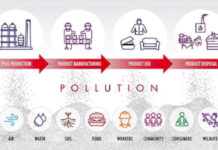
Denmark’s initiative is undoubtedly laudable and yet inadequate to protect public health with respect to the risks associated with exposure to perfluorinated compounds. are used in numerous other current-use applications. In the production of PTFE (Teflon and related), the coating used in many nonstick pans, for example. As well as, since the 1950s, in emulsifiers and surfactants found in cleaning products, insecticides, and protective coatings. They are then used in the production of waterproof clothing, printer products, photographic films, wall surfaces, and microelectronics materials. Most importantly, in fire-fighting foams (used in multiple contexts, aircraft and motor vehicles but also oil platforms) and paints, which are in fact one of the leading causes of environmental pollution.
UNEP (United Nations Environmental Program) has started negotiations with the representations of 180 countries in May 2019. (9) With the goal of reaching agreement on a global ban on toxic carcinogenic or otherwise seriously hazardous chemicals (e.g., PFOA, PFAS, PFOS). However, government delegations and the European Commission itself objected, requesting exemptions for about ten sectors. From textiles to pharmaceuticals, microelectronics, fire-fighting foams, etc. The more lofty goals-strengthening three treaties on hazardous substances, including the ‘Stockholm Convention on Persistent Organic Pollutants‘-have thus, once again, waned. And the Sustainable Development Goals (SDGs) are receding.
Environmental pollution by PFOA, PFAS, PFOS, meanwhile, continues on five continents. These compounds have often been detected in concentrations, even significant concentrations, in environmental samples and living organisms, including humans. This is the finding of hundreds of scientific studies and monitoring done even by public agencies, including the EPA(Environment Protection Agency, an understatement, in the US). The ‘eternal’ substances, as they were called even by their inventors, continue to poison the planet. Italy, too, as is well known, with epidemic effects in Veneto.
The high resistance of this group of substances to the processes of thermal degradation, biodegradation, hydrolysis, and metabolization coupled with their equally high solubility in water has prompted the National Institute for Environmental Protection and Research, ISPRA, to initiate a special program to monitor their presence in surface and groundwater bodies. (10) From politics, ça va sans dir, no signal.
Dario Dongo and Luca Foltran
Notes
(1) See reg. EC 1935/04. Sanctions in Italy were introduced only after 13 years (!), through Legislative Decree. 29/2017. See https://www.foodagriculturere quirements.com/archivio-notizie/moca-materiali-e-oggetti-a-contatto-con-gli-alimenti-le-sanzioni-in-italia_1
(2) Refers to the ITX case, a dangerous contaminant migrated from packaging inks into infant milk produced by Nestlé and marketed all over the world
(3) See Food contact materials, roadmap on the European Commission website.
(4) For more on this topic, please refer to our free ebook ‘Food Safety, Mandatory Rules and Voluntary Standards,’ at https://www.greatitalianfoodtrade.it/libri/sicurezza-alimentare-regole-cogenti-e-norme-volontarie-il-nuovo-libro-di-dario-dongo
(5) EFSA. Risk to human health related to the presence of perfluorooctane sulfonic acid and perfluorooctanoic acid in food. EFSA Journal 2018;16(12):5194. doi: 10.2903/j.efsa.2018.5194, https://www.efsa.europa.eu/en/efsajournal/pub/5194
(6) Cf. Ministry of Food, Denmark, press release 2.9.19,
(7) NB: In Italy, the use of recycled paper is allowed only in dry solid food packaging (e.g., salt, sugar, rice, dry pasta)
(8) A number of studies performed on different animal species indicate the liver as the main target organ
(9) See Stephanie Nebehay. China seeks loophole as UN nears pact banning toxic chemical – activists. Reuters, 1.5.19,
(10) ISPRA (2019). Guidelines for the design of perfluoroalkyl substances (PFAS) monitoring networks in surface and groundwater bodies. ISBN: 978-88-448-0950-8, http://www.isprambiente.gov.it/it/pubblicazioni/rapporti/indirizzi-perla-progettazione-delle-reti-di-monitoraggio-delle-sostanze-perfluoroalchiliche-pfas-nei-corpi-idrici-superficiali-e-sotterranei

Dario Dongo, lawyer and journalist, PhD in international food law, founder of WIISE (FARE - GIFT - Food Times) and Égalité.

Expert in packaging and materials intended to come into contact with food substances and related legislative changes. He manages the information site foodcontactmaterials.info on European and extra-European regulations in the field of materials intended for contact with food.