
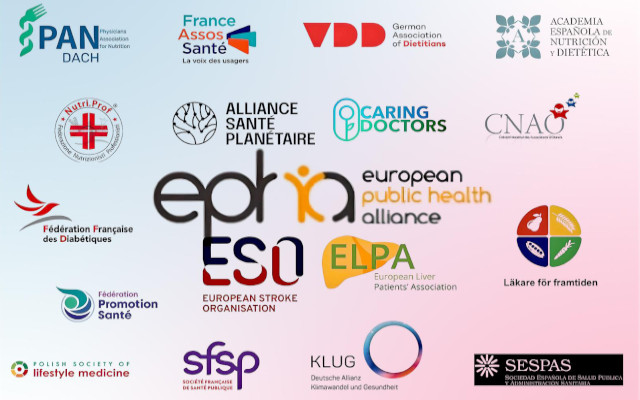
On December 11, 2024, eighteen associations committed to public health addressed an open letter to the European Commission, to express their ‘sincere concern about the lack of health representation in recent European political discussions on the future of food and agriculture in the EU’. (1)
1) Health associations, open letter to the new European Commissioners
Eighteen associations of health, patients and medical professionals operating at international, European and individual Member State level – under the coordination of EUPHA (European Public Health Alliance) – address their appeal to the new European Commissioners:
– Cristophe Hansen (Agriculture and Food)
– Oliver Várhelyi (Health and Animal Welfare)
– Jessika Roswall (Environment, Water Resilience and a Competitive Circular Economy)
– Wopke Hoekstra (Climate, Net Zero and Clean Growth)
– Costas Kadis (Fisheries and Oceans).
The urgency is claimed to involve the health sector and put public health at the centre of discussions, both in the Strategic Dialogue on the future of agriculture in the EU and in the necessary reforms in terms of consumer information already called for by the European Court of Auditors (2,3).
2) Food system and public health, European scenario
‘Our food system, together with the resulting unhealthy European diets, are major contributors to the burden of disease in the EU. Today, the vast majority of people in the EU die from cancer or cardiovascular disease. Both types of disease, as well as other disorders such as obesity and diabetes, are strongly influenced by unhealthy diets. (4)
This is a public health emergency which costs society billions each year in health care costs and lost productivity.
Most triggers of foodborne diseases are linked to excessive consumption, in particular, of salt, sugar, saturated fats (mainly found in animal products, but also in palm and coconut oil) and calories in general. In parallel, people are consuming insufficiently other types of foods, such as whole grains, fruits, legumes and vegetables, which is further exacerbating the health risks’.
3) Antibiotic resistance, pollution and environmental degradation
Antibiotic resistance is another serious public health problem related to agri-food systems, ‘with over 60% of antibiotics used on livestock’ (in addition to excessive use of antibiotics in some Member States, ed.). (5) Other serious risks concern pollution and environmental degradation, as well as climate change, to which European food chains also contribute.
The Commission’s recommendation to address these issues with a One Health approach– which integrates consideration of human health, animal health and welfare, and environmental protection (6) – is therefore fundamental. To this end, the writer adds, great attention must be paid to due diligence of operators on the risks associated with the supply of foodstuffs from third countries (e.g. Mercosur). (6,7)
3) Political responsibility
‘A change in diets – and in the food system – is urgent and necessary to ensure the health of Europeans. This would put the emphasis on disease prevention over treatment measures, a favourable, cost-effective and structural approach to improving European health.
The approaches which place the responsibility on consumers to choose healthier foods have, however, proven to be both unfair and ineffective.
Customers, have limited power to change consumption patterns in their individual capacity, unlike large companies at the centre of the value chain, which have the power to shape the food environments that influence consumers’ food choices, but are not sufficiently regulated’.
4) Nutritional profiles and ready-to-eat meals
‘One concrete opportunity to promote healthier diets, with significant potential impact and so far untapped, is to influence the nutritional profiles of ready-to-eat meals. This is an area where large companies have the most direct influence on what people eat since retailers, fast food chains and catering companies (serving both the private and public sectors) have full discretion over the ingredients and composition of the dishes they offer.
‘A recent study has shown that ready-to-eat meals are particularly unhealthy and unsustainable (e.g. ready-to-eat meals sold at retail contain three times the salt of the average EU diet and more than twice as much meat). (8) This is alarming, especially considering that the share of ready-to-eat meals has increased (now around 17% of calories consumed in the EU) and is still increasing significantly. Also considering the exemplary (educational) role of ready-to-eat meals towards consumers.
‘Regulating ready-to-eat meals could provide a powerful example and is at the intersection of the recommendations of the Strategic Dialogue on the update of the public procurement framework, food reformulation policies and updates of nutritional guidelines. It could save billions of euros in public health costs, save EU consumers €2,8 billion every year and significantly reduce the EU’s carbon footprint’.
5) How to incorporate public health in EU agri-food policies
The concrete demands of the health associations to the European Commissioners concern:
– binding policies of food reformulation, aimed at improving the health and nutritional profiles of processed foods and mass catering. With objectives of reducing added sugars, salt, saturated fats and calories, as well as paying attention to ingredients such as vegetables, legumes and whole grains;
– inclusion of health representatives in the EBAF platform, European Board on Agri-Food, the establishment of which was provided for in the Strategic Dialogue for the Future of Agriculture;
– update of EU regulations on ‘green public procurement’, to ensure the supply of healthy and sustainable food, with updating of nutritional programs in schools;
– a framework of recommendations for the development of nutritional guidelines of the Member States, taking into account the latest scientific literature on healthy and sustainable diets;
– an EU action plan on foods of plant origin, aimed at promoting its production and consumption, to be adopted by 2026;
– tax incentives (ie VAT reductions) to promote access to healthier and more sustainable food products;
– restrictions or prohibitions on marketing of foods rich in saturated fats, sugars and salt aimed at children and adolescents;
– obligation to use the nutritional labelling system Nutri-Score on the front of all food product packaging.
6) Perspectives and conclusions
‘EU policymakers have already begun to recognise the need for policy to address Non-Communicable Diseases (NCDs), as demonstrated for example by calls for an EU action plan for better cardiovascular health from MEPs and the European Council. (9)
We are also pleased to see that the Strategic Dialogue recognizes that ‘status quo’ is not an option and clearly calls for policies that give consumers access to healthier and more sustainable food.
We call on you to include the above policies in the Vision and Roadmap for Agriculture and Food and ensure implementation within this mandate by collaborating across different policy areas. Despite the urgency, we still see little progress so far’.
Dario Dongo
Footnote
(1) Open letter to EU Policy Makers Inclusion of health voices in the EU conversation on Food and Agriculture. December 11, 2024 https://bit.ly/3ZQcPC2
(2) Dario Dongo. Strategic dialogue on the future of agriculture in the EU. FT (Food Times). September 8, 2024
(3) Dario Dongo. Special – Food labels in the EU, the Court of Auditors report. FT (Food Times). November 27, 2024
(4) Dario Dongo. Nutri-Score and prevention of cardiovascular diseases, study in 7 countries. FT (Food Times). December 8, 2024
(5) Dario Dongo, Sabrina Bergamini. Antibiotics, consumption in Italy. Aifa report. Égalité. 28.11.19
(5) Dario Dongo, Andrea Adelmo Della Penna. One Health and Antibiotic Resistance, one solution at your fingertips. FT (Food Times).
(6) Dario Dongo. Directive (EU) No 2024/1760 on Corporate Sustainability Due Diligence, the ABC. FT (Food Times). September 23, 2024
(7) Dario Dongo. EU-Mercosur, citizens against politics. FT (Food Times). December 6, 2024
(8) Dario Dongo, Giulia Caddeo. Green procurement, the ecological push of the reform. FT (Food Times).
(9) Systemiq. (2024). Making prepared foods healthier and more sustainable
https://epha.org/making-prepared-foods-healthier-and-more-sustainable
(10) European Society of Cardiology. European Commission announces EU Cardiovascular Health Plan. 3.12.24 https://tinyurl.com/yc4wyhu2

Dario Dongo, lawyer and journalist, PhD in international food law, founder of WIISE (FARE - GIFT - Food Times) and Égalité.