

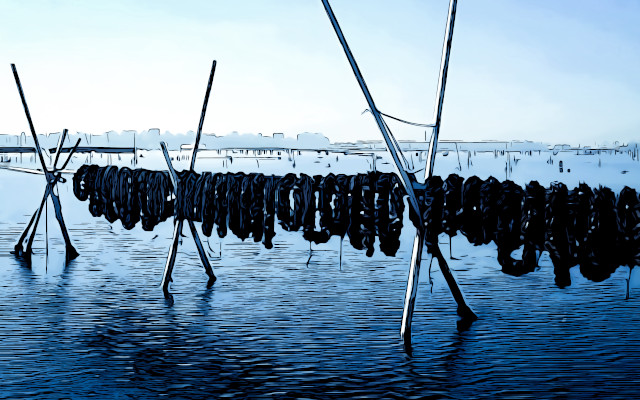
Farming of bivalve mollusks, such as mussels and other mussels, can help mitigate the effects of climate change. This is highlighted by a group of researchers from CREA Animal Husbandry and Aquaculture in a study published in Science of the Total Environment. (1)
Aquaculture sequesters carbon
Greenhouse gas emissions in shellfish farming (mussels, clams and oysters) are significantly lower than those of any other livestock production.

An additional benefit in terms of environmental sustainability is that this type of aquaculture sequesters carbon dioxide (or carbon dioxide) within the shellfish shell. A subtraction that contributes to decreasing global warming caused by the greenhouse effect.
Crazy for mussels
Researchers studied the phenomenon in mussel farms in the North Adriatic Sea, the area most suited to shellfish farming in Italy. The sector, including Mediterranean mussel(Mytilus galloprovincialis), veracious clam and oyster, accounts for more than 50 percent of aquaculture production (about 75,000 tons in 2020, with a total value of 187 mln €, figures that place us among the top five European countries.
High domestic demand for mussels is not met by domestic production, forcing the import of more than 22 thousand tons per year. Italy, on the other hand, exports clam verace(Ruditapes philippinarum), of which it is the leading producer at the European level. And it represents the second largest market in Europe for oyster consumption, after France.
Three strands of improvement
In the study, researchers adopted the Life Cycle Assessment (LCA) methodology and supplemented it with a site-specific assessment of the potential carbon sink role of mussels.
In this way, the most impactful elements of the farms were identified, with three improvement strategies identified:
– Replace heat -powered boats with electric or hybrid-powered boats,
– Use solar energy (with photovoltaic panels or certified supplies) to purify shellfish when necessary,
– Adopt mussel fattening socks made of natural, biodegradable and ecofriendly cultivated materials, such as hemp, to replace plastic (polyethylene) ones.
The plus of aquaculture
The environmental benefits of well-managed aquaculture, preferably organic, add up to the good nutritional properties of shellfish, which are rich in protein and polyunsaturated fatty acids.
The combination is valuable everywhere, but it takes on a resilience role in some areas of the planet, fostering economic development in coastal communities, as highlighted by research published in PLOS ONE. (2)
Notes
(1) Arianna Martini, Massimo Calì, Fabrizio Capoccioni, Marco Martinoli, Domitilla Pulcini, Luca Buttazzoni, Thomas Moranduzzo, Giacomo Pirlo, Environmental performance and shell formation-related carbon flows for mussel farming systems. Science of The Total Environment, Volume 831, 2022, https://doi.org/10.1016/j.scitotenv.2022.154891.
(2) Marta Strinati.
Algae and shellfish, aquaculture that regenerates the seas.
. GIFT(Great Italian Food Trade), 10.11.19.

Professional journalist since January 1995, he has worked for newspapers (Il Messaggero, Paese Sera, La Stampa) and periodicals (NumeroUno, Il Salvagente). She is the author of journalistic surveys on food, she has published the book "Reading labels to know what we eat".
Related post
 Oysters, not just luxury. Delicacies helpful in addressing malnutrition and pollution
 Ancient grains and combating climate change, scientific study
 Biodistricts, or organic districts. The Ministry of Agriculture defines the requirements. THE ABC’S
 2022, international year of artisanal fisheries and aquaculture

