
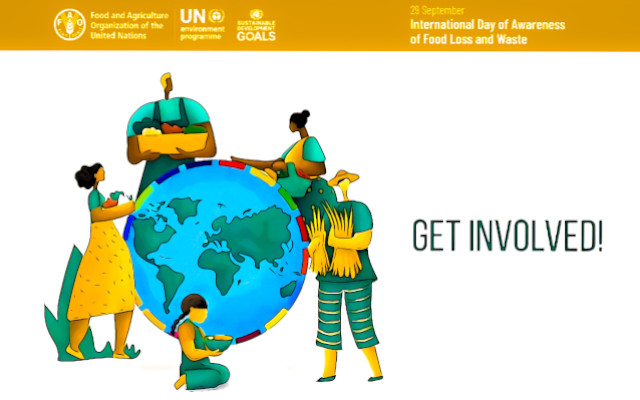
At every stage of the production chain, from post-harvest to consumption, a large proportion of food is wasted. In addition to consequences from a social point of view-still millions of people around the world suffer from hunger-this phenomenon has economic and environmental repercussions. Therefore, the UN decided in 2020 to dedicate September 29 to combating food waste to raise awareness of the issue among governments and individuals. (1)
1. Food Loss and Food Waste
Hard data on how much food is thrown away each year does not exist due to the lack of a food tracking system. In general, food surpluses are divided into two groups according to when they occur.
Food loss (food loss) occurs from the time after harvest and before retail sale. At this stage, about 13 percent of food is lost each year. Of these, 32 percent are fruits and vegetables, which are the foods with the best nutritional properties. Most of the losses at this stage occur in developing countries.
Food waste (food waste), on the other hand, occurs in the final stages of the supply chain, i.e., in homes, food services and retail. To better understand the extent of this waste, each of us produces an average of 74 kg of food waste per year. Waste is mainly concentrated in middle- and high-income regions and at the household level: 570 million tons of food out of 913 is wasted at home, averaging 74 kg per capita per year (2.3)
2. The true cost of food
Food waste costs us about $750 billion. Fruit and vegetable waste results in the loss of 912 trillion kilocalories and micronutrients. But in addition to material losses, additional costs are hidden.
2.1 Consequences for the environment
To waste food is to have also wasted all the resources needed to produce it:
- We lose 253 cubic kilometers of drinking water,
- we occupy and work in vain 1.4 billion hectares of land (30 percent of the world’s agricultural area) on which pesticides are often sprayed.
In addition, greenhouse gas emissions related to food losses are around 3.3 billion tons, to which must be added emissions from food fermentation in landfills. (4)
‘If food loss and waste were a country, it would be the third largest source of greenhouse gas emissions‘ (5)
2.2. Social consequences
Parallel to food waste and loss, hunger afflicted between 691 and 783 million people in 2022, still 122 million more than pre-pandemic figures. This figure is likely to worsen as a result of the war in Ukraine and the effects on exports and commodity prices, as we have seen. (6)
3. Commitments
Reducing food loss and waste requires commitment and collaboration at every level, from governments to businesses to individuals. National systems should provide tools to monitor the flow of food and measure waste and loss so that timely action can be taken. It is critical to drive the transition to agrifood systems in favor of healthy, short-chain diets. (7)
3.1. EU’s commitment
SDG 12.3 of the UN 2030 Agenda commits states to halve global food waste and loss per capita by 2030. (8) The European Union, in addition to adhering to UN targets, has adopted the Waste Framework Directive, which calls on member states to reduce food loss and waste and encourages food donations.
An important step in reducing waste occurred in 2016 when the European Union launched a program to monitor food waste. It is only through data collection that it is possible to better understand the problem and the best actions to prevent it. (9)
3.2. Waste in Italy
Food waste in Italy dropped by 12 percent in 2022 compared to the previous year. On average, we threw away 27 kg of food per person. For consumers, such waste is worth 6.5 billion euros, in addition to the 9 billion lost along the supply chains. However, we also have food security problems in Italy: more than 2.6 million people do not have the opportunities to feed themselves regularly. (10)
Coop Italy’s commitment
A virtuous example among companies is Coop Italia, the first Italian retailer, and one of the first 65 European players, to adhere to the EU Code of Conduct on Responsible Business and Marketing Practices in the Food Sector.
Coop Italy has adopted a system for formulating orders to avoid overstock and accumulate surplus. Through the ‘Good End’ project, Coop supermarkets have donated 5,642 tons of foodstuffs, generating more than 11 million meals, and worth 28 million euros. Consumers, on the other hand, have the opportunity to buy food products close to expiration at a discount of up to 50 percent through the ‘Eat Me Now’ project. (11)
What can consumers do?
Consumers play a key role in reducing waste at the final stage of the supply chain. They are asked to make an effort in changing their eating habits. Here are 15 tips FAO offers consumers to prevent waste:
1. Adopt a healthier and more sustainable diet, such as choosing less processed foods.
2. Buy only what you need. Planning and sticking to the shopping list can help.
3. Choose ugly fruits and vegetables, which are often thrown away because they do not meet aesthetic standards.
4. Store food wisely, keeping those with shorter expiration dates more visible.
5. Understand the food label. There is a big difference between expiration date and ‘best before’.
6. Start small: choose smaller portions or share large plates at restaurants.
7. Love your leftovers: you can freeze them or use them for another meal.
8. Reuse your food waste, compost it.
9. Respect food, informed about the production process.
10. Support local producers: support small businesses in your community and fight pollution by limiting long product trips.
11. Preserves fish populations. Eat the most abundant species instead of overfished ones such as cod and tuna.
12. Use less water.
13. Keep our land and water clean through proper management of the most hazardous wastes, such as batteries, medicines and chemicals.
14. Eat more legumes and vegetables.
15. Sharing is important. Donate food that would be wasted thanks also to apps. (11)
Conclusions
Our agribusiness system is not sustainable and will be even less so in 2050 if the population reaches 9.6 billion. Then the natural resources of 3 planet Earths will be needed to ensure a food model like the present one. Synergy between the various levels of decision-making and research efforts is needed. In this regard, the WIISE team is participating in the Wasteless project within the Horizon Europe program for which it will develop a blockchain system to monitor food flows. (13)
Alessandra Mei
Notes
(1) European Commission. International Day of Awareness of Food Loss and Food Waste https://food.ec.europa.eu/safety/food-waste/international-day-awareness-food-loss-and-waste_en
(2) FAO. Sustainable Development Goal 12. https://www.fao.org/3/cc1403en/online/cc1403en.html#/12
(3) Alessandra Mei. Food loss and waste, the US action plan to reduce food waste. FT (Food Times) 3/26/2023 https://www.greatitalianfoodtrade.it/progresso/food-loss-and-waste-il-piano-di-azione-usa-per-ridurre-lo-spreco-di-cibo/
(4) FAO. Food waste burdens the climate, water resources, soil and biodiversity. https://www.fao.org/news/story/it/item/196458/icode/
(5) Quote from Inger Anderson, Executive Director United Nations Environment Programme in the opening of the UNEP Food Waste Index Report 2021. March 2021 https://www.unep.org/resources/report/unep-food-waste-index-report-2021
(6) FAO. The state of food security and nutrition in the world. 2023 https://www.fao.org/3/cc3017en/online/cc3017en.html
(7) FAO. What governments, farmers, food firms-and each of us-can do to reduce food waste. https://www.fao.org/news/story/it/item/196465/icode/
(8) Goal 12: Ensure sustainable consumption and production patterns https://www.un.org/sustainabledevelopment/sustainable-consumption-production/
(9) European Council. Reduce food loss and waste. https://www.consilium.europa.eu/it/policies/food-losses-waste/
(10) WWF. Stop food waste. 4.2.2023 https://www.wwf.it/pandanews/societa/giornata-nazionale-di-prevenzione-dello-spreco-alimentare/
(11) Coop. COOP’s commitment to combating food waste is back. 3.2.2023 https://www.coop.it/news/torna-limpegno-di-coop-il-contrasto-allo-spreco-alimentare
(12) FAO. 15 quick tips for reducing food waste and becoming a food hero. 9/29/2020 https://www.fao.org/fao-stories/article/en/c/1309609/
(13) Dario Dongo. Andrea Adelmo Della Penna. Wasteless, EU research project on circular economy and blockchain. GIFT(Great Italian Food Trade). 5.9.2022

Graduated in Law from the University of Bologna, she attended the Master in Food Law at the same University. You participate in the WIISE srl benefit team by dedicating yourself to European and international research and innovation projects.