
An innovative supercritical CO₂ extraction process can enable the upcycling of olive pomace, a co-product of the oil industry, into functional ingredients with potential applications in the food and nutraceutical, cosmetic and pharmaceutical sectors. The innovation developed by an Italian startup in Umbria is the subject of studies at the Department of Pharmaceutical Sciences of the University of Perugia, whose initial results were presented at the European Biotechnology Congress 2025 in Tirana (Albania).
Olive pomace constitutes the residue from pressing olives used to produce virgin olive oils. Pomace is obtained through a mechanical separation process of oil from the olive, which involves its extraction through pressure and centrifugation. It contains fragments of pit, sections of skin and pulp residues.
Traditionally, this by-product finds main applications in the extraction of crude pomace oil, destined for further processing for food use, and in energy valorization (biomethane). Pomace is also used as a soil amendment as well as, in minimal quantities, for the production of ingredients intended for the cosmetic industry.
Olive pomace oils
Regulation (EC) No. 1308/2013 and subsequent amendments classify olive pomace oils into three categories:
- crude olive pomace oil. Oil obtained from olive pomace by treatment with solvents or by physical processes, other than oil obtained by re-esterification and from any mixture with oils of other nature, not suitable for human consumption;
- refined olive pomace oil. Oil obtained from the refining of crude olive pomace oil, with a free acidity content expressed in oleic acid of less than 0.3%, intended for the production of olive pomace oil for food use;
- olive pomace oil. Oil consisting of a mixture of refined olive pomace oil and virgin olive oil other than lampante, with free acidity below 1%. It is the only product in the category that can be marketed to the final consumer (EU Reg. 2022/2104, Art. 2).
Olive pomace oil is traditionally used as an ingredient in bakery products (e.g., focaccia) and in frying, including in industrial settings, thanks to its high smoke point which promotes good oxidative stability during high-temperature cooking and a neutral sensory profile (Holgado et al., 2021).
The Italian production of olive pomace oil stands at around 20,000 tons per year, compared to approximately 30,000 tons of imports and 40,000 tons of exports (Assitol data, reported by Il Sole 24 Ore, 2025). In recent years, however, olive pomace oil has entered into competition with energy uses, also due to specific public incentives, giving rise to legal disputes. These disputes concluded with rulings by the Council of State that reaffirmed the priority of food destination over energy use (Il Sole 24 Ore, 2025).
Pomace upcycling: Farmech’s innovation
Farmech, active in Umbria since 2012 in the field of agro-industrial crops and an innovative start-up since 2021, aims to valorize olive pomace – whose annual production amounts to approximately 20,000 tons in the Umbria region alone, 200,000 tons in Italy – through its upcycling into high-value-added functional ingredients.
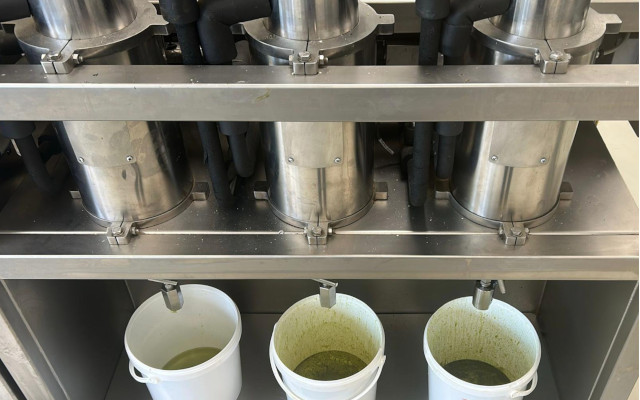
The process begins with the selection, collection and storage of pomace which is then subjected to dehydration and subsequent extraction using supercritical CO₂. The project aims to create a production hub that uses Industry 4.0 technologies, such as an IoT system associated with Machine Learning technology, to optimize the extraction process of bioactive compounds from olive pomace.
The collaboration with the University of Perugia has enabled the initiation of two studies on the composition and efficacy of the extracts in view of their possible uses in the food and nutraceutical, cosmetic and pharmaceutical sectors. The innovation also contributes to regional ecology, reducing and/or mitigating the environmental impact of agricultural waste and generating new application opportunities.
Pomace composition and supercritical CO₂ extraction
Olive pomace is composed of pit, skin, pulp, water (approximately 25%) and residual oil (4.5-9%). It features:
- a high content of oleic acid, the most abundant among fatty acids (5-9%);
- a linoleic acid content (9.5-15.5%) higher than that of olive oil;
- elaidic acid (0.2%), a trans isomer of oleic acid that forms during the purification process;
- a significant amount of fiber, divided into 10% hemicellulose, 15% cellulose and 27% lignin;
- potassium, polyphenols and other bioactive phenolic compounds.
The supercritical CO₂ extraction process developed by Farmech has made it possible to obtain a pure extract from olive pomace that simultaneously ensures environmental sustainability and a high level of quality and purity of its components. Analyses conducted by research partner Crabion have already shown a fatty acid composition and fat-soluble vitamin content similar to those of extra virgin olive oil. The first fractions proved rich in triglycerides, phytosterols, hydrocarbons and tocopherols; the intermediate fractions contained non-polar phenols, aliphatic alcohols, mono- and diacylglycerols and light oxygenated compounds, all potentially bioactive. The hydroxytyrosol value was 0.038%.
One of the most promising aspects emerging from the University of Perugia’s research in collaboration with Farmech concerns the total phospholipid content, 46 mg/g, in the pomace extract obtained through supercritical CO2. Lipidomic analysis also revealed the presence of N-arachidonylglycine, ceramides and hexosyl-ceramides.
Implications for the circular economy
This study fits perfectly within the circular economy paradigm applied to the agri-food sector. The valorization of olive pomace – from simple co-product to sustainable functional ingredient with various possible applications in the food and nutraceutical, cosmetic and pharmaceutical sectors – represents a virtuous example of waste reduction and resource optimization in the olive oil sector.
Conclusions
The innovation under examination and the ongoing research at the University of Perugia show that olive pomace, traditionally considered a low-value co-product, can be valorized to obtain an extract rich in bioactive compounds, particularly phospholipids and ceramides.
This approach represents a concrete example of how scientific research can contribute to the development of a more sustainable and efficient agri-food supply chain, transforming production waste into valuable resources for the olive oil sector economy.
#Wasteless
Dario Dongo
References
- Giorgio Dell’Orefice (2025, 12 ottobre). Olio di sansa, al bivio tra uso alimentare e fonte bioenergetica. Il Sole 24 Ore. https://www.ilsole24ore.com/art/olio-sansa-bivio-uso-alimentare-e-fonte-bioenergetica-AH1MfCvC?refresh_ce
- Holgado, F., Ruiz-Méndez, M. V., Velasco, J., & Márquez-Ruiz, G. (2021). Performance of Olive-Pomace Oils in Discontinuous and Continuous Frying. Comparative Behavior with Sunflower Oils and High-Oleic Sunflower Oils. Foods (Basel, Switzerland), 10(12), 3081. https://doi.org/10.3390/foods10123081
- Regulation (EU) No 1308/2013 of the European Parliament and of the Council of 17 December 2013 establishing a common organisation of the markets in agricultural products. Consolidated text: 08/11/2024 http://data.europa.eu/eli/reg/2013/1308/2024-11-08
- Università di Perugia, Dipartimento di Scienze Farmaceutiche. Presentazione dello studio di Valentina Trovarelli (PhD Student), Silvia Bellini Baldelli, Federico Fiorani, Alessandro Floridi, Andrea Lazzarini, Laura Ottavi, Alessio Gaggiotti, Elisabetta Albi allo European Biotechnology Congress 2025, Tirana, Albania (11-13 settembre 2025)

Dario Dongo, lawyer and journalist, PhD in international food law, founder of WIISE (FARE - GIFT - Food Times) and Égalité.