
The European Commission has issued a communication ‘on theimplementation of food safety management systems covering good hygiene practices and procedures based on HACCP principles, including facilitation/flexibility in implementation in certain food businesses‘ (2022/C 355/01). (1)
The paper updates the previous communication (2016/C 278/01), in light of the reform of reg. EC 852/04(Hygiene 1 Regulation) intervened with reg. EU 2021/382 (2,3,4). With focus on food safety culture and food allergen management. Also in light of developments recorded in Codex Alimentarius (2020) and ISO 22000:2018.
Food safety management systems, FSMS. Foreword
Food Safety Management Systems (FSMS) are the evolution of self-control, which includes Good Hygiene Practices (GHG) andHazard Analysis on Critical Control Points (HACCP).
Collectivities (bars, restaurants, fast-food outlets, food delivery) and small-medium enterprises, which account for more than 90 percent of food production in the EU, still struggle, in fact, to understand the HACCP system. Although it was introduced 30 years ago (dir. 93/43/EC). (4)
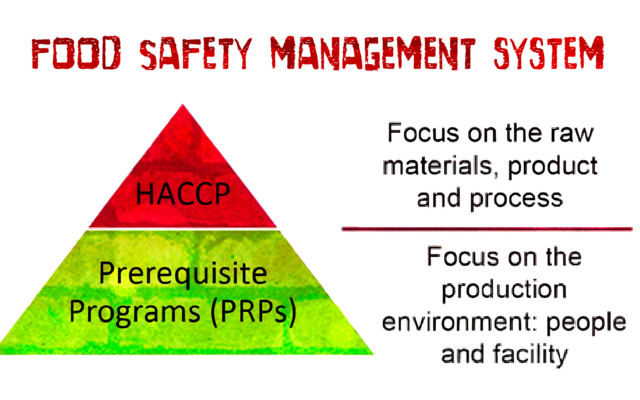
The communication under review therefore focuses once again, as it did in 2016, (5) on good hygiene practices. Now integrated into the broader concept of PRPs, Pre-Requisite Programs, as pillars of FSMS prevention and preparedness.
EC Guidelines, 2022
The EC Guidelines on Food Safety Management Systems, while lacking legal force, offer some insights on:
- relationships between GHPs, prerequisite programs (PRPs), operational PRPs (OPPRPs) and HACCP, within the framework of an FSMS,
- GHP (Annex I),
- Procedures based on the HACCP system (All. II),
- audit of the FSMS (All. III).
The aim of the document is to promote the development of a food safety culture in line with the evolution of the international reference standard, ISO 22000.
Risk analysis
The concepts of attention points and control points are introduced in the FSMS to bridge the gap between GHPs and CCPs(Critical Control Points), distinguishing intermediate and significant risks.
Risk analysis-which is precisely based on the examination of hazards and the probability of their occurrence, as well as the severity of their potential effects on food safety and public health (6)-has a central role.
Good hygiene practices (GHPs), following the risk analysis, may be sufficient or unsuitable. And in the latter case, it is appropriate to distinguish intermediate risks from significant risks, to be addressed by operational PRPs and CCPs, respectively.
ISO 22000, the high road
The approach taken by the European Commission to bridge the gap between GHPs and CCPs-and thus, to more accurately classify intermediate versus significant risks-follows the path of ISO 22000, through identification of PPOs. That is, through appropriate control measures to be taken to prevent or reduce a significant food safety risk to an acceptable level. (7)
Instead, Codex Alimentarius General principles of Food Hygiene (CXC 1-1969) refers to “GHPs requiring higher attention.” With a simplified approach, indicating the need for “heightened attention,” expressed in terms of increased frequency of application, surveillance and verification of effectiveness of good hygiene practices.
The three stages of prevention
PRPs-Pre-Requisite Programs, which include GHPs and other practices and procedures (e.g., training and tracking) essential to establish the basic environmental and operational conditions for HACCP system implementation-must be identified and applied in all Food Safety Management Systems (FSMS).
The identification of hazards for each process step is the second phase of the risk analysis, which is developed, in a third phase, with the identification of different levels of risk. And so:
– for lower risk levels, the application of effective GHPs may be sufficient to ensure food safety,
– intermediate levels of risk can be addressed preventively through “intermediate” measures, such as OPPRPs, (7)
– high risks should be monitored through appropriate CCPs (Critical Control Points) to verify the effectiveness of GHPs and OPPRPs aimed at preventing them (Communication 2022/C 355/01, Appendix 1).

FAO/WHO Risk characterization of microbiological hazards in food (8) is cited in Appendix 2 as a basic example on which to build the risk analysis and determine GHP, OPPRP, CCP.
Allergens, prevention and information
The European Commission’s ambiguity about the risks of unintentional contamination of food with allergens not declared on the label exceeds all limits. Where, in this paper, simple examples of the application of good hygiene practices (GHP) are given, and the abstract principle that the
Precautionary Allergen Labeling
(PAL) must come based on ‘risk analysis‘ (Annex I, Section 3.7).
Allergens (potentially) present in the product due to cross-contamination, according to the Commission, should not be included in the ingredient list since they were not intentionally added. However, this same European Commission is starring in recalls of products ‘suspected of‘ cross-contact by allergens with aprioristic avoidance of risk analysis (9,10).
Flexibility for small businesses
Flexibility in the application of good hygienic practices and procedures based on the HACCP system must always consider the nature of the activity (and its hazards), as well as the size of the establishment. As already stipulated in reg. EC 852/04(Hygiene 1 Regulation).
Food safety remains a primary objective to be pursued wherever possible through GHG enforcement and reduction in the number of CCPs. With a simplification that in fact corresponds to the Codex Alimentarius approach (see supra, para. 3.1). Nothing new in short.
Audits on GHP and HACCP
Official controls should include two types of audits, to verify the suitability of good hygiene practice (GHG) manuals and HACCP-based procedures:
– comprehensive audit, with in-depth examination of all operational and documentary aspects of the food business operator (FBO) being audited,
– partial audit. It often follows a full audit as a follow-up to verify compliance with requirements already imposed. That is, in general terms, to delve into certain aspects (ex. traceability, sanitation, training, etc.).
Method of conducting audits
The function of audits is ‘toprovide useful information-both to the food business operator and to the competent authority-for the purpose of improving compliance.’
Guidance on how to perform audits is provided in Annex III to this communication, with some insights on how to identify deficiencies in legal obligations and technical nonconformities.
Inspection activities may (and not ‘must’) be notified in advance to the operator when this is ‘necessary to ensure the proper conduct of the inspection.’ An example of an official communication is shown in Appendix 6.
Food safety culture, evaluation
‘To avoid subjective perception, verification of food safety culture should be done by checking objective data, for example:
- food hygiene practices,
- The training followed by the staff,
- The control of documentation related to the flow of information and exchanges between employees and managers, or
- performance monitoring such as the results of internal audits‘.
A checklist on food safety culture, as an example of indicators that competent authorities can follow in official controls, is available in Appendix 3 to this communication.
Training
Training food business personnel in food hygiene-for the proper application of GHP and other PRPs, in addition to HACCP procedures-is a key element in fulfilling the food safety culture requirement introduced by Reg. EU 2021/382 in reform of the Hygiene 1 Regulation (EC Reg. 852/04).
‘Training is often the most important tool for achieving a good food safety culture or taking corrective action if deficiencies are found during the assessment of the extent of food safety culture‘ (11,12).
Training by the authorities
The effectiveness of self-control and risk analysis–on which modern food law is based–is closely linked to the level of food safety culture of food business operators (FBOs) and their staff. Therefore, the importance of specific HACCP training to workers who supervise or manage critical control points (CCPs) is emphasized.
On the other hand, ‘training on GHP, other PRPs, and HACCP system for staff in food enterprises should be commensurate with the nature and size of the enterprise and take into account the specific risks related to the nature of the business.’
Therefore, competent authorities should consider involving food chain operators in food safety training activities. To this end, the European Commission recalls the FAO/WHO guidance to governments on the application of HACCP in small and/or less-developed food businesses. (13)
Final considerations
Food safety is the pre-requisite for any activity that may in any way affect the production, distribution and administration of food and feed, as well as their ingredients and substances fed into processes and food contact materials and objects (MOCA or FCM, Food Contact Materials).
Moreover, the extreme variability of environmental and operational conditions and emerging risks highlight how food safety itself is a dynamic concept, a value and a goal to which everyone must contribute their skills and experience. To constantly update the practical applications of prevention and control.
Paths of participatory dissemination – such as those at the time carried out in the EU in the ‘Better training for safer food‘ program, to which the writer (Dongo) had the opportunity to contribute – should be included in public programs of research and innovation, as well as of promotion of food safety in the different territories.
Dario Dongo
Notes
(1) European Commission. Commission Notice on the implementation of food safety management systems covering Good Hygiene Practices and procedures based on the HACCP principles, including the facilitation/flexibility of the implementation in certain food businesses %3A52022XC0916% (2022/C 355/01)
(2) Dario Dongo. Reg. EU 2021/382. Allergen management, safety culture, food redistribution. FT (Food Times). 9.3.21
(3) Reg. (EC) No 852/2004, on the hygiene of foodstuffs. https://eur-lex.europa.eu/legal-content/EN/TXT/?uri=CELEX%3A32004R0852&qid=1671973897521 Consolidated text as of 24.3.21 on Eur-Lex
(4) Food and Veterinary Office (FVO), European Commission (2016). Overview Report on the State of Implementation of HACCP in the EU and Areas for Improvement.
(5) Dario Dongo. Hygiene in restaurants, the ABCs. FT (Food Times). 27.12.17
(6) Dario Dongo, Giulia Torre. Official public controls, EU Regulation 2017/625 kicks off. FT (Food Times). 18.12.19
(7) Some examples of OPRPs:
– Stricter entry controls upon receipt of raw materials if the supplier does not guarantee the desired level of safety (e.g., mycotoxins in spices),
– Efficient sanitization to control cross-contamination between production batches that contain different allergens (e.g. nuts, soy, milk, etc.)
(8) FAO/WHO (2009). Risk characterisation of microbiological hazards in food https://www.fao.org/4/i1134e/i1134e.pdf ISBN 978-92-4-154789-5 (WHO).
(9) Dario Dongo. Allergens and RASFF, European blackout. FT (Food Times). 13.7.22
- (10) Moreover, the bicephalic DG SANTE (European Commission) recalls some documents where it expressly refers to Reference Doses (RD) for allergen contamination risk analysis, including:
Ad hoc Joint FAO/WHO Expert Consultation on Risk Assessment of Food Allergens – Part 3: Review and establish precautionary labeling in foods of the priority allergens https://www.who.int/news-room/events/detail/2021/10/18/default-calendar/ad-hoc-joint-fao-who-expert-consultation-on-risk-assessment-of-food-allergens-part-3-review-and-establish-precautionary-labelling-in-foods-of-the-priority-allergens - FoodDrinkEurope. Precautionary Allergen Labeling (PAL): a science-based approach based on Quantitative Risk Assessment https://www.fooddrinkeurope.eu/wp-content/uploads/2021/05/Precautionary-Allergen-Labelling.pdf
(11) Communication 2022/C 355/01, Annex I, Section 4.14
(12) NB: The training of community staff (ex. bars, restaurants, fast-food) on risk management in case of patrons’ allergic reactions should include instructions on first aid actions, given the real risk of anaphylactic shock with possible lethal outcome and the widespread ignorance found in a recent scientific study by the University of Cologne (Loerbroks et al., 2019). V. Dario Dongo. Allergies in restaurants, danger guaranteed. German study. FT (Food Times). 26.5.19
(13) World Health Organization & Food and Agriculture Organization of the United Nations. (2006). FAO/WHO guidance to governments on the application of HACCP in small and less-developed food businesses. World Health Organization. https://apps.who.int/iris/handle/10665/43598

Dario Dongo, lawyer and journalist, PhD in international food law, founder of WIISE (FARE - GIFT - Food Times) and Égalité.