
A groundbreaking study published in Communications Sustainability reveals that technology-driven interventions to reduce fish post-harvest losses could deliver an additional 850 million portions of fish daily without harvesting a single extra fish. The research – conducted by Wu et al. (2026) at the University of Wuhan, Hubei, China – demonstrates that increasing net fish consumption from the current 54% to 74% through feasible technological adoption could significantly enhance global nutrition security while reducing consumer prices by nearly 10%.
The study establishes that globally, only 54% of harvested fish reaches direct human consumption, with the remainder lost through spoilage, inefficient processing, limited by-product utilisation, or diverted to non-food uses (Wu et al., 2026). Approximately 17% is lost as post-harvest waste, 11% is directed to non-food applications such as fishmeal and fish oil, and 18% comprises unutilised by-products. These inefficiencies impose substantial economic costs while limiting opportunities to strengthen food security, improve fisherfolk livelihoods, and conserve fishery resources.
Regional disparities are striking. While developed regions such as Europe and North America maintain spoilage losses below 10%, developing tropical regions experience losses reaching up to 40% in certain sub-Saharan African areas (FAO, 2024). In South and Southeast Asia, artisanal supply chains face losses ranging between 15–30%, predominantly due to inadequate cold chain infrastructure, delayed marketing, and rudimentary processing methods (Paul et al., 2018). China, the world’s largest seafood producer, exhibits variable losses: industrial operations typically maintain spoilage below 12%, while inland and small-scale operations can experience losses of 20–30% (Li et al., 2022).
Methodology and modelling framework
Wu et al. (2026) employed a quantitative modelling approach integrated with qualitative synthesis of case studies and literature. The mathematical model represents the fish post-harvest chain through four interconnected stages:
- allocation between food and non-food applications (parameter a);
- post-harvest loss and waste (parameter b);
- edible-portion yield at processing (parameter c);
- by-product re-utilisation (parameter d).
The net utilisation rate (f) was calculated as the proportion of harvested mass ultimately used for direct human consumption, including re-utilised by-products.
The baseline condition reflects current global utilisation without additional technological adoption, where a₀ = 89%, b₀ = 81%, c = 65% (constant), and d₀ = 30% (World Economic Forum, 2024). The model then simulated improvements under various technology adoption scenarios (0% to 100%), calculating how interventions targeting cold chain improvements, better handling practices, and by-product valorisation would compound to increase overall efficiency. Regional variations were incorporated using continent-specific parameters derived from FAO statistics and peer-reviewed literature.
Technological interventions and their impacts
The research identifies four principal categories of post-harvest interventions:
- cold chain improvements: cold chain innovations – ranging from simple iceboxes for artisanal fishers in tropical regions to solar-powered village freezing units – reduce spoilage by maintaining proper temperatures from capture to market. In India, providing small-scale fishers with iceboxes increased incomes by approximately 20% during trial periods by allowing sales at full price (Rajeev & Bhandarkar, 2022). In China, portable insulated containers are widely employed among coastal small-scale fishers to preserve freshness beyond 12 hours (Zhao & Jia, 2020);
- enhanced drying and smoking technologies: improved drying and smoking technologies, such as the Chorkor and Ahotor ovens in West Africa, deliver multiple benefits. In Ghana, the Ahotor oven produces more uniform smoked fish with 40% less fuel consumption and lower carcinogen levels, yielding longer shelf life and reduced breakage (Michael et al., 2019). Solar tent dryers in Malawi cut drying time whilst enabling all-weather processing, reducing losses to near zero (Chiwaula et al., 2020). These innovations not only improve product safety but also preserve micronutrient integrity compared with traditional techniques;
- efficient handling and processing;
- fish by-product utilisation. By-product valorisation represents perhaps the most scalable opportunity. Globally, 30–70% of fish biomass comprises by-products depending on species, yet only approximately 30% of fish meal and 51% of fish oil currently derives from such side streams (Zhang et al., 2024). The study demonstrates that protein isolates recovered from fish backbones using pH-shift processing contain 80.6 g protein and 1.6 g EPA + DHA per 100 g dry weight. A single 100 g portion delivers 168% of daily protein requirements and 226–482% of individual indispensable amino acids, alongside 640% of recommended EPA + DHA intake (Wu et al., 2026).
Nutritional and public health implications
The nutritional consequences of reducing post-harvest losses are substantial. The estimated 31 million tonnes of fish lost annually post-harvest could yield approximately 850 million additional 100 g portions daily – sufficient to provide 10% of the global population with 50% of their daily protein requirement (Wu et al., 2026). Assuming average muscle protein content of 20%, this equates to roughly 2 million tonnes of high-quality protein, meeting annual requirements for approximately 114 million adults.
Fish protein isolates from by-products exhibit:
- remarkably high concentrations of lysine, threonine, and histidine – amino acids often deficient in plant-based diets – and meet or exceed WHO recommended nutrient intake levels (WHO/FAO/UNU, 2007);
- essential micronutrients including omega-3 fatty acids, selenium, vitamin D, and minerals critical for addressing malnutrition, particularly in children and vulnerable populations.
The convergence of increased edible yield and exceptional nutrient density positions post-harvest loss reduction as a high-impact intervention for enhancing dietary quality while reducing pressure on aquatic ecosystems.
Economic and environmental benefits
Wu et al. (2026) developed an economic modelling framework demonstrating that increasing technology adoption from 0% to 80% could reduce costs per tonne of marketed fish by 374 USD (from 4,479 to 4,105 USD), primarily through distributing fixed costs over greater volumes of saleable fish. This efficiency translates to a total market price reduction of 748 USD/t – an 8.4% decrease – representing substantial economic benefit to consumers. Field studies support these projections: solar dryers deployed in Cambodia enabled production of higher-quality dried fish commanding premium prices, simultaneously increasing producer income and consumer accessibility to nutritious food (Hin et al., 2024).
Environmental benefits extend beyond reduced fishing pressure. Improved smoke ovens like the Ahotor model use 40% less firewood, mitigating deforestation (Michael et al., 2019), while solar tent dryers offer energy-efficient alternatives to traditional methods (Chiwaula et al., 2020). By increasing the proportion of harvested biomass reaching consumers, fewer fish need be caught to meet each unit of demand, aligning with sustainable intensification strategies. Furthermore, enabling increased fish-based protein delivery could facilitate displacement of meat-based proteins, which exhibit markedly higher carbon, land, and freshwater footprints (Golden et al., 2021).
Discussion and future directions
The research underscores that while production-focused improvements in fisheries and aquaculture have historically dominated policy attention, post-harvest optimisation represents a critically underutilised lever for advancing nutrition security. The study’s findings converge with global assessments by FAO (2024) and the Blue Food Assessment (Tigchelaar et al., 2022), which emphasise enhancing aquatic food system efficiency as central to future food security. Importantly, technological solutions prove most effective when deployed in integrated, multi-stage interventions rather than piecemeal fixes, yielding compounding benefits across the value chain.
However, Wu et al. (2026) acknowledge important limitations. The analysis establishes upper bounds on technically feasible potential rather than predicting realised outcomes, as actual adoption depends on heterogeneous factors including governance capacity, access to capital, species composition, and gendered labour structures. The modelling treats technological adoption as proportional and harmonised across value-chain nodes – a simplification that facilitates global comparability but abstracts from context-dependent adoption dynamics. Future research should incorporate country- and species-weighted adoption scenarios informed by empirical uptake data, alongside environmental life-cycle assessments and evaluations of social-equity outcomes.
Conclusions and policy Implications
This comprehensive study demonstrates that technology-driven reduction of fish post-harvest losses offers a cost-effective, high-impact strategy for achieving global food security, advancing nutrition, and supporting inclusive economic growth. The technological solutions – spanning cold chain improvements, enhanced preservation methods, efficient handling systems, and by-product valorisation – are proven, affordable, and scalable. What is now required is political will, catalytic investment, and integrated policy frameworks to ensure widespread adoption, with particular attention to ensuring that women and small-scale fishers who represent much of post-harvest labour are not excluded from benefits.
The fundamental insight is clear: the next step-change in sustainable blue food systems lies not in extracting more from aquatic environments, but in utilising what is already harvested more wisely. By shifting focus to post-harvest efficiency and full biomass valorisation, the sector can realise a future in which nutritious, equitable, and climate-smart aquatic foods nourish billions without further depleting marine resources (Wu et al., 2026).
Dario Dongo
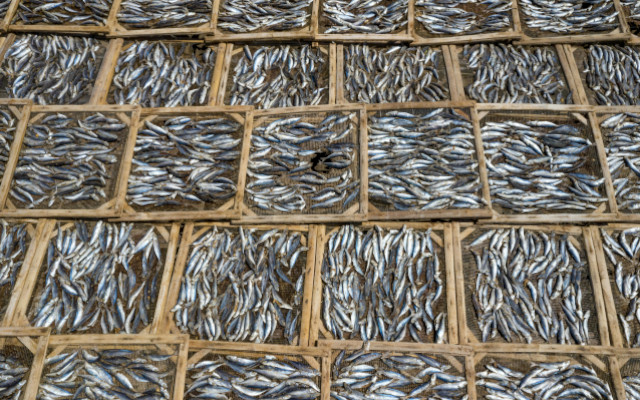
Photo by Quang Nguyen Vinh
References
- Chiwaula, L. S., Kawiya, C., & Kambewa, P. S. (2020). Evaluating economic viability of large fish solar tent dryers. Agricultural Research, 9(2), 270–276. https://doi.org/10.1007/s40003-019-00416-8
- Food and Agriculture Organization of the United Nations. (2024). The State of World Fisheries and Aquaculture 2024 – Blue transformation in action. FAO. https://doi.org/10.4060/cd0683en
- Golden, C. D., Koehn, J. Z., Shepon, A., Passarelli, S., Free, C. M., Viana, D. F., Matthey, H., Eurich, J. G., Gephart, J. A., Fluet-Chouinard, E., Nyboer, E. A., Lynch, A. J., Kjellevold, M., Bromage, S., Charlebois, P., Barange, M., Vannuccini, S., Cao, L., Kleisner, K. M., … Thilsted, S. H. (2021). Aquatic foods to nourish nations. Nature, 598(7880), 315–320. https://doi.org/10.1038/s41586-021-03917-1
- Hin, L., Buntong, B., Mean, C. M., Chhoem, C., & Prasad, P. V. (2024). Impacts of using solar dryers on socio-economic conditions of dried fish processors in Cambodia. Sustainability, 16(5), 2130. https://doi.org/10.3390/su16052130
- Li, C., Huang, J., Zhang, Y., Wang, Y., & Chen, J. (2022). A systematic review of food loss and waste in China: Quantity, impacts and mediators. Journal of Environmental Management, 303, 114092. https://doi.org/10.1016/j.jenvman.2021.114092
- Michael, S. E., Cai, J., Ampofo-Yeboah, A.-Y., & Adele, A. (2019). Fish smoking in Ghana: A review. Journal of FisheriesSciences.com, 13(1), 13–24. https://doi.org/10.36648/1307-234X.13.3.165
- Paul, P. C., Reza, M. S., Islam, M. N., & Kamal, M. (2018). A review on dried fish processing and marketing in the coastal region of Bangladesh. Research in Agriculture, Livestock and Fisheries, 5(3), 381–390. https://doi.org/10.3329/ralf.v5i3.39587
- Rajeev, M., & Bhandarkar, S. (2022). Unravelling supply chain networks of fisheries in India: The transformation of retail. Springer Nature. ISBN 978-981-19-1746-4. https://download.e-bookshelf.de/download/0017/5212/03/L-G-0017521203-0076175543.pdf
- Tigchelaar, M., Leape, J., Micheli, F., Allison, E. H., Basurto, X., Bennett, A., Bush, S. R., Cao, L., Cheung, W. W. L., Crona, B., Gelcich, S., Gephart, J. A., Consumo, H., Little, D. C., Naylor, R. L., Sarto, N., MalCA, E., Siddique, A., Sinner, J., … Lubchenco, J. (2022). The vital roles of blue foods in the global food system. Global Food Security, 33, 100637. https://doi.org/10.1016/j.gfs.2022.100637
- World Economic Forum. (2024). Investigating global aquatic food loss and waste – White paper annex. World Economic Forum. https://www3.weforum.org/docs/WEF_Investigating_Global_Aquatic_Food_Loss_and_Waste_2024.pdf
- World Health Organization, Food and Agriculture Organization of the United Nations, & United Nations University. (2007). Protein and amino acid requirements in human nutrition: Report of a joint WHO/FAO/UNU expert consultation(WHO Technical Report Series, No. 935). World Health Organization. ISBN 978-92-4-120935-9. https://iris.who.int/server/api/core/bitstreams/b7c5ec43-bc59-4b38-b702-3f0e96a06fa1/content
- Wu, H., Zhang, J., Zhu, H., Peñarubia, O., & Willer, D. F. (2026). Technology-driven reduction of fish post-harvest loss could enhance food security and economic resilience. Communications Sustainability, 1, 45. https://doi.org/10.1038/s44458-026-00048-4
- Zhang, J., Ahmmed, M. K., Regenstein, J. M., & Wu, H. (2024). Recent advances of recycling proteins from seafood by-products: Industrial applications, challenges, and breakthroughs. Trends in Food Science & Technology, 149, 104533. https://doi.org/10.1016/j.tifs.2024.104533
- Zhao, X., & Jia, P. (2020). Towards sustainable small-scale fisheries in China: A case study of Hainan. Marine Policy, 121, 103935. https://doi.org/10.1016/j.marpol.2020.103935

Dario Dongo, lawyer and journalist, PhD in international food law, founder of WIISE (FARE - GIFT - Food Times) and Égalité.