

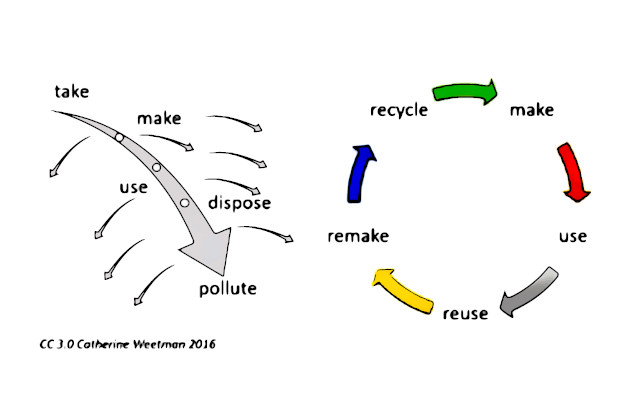
The European Parliament’s recent resolution on the European Commission’s action plan charts the way forward to promote thecircular economy on the Old Continent.
Lo
European Green Deal
, presented by Ursula von der Leyen on 11.12.19, is thus beginning to decline into concrete initiatives. With attention also given to consumers’ rights to sustainable and repairable products, as well as correct information.
One has regard to Sustainable Development Goals (SDGs) 12(Responsible Consumption and Production) and 15(Life on Earth), in UN Agenda 2030. As well as the goal of achieving climate neutrality in the EU by 2050.
Circular economy, context
2.5 billion tons of waste are generated annually in the EU. And the environmental impact of goods depends substantially, up to 80 percent, on the design phase. The single-use paradigm, in products and packaging, is completely unsustainable. Half of total greenhouse gas emissions-and more than 90 percent of water stress and biodiversity loss-come from resource extraction and processing. And if global consumption of materials doubles in the next four decades, the amount of waste generated each year is estimated to increase by 70 percent by 2050.
First and foremost, the circular economy postulates a significant reduction in the overall use of natural resources and waste generation (1,2). Its realization, however, requires a profound transformation of value chains throughout the economy and the sustainable use of primary raw materials. Cut down carbon emissions, reduce the environmental footprint of productions, eliminate toxic substances. To move from a linear pattern of ‘production-consumption-discard’ to an effective circularity. By 2050, according to targets stated in Brussels.
Circular economy, the EU action plan
The European Commission-in Action Plan 11.3.20 on the circular economy-had focused on waste prevention and optimal waste management, with specific focus in seven key areas. Plastics, textiles, e-waste, food and water, packaging, batteries and vehicles, and buildings and construction. (3) Without abandoning the EU’s aspirations for growth, competitiveness and even global leadership on these issues.
The Ecodesign directive, on eco-design, must therefore be extended to include products not related to energy use. (4) In turn, the Parliament has approved initiatives to combat planned obsolescence, improve the durability and repairability of products, and make consumer rights stronger with the ‘right to repair’. Also stressing the importance of consumers’ right to be properly informed about the environmental impact of products and services, as opposed to greenwashing and false environmental claims.
Circular economy action plan, European Parliament resolution
On 10.02.21, the European Parliament approved the Commission’s proposed action plan, adding a series of recommendations aimed at completing the path to the circular economy by 2050. The Strasbourg assembly calls for stricter rules on consumption and recycling (5) and urges the Commission to follow the timetable already established.
It is stressed that each legislative proposal should come based on a comprehensive impact assessment, and member states should in turn integrate the circular economy into their national recovery and resilience plans. Strasbourg’s recommendations, in the 10 key points to follow.
Binding targets and harmonized indicators
1. Binding targets for 2030 are to be set on the environmental footprint of materials, throughout the life cycle and for each product category, and the ecological footprint of consumption.
2. Introduction of harmonized, comparable and uniform circularity indicators by 2021 on material and consumption footprints, with a set of sub-indicators on resource efficiency and ecosystem services.
The indicators should measure the resource consumption and life cycle of products made in the EU, also taking into account imports, third-country processing and exports. They must be consistent with international standards and updated periodically.
Facilities and grants
3. Regulations and policies in favor of new sustainable and circular business models that save resources and reduce environmental impact. With removal of unjustified regulatory and tax barriers, while also addressing environmental challenges related to digitization.
4. Elimination of subsidies to environmentally harmful activities, including in the frameworks of the Industrial Strategy for Europe and the SME strategy. Industry must take an active role in the transition to a more circular economy.
Transparent information
5. Digital passports should be introduced to help businesses, consumers and market surveillance authorities to:
– record the climate, environmental, social and other impacts on a product throughout the value chain,
– Provide reliable, transparent, and easily accessible information on product durability and options for maintenance, reuse, repair, and decommissioning, as well as on the
– end-of-life materials management, composition (materials and chemicals used), environmental and other impacts. In this regard, the Commission is asked to consider options for the introduction of an appropriate label.
6. Combating greenwashing and false environmental claims, including by regulating the use of green claims and establishing harmonized calculation methods.
Compliance audits, green public procurement
7. Increased compliance checks on products imported and distributed in the EU including throughecommerce. Official controls in the member states must follow uniform criteria providing for their minimum numbers and frequency, under the coordination of the European Commission.
8. Implementation of green public procurement (GPP), perhaps even on a mandatory rather than voluntary basis, to accelerate the green transition.
Blockchain, incentives and tariffs
9. Promotion of digital technologies such as publicblockchain to track material flows, processes and ecological performance of products throughout the supply chain.
10. Economic incentives and tariffs. Modulation of utility rates and taxation on a green basis, tax incentives for sustainable consumption (e.g., VAT) must be accompanied by taxes on greenhouse gas emissions and unsustainable supply chains.
Planned obsolescence
It also supports initiatives that improve the durability and repairability of products by strengthening consumer rights through free access to necessary repair and maintenance information, including information and access to spare parts and software updates.
Clear and easily understood harmonized labeling, the development of uniform repair scoring, and the introduction of usage counters for certain product categories are indispensable. The ‘right to repair’ should also cover the extended life cycle of products, access to spare parts and complete information about them, affordable costs for repair.
Planned obsolescence should also be countered through ad hoc legislative measures, such as its listing in Annex I of the Unfair Commercial Practices Directive (dir. 2005/29/EC, implemented in Italy by the d.lgs. 206/05, c.d. Consumer Code).
Waste prevention, reuse and recycling
Waste prevention is the top priority. The Commission is therefore invited to propose binding targets for the overall reduction of waste and specific waste streams and product groups, as well as targets to limit the generation of residual waste, in the revision of the Waste Framework Directive and the Landfill Directive scheduled for 2024.
Design must consider the ability of materials to retain their characteristics over time and their aptitude for reuse. And secondarily to recycling. Member states must then implement effective deposit return and collection systems.
Global agreements, coherence and protection of human rights
The EU aspires to lead global action, amplify efforts for an international agreement that keeps natural resource management within a ‘planetary boundary’ for natural resource use. To have this leadership role, however, a clear strategic trade policy is needed to make progress in the transition to the circular economy and the achievement of the Sustainable Development Goals (SDGs).
Trade and investment agreements must be in line with circular economy policies. Parliament therefore stresses ‘the importance of imposing a requirement that primary and secondary raw materials imported into the EU meet human rights, human health and environmental protection standards equivalent to EU standards, including through the Commission’s forthcoming legislative proposal on sustainable corporate governance and duty of care, and to ensure a level playing field in key EU supply chains.’ (6)
Dario Dongo and Giulia Torre
Notes
(1) Luca Foltran, Dario Dongo (2018). Circular economy, ABC EU package. GIFT(Great Italian Food Trade) https://www.greatitalianfoodtrade.it/imballaggi/economia-circolare-abc-pacchetto-ue and.
(2) Dario Dongo, Giulia Torre (2020). Circular Economy Package, implementation in Italy in September 2020. GIFT(Great Italian Food Trade), https://www.greatitalianfoodtrade.it/progresso/pacchetto-economia-circolare-attuazione-in-italia-a-settembre-2020.
(3) Communication from the Commission ‘A new action plan for the circular economy: Towards a cleaner and more competitive Europe‘ (COM(2020)0098)
(4) Directive 2009/125/EC establishing a framework for the setting of ecodesign requirements for energy-related products
(5) European Parliament, Resolution 1.2.20. ‘Paving the way for a global circular economy: current situation and prospects’ (SWD(2020)0100). https://www.europarl.europa.eu/doceo/document/TA-9-2021-0040_IT.pdf
(6) See resolution referred to in footnote 5, item 123.

Dario Dongo, lawyer and journalist, PhD in international food law, founder of WIISE (FARE - GIFT - Food Times) and Égalité.

Graduated in law, master in European Food Law, she deals with agro-food, veterinary and agricultural legislation. She is a PhD in agrisystem.


