

Slaughtering the Forest, Slaughtering the Forest. Greenpeace Argentina’s July 2019 report showed the extraordinary pace of deforestation imposed by the local beef industry. (1) Primarily Cresud, Argentina’s first agribusiness group listed in Buenos Aires and Wall Street, which also supplies the Metro Group. Our brief shelf survey of Metro Italia at the Turin cash & carry . Buycott!
Gran Chaco. Ecosystems and indigenous communities, devastation and land robbery
The Gran Chaco is the second largest forest in South America, extending into Argentina and Paraguay, Bolivia and to a small extent into Brazil. It is one of the largest reserves of biodiversity on the planet, with more than 3,400 species of plants, 500 of birds, 150 mammals, 120 reptiles and 100 amphibians. And it is seriously threatened, as we have seen, by unrestrained deforestation that has intensified just in recent years.
4 million people -equal to 80 percent of Ireland’s population-live in the Gran Chaco. Small farmers, mostly, and indigenous communities (8%). The word Quechua, which we all associate with the brand of sportswear sold by Decathlon, is the name of the language spoken by ethnic groups in this area. And ‘Chaku,’ in Quechua idiom, means hunting place. Everyone depends on its endless forest for food, water, woods and medicine.
Campesinos and indigenous peoples have inhabited these lands since time immemorial, but without holding title. And over the past two decades, as agro-industry has advanced, they have been and still are being driven out with increasingly frequent murder and violence by the police and private militias of the fazendeiros. Who then proceed to deforest and poison water and land with massive doses of pesticides to prevent any different use of the areas. Before starting GMO soy monocultures and bringing in beef cattle.
Cresud, the Risk Champion
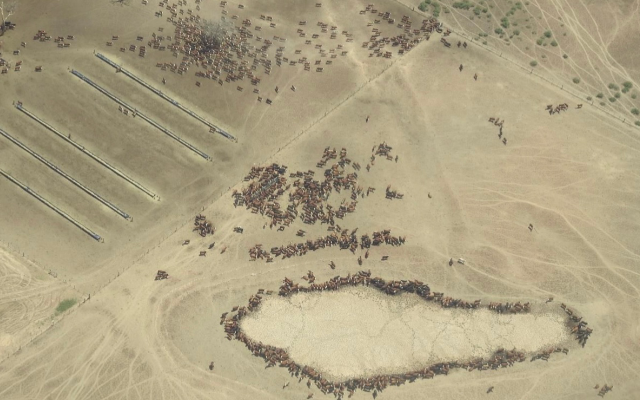
Beef exports from Argentina almost tripled, between 2012 and 2018, with a record increase (+77%) from 2017 to 2018. One of its key players is the Cresud group, which owns more than 800,000 hectares-equivalent to 1/5 of Holland (!)-in Argentina, Bolivia, Brazil and Paraguay. The Argentine giant runs the all-around cattle ranching business, from growing grains and GMO soybeans to breeding, slaughterhouses, and meat production. Sweetening the view is a bit of sugar cane.
Agribusiness is the arm of big finance. The imperative is to conquer territories, put them to use and maximize their yields. According to the cliché described on the Cresud website:
– Acquire ‘underutilized’ land holdings to turn non-productive land into pasture for livestock,
– Converting livestock areas to more productive and profitable agricultural uses,
– transforming rural properties into urban areas, in the final stage of the real estate development cycle,
– replicate the model ‘in other Latin American countries, including Brazil, Bolivia and Paraguay.’
‘We believe that it is possible improve the productivity and long-term value of low-cost and/or underdeveloped lands by investing in new technologies such as high-yielding genetically modified seeds, (…) use of fertilizers and agricultural chemicals. Livestock production to improve our genetic technology (…)
Argentine meats in Metro Italy, deforestation at home
The Metro Group – a global cash & carry giant – declares its commitment to ‘Corporate Social Responsibility‘. Referring to ‘the integration, in companies’ business operations and in their dealings with stakeholders, of social and ecological concerns through a voluntary process of self-regulation.’ (1)
On Argentine meats, in the ‘Metro supply chains’ area of the website, we read the bucolic story of a couple of suppliers who would practice extensive farming in the vast plains of the Pampas. (2)
All in accordance with ‘principles of environmental sustainability,’ at least in words. Thus the ‘Frigorìfico Gorina S.A.I.C.’ and generally the beef suppliers of the American continent such as ‘La Anonima’, ‘Marfrig Global Foods’, ‘Oakey Beef Exports’.
However, Metro also continues to sell meat from the conqueror Cresud, which is credited on its supplier list to this day. As confirmed to us by an employee of the Turin cash & carry, where we went on 3.10.19. ‘It all depends on the purchases being made upstairs, by Metro International.’ When the offer is good, you do the loading. Meats from the American continent from Metro however are never lacking, as shown in Attachment.
Restaurant meat origin, the transparency that is missing
Managers of restaurants, trattorias and canteens-in Italy as in Europe-are the biggest Clients of the South American slaughterhouse of deforestation. But if consumers knew where these meats came from and knew their environmental and social impact, would they order them? And wouldn’t they rather be willing to spend an extra coin to have a guaranteed national meat?
The indication of origin of meat in mass catering should be made mandatory in Italy, as we have been demanding for years. And as indeed is already the case in France, where users of restaurants and trattorias, fast food restaurants and canteens have for years been granted the right to transparency about the origin and provenance of the meat served to them. (3)
Transparency is all the more urgent to enable consumers to consciously choose meats that come from truly sustainable supply chains and tracked as such, even better if – on a voluntary basis – supported by a technological guarantee such as public blockchain.
#Buycott! American meats, GMO soybeans and palm oil
TheMercosur-EU agreement is bound to attract increasing volumes of GMO meat and soybeans from those countries. This accelerates the globalization of exploitation that starts with land robbery, deforestation and the poisoning of ecosystems.
#Buycott! American meats, GMO soybeans and palm oil. Sign the petition at https://www.egalite.org/buycott-petizione/
Dario Dongo and Giulia Caddeo
Notes
(1) See Green Peace Argentina (2019). Slaughtering the Forest
See also FAO. (2016). Global Forest Resources Assessment 2015, second edition. ISBN 978-92-5-109283-5, http://www.fao.org/3/a-i4793e.pdf
(2) Metro Italy’s website states.
‘land FILIERE meats come from selected farms within production areas. Our suppliers ensure high standards in terms of productivity and technology, respecting animal welfare and environmental sustainability. (…) Sustainability of Filiere means meat produced in a traditional way, with full respect for the environment and animals. An integrated approach to the product in which the guiding values are authenticity, safety, typicality and ethics. In fact, our suppliers also adopt labor and employment policies to protect the land‘. V. https://www.metro.it/metro-piu/piu-servizio/materie-prime/carne
(3) Details on our proposed decree in the previous article https://www.foodagriculturerequirements.com/archivio-notizie/origine-carni-bovine-al-ristorante-lo-schema-di-decreto-legge-del-consorzio-l-italia-zootecnica-analisi-di-dettaglio_1
Attachment – Metro Italy, Turin. Available American meats, brands and prices. Survey 3.10.19
PICANA BOV ADULT ARGENTINA PZ A KG 17.50 EURO – Gorina Refrigerator
ANGUS PARAGUAY HEART SCAMON PZ A KG 10.50 EURO – Aberdeen Paraguay
SCAMONE HEART BOV ADULT BRAZIL PZ A KG 11.99 EURO – Marfrig Global Foods SA
ANGUS PARAGUAY FILET PZ A KG 20.50 EURO – Aberdeen Paraguay
FILETTO S/cord brazil s/v ¾ 19.99 euros per kg – Marfrig Global Foods SA
ENTRECOTE (CUBE ROLL) BOV AD BRAZIL EURO 11.99 PER KG – Aberdeen Paraguay
ENTRECOTE (CUBE ROLL) ANGUS PARAGUAY EURO 15.99 PER KG – Aberdeen Paraguay
ENTRECOTE (CUBE ROLL) BOV AD ARGENTINA EURO 18.50 A KG – Marfrig Global Foods SA
MAGATELLO BOV AD AUSTRALIA WAGYU EURO 10.99 A KG – Oakey Beef Exports LDT

Dario Dongo, lawyer and journalist, PhD in international food law, founder of WIISE (FARE - GIFT - Food Times) and Égalité.

Graduated in law, master in Food, Law & Finance. You have explored the theme of green procurement and urban food policies in the International Cooperation and Peace sector of the City of Turin.