

Intercropping offers interesting opportunities for the cultivation of cereals and legumes, especially within an organic farming regime. This is why the LEGUMINOSE project is designed to support farmers in developing sustainable systems to implement this farming technique in different EU countries. (1)
Intercropping
Intercropping is a technique used in agronomy to increase the efficiency of the resources employed in the cultivation of different crops, with two or more types grown in the same portion of soil. The combination of legumes and cereals is one of the most interesting practices, thanks to the nitrogen fixation of the former – generally improving crops (i.e. those that enhance soil fertility) – in favour of the latter, which are instead depleting crops (i.e. those that reduce soil fertility). (2)
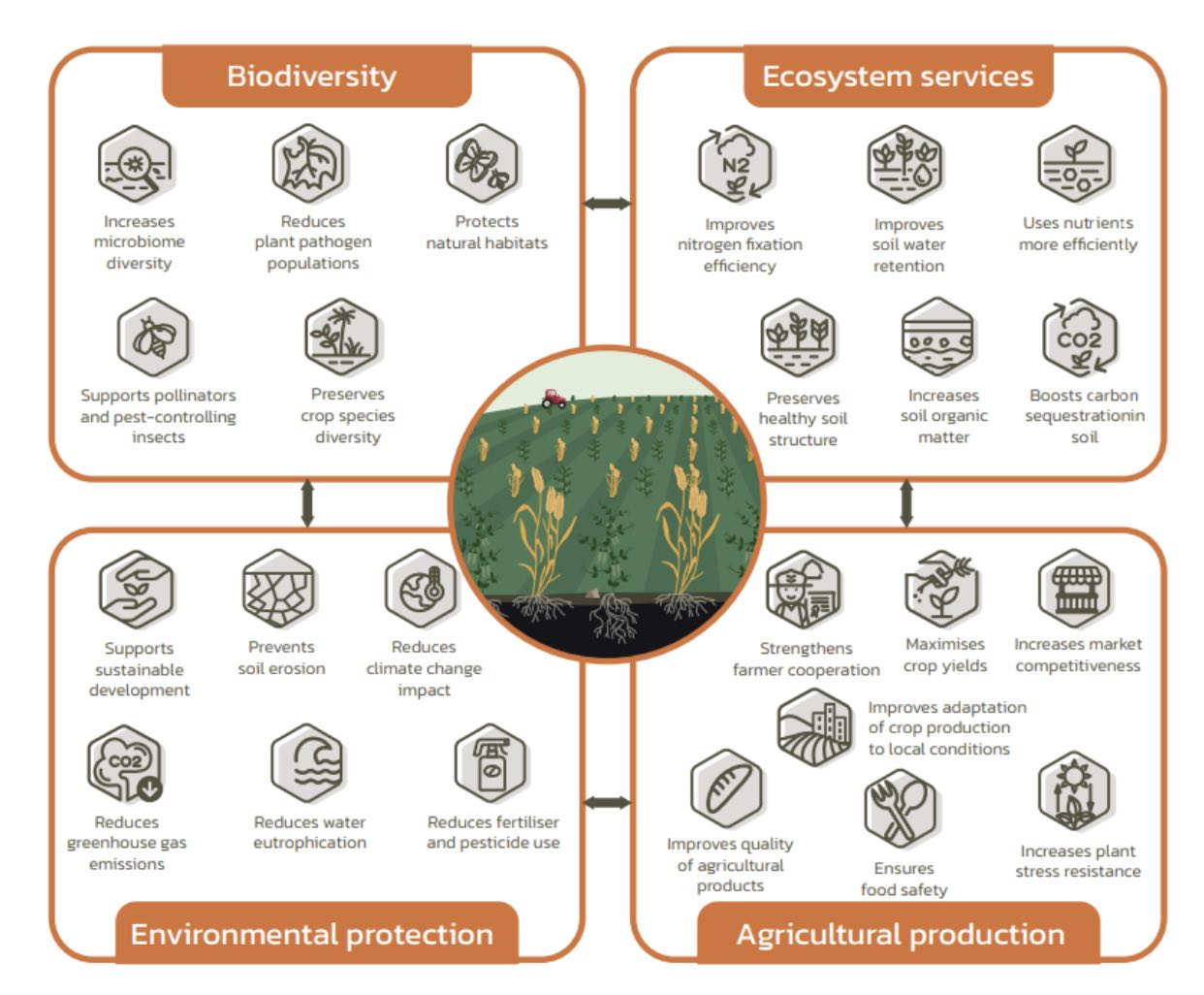
Further advantages of intercropping include the improvement of soil structure and increased resistance to lodging, particularly in grasses. In addition, it helps reduce weed competitiveness and insect attacks, leading to a reduction in the use of pesticides in the field and the related residues in food.
The choice of species and varieties to interplant depends on several factors, but environmental elements and the compatibility between the associated species are of primary importance. A careful choice can enhance the expected effects and improve both the qualitative and quantitative yields.
Different types of intercropping
There are different types of intercropping, but the main ones are:
- Row intercropping: involves the cultivation of intercrops within or outside the rows while one or more crops are grown in the typical rows. A popular strategy to maximise production and make the best use of available resources;
- Mixed intercropping: the cultivation of two or more crops together without maintaining a predetermined proportion between the rows. When resources (soil and nutrients) are limited, mixed cropping is often adopted to meet both food and fodder needs;
- Strip intercropping: consists of growing two or more crops in strips on sloping land. It has been shown to improve radiation use efficiency (RUE), i.e. the biomass produced per unit of intercepted solar radiation, in marginal and poor areas;
- Relay intercropping: a technique of cultivating two or more crops simultaneously during part of the growing season of each crop. The second crop is planted after the first has completed a significant part of its life cycle and has reached the reproductive stage or is nearly mature but not yet ready for harvest.
LEGUMINOSE project
LEGUMINOSE (Legume-cereal intercropping for sustainable agriculture across Europe) is a project funded by the Horizon Europe programme, which aims to increase the adoption of intercropping by EU farms, with a focus on legumes and cereals (currently only 2% of land is used for legume-cereal intercropping), in order to meet future increases in food demand due to the significant forecast of global population growth by 2050.
The University of Florence coordinates the project, with the contribution of the Confederazione Italiana Agricoltori (CIA) which, as a partner, intends to promote and disseminate the use of intercropping in national farms, assessing the various benefits and the cultural or other limitations that may hinder the adoption of this technique in the field, while providing support and training to remove any barriers and optimise production efficiency.
7 case studies
The project includes 7 case studies implemented in 6 Member States and in one country associated with the Horizon Europe programme, the United Kingdom. In each country, the effects of soil and climate conditions on the chosen intercrops are evaluated, using different reference parameters such as crop yields, soil chemical and physical properties, soil microbiota, and greenhouse gas emissions.
Main results
An online tool has been developed to support users in choosing the optimal combinations of cereal and legume species or varieties to employ for the most appropriate intercropping, also thanks to the use of meteorological and soil data associated with sowing time and any fertiliser use. Daily growth and crop requirements are also predicted by the tool, along with other parameters such as phenological development and leaf area, light use, dry biomass production and more. (3)
To facilitate the adoption of intercropping, so-called Dynamic Innovation Partnerships (DIPs) have been conceived, where views and opinions are exchanged on technical requirements, market challenges and gaps in the legume-cereal intercropping value chain. A DIP is generally initiated with a facilitator (e.g. farmer, researcher) and works on a specific value chain with several other stakeholders who meet frequently to address issues of interest.
Alongside positive and interesting results, there are also various challenges and criticalities that demonstrate and confirm how intercropping cannot always be adopted. Several trials have shown limited compatibility between different crops (e.g. lupin and wheat) or difficult adaptation to soil conditions (e.g. winter pea sensitive to high soil moisture). Correct sowing in terms of timing and method can improve these limitations.
Intercropping and soil microbiome
The soil microbiome, determined by the composition of the microorganisms present, is influenced by soil properties and the plants growing there, cultivated or not. The rhizosphere, thanks to contact with the plant roots, sees the release of substances that promote or inhibit microbial growth. With appropriate combinations of cultivated species and the related substances released in the rhizosphere, it is also possible to control the soil microbiome. (4)
In LEGUMINOSE, legume-cereal intercropping has been shown to have positive effects on the soil microbiome, as evidenced by its improved ability to counter pathogenic microorganisms and to enhance overall soil biodiversity and health. The correct distribution of beneficial microorganisms increases nutrient availability for plants and their growth, as well as soil fertility.
Challenges and recommendations
The LEGUMINOSE and IntercropVALUES projects (Developing Intercropping for agrifood Value chains and Ecosystem Services delivery in Europe and Southern countries) (5) have joined forces to draft a policy brief to be submitted to EU and Member State policymakers, in order to promote the adoption of intercropping in agriculture. (6)
A set of recommendations has been provided with the aim of improving EU policies and regulations, so as to achieve the goal of enhancing the use of intercropping practices. The main recommendations are:
- Adoption of agroecological practices within the Common Agricultural Policy (CAP), to benefit soil health, biodiversity and the water cycle. Intercropping can be included as a practice to ensure compliance with certain Good Agricultural and Environmental Conditions (GAECs);
- Increase of direct payments within the CAP for intercropping;
- Development of eco-schemes for intercropping by Member States;
- Increase of public investment in the development of value chains based on intercropping;
- Strengthening of advisory and strategy services, training and education by Member States;
- Development of a protein strategy (already considered by the European Parliament and the Commission itself), which includes intercropping.
Provisional conclusions
Intercropping represents an interesting strategy to improve yields in agriculture. It makes it possible to obtain various advantages in terms of production and profitability, and to exploit a smaller land area to achieve higher production with fewer inputs and improved soil health, including the microbiome.
Its use is unfortunately still limited, and it is necessary to invest time and resources, as the LEGUMINOSE project is doing, to spread knowledge of this practice and maximise its potential, in respect of the chosen crops and the soil and climate capacities of the geographical context. New policies and regulations should welcome the dissemination of this practice, which should become standard both in conventional and organic farming regimes.
Andrea Adelmo Della Penna and Dario Dongo
References
(1) V. https://www.leguminose.eu/
(2) Amandeep Kaur A. & Sharma S. (2025) Intercropping a sustainable holistic approach for improving growth and productivity of crops. International Journal of Research in Agronomy 8(4):133-139, https://www.doi.org/10.33545/2618060X.2025.v8.i4b.2757
(3) V. https://leguminose.farming.software/login
(4) Ge A.H. & Wang E. (2025) Exploring the plant microbiome: A pathway to climate-smart crops. Cell 188(6):1469-1485, https://doi-org.unimib.idm.oclc.org/10.1016/j.cell.2025.01.035
(5) V. https://intercropvalues.eu/

Graduated in Food Technologies and Biotechnologies, qualified food technologist, he follows the research and development area. With particular regard to European research projects (in Horizon 2020, PRIMA) where the FARE division of WIISE Srl, a benefit company, participates.

Dario Dongo, lawyer and journalist, PhD in international food law, founder of WIISE (FARE - GIFT - Food Times) and Égalité.