

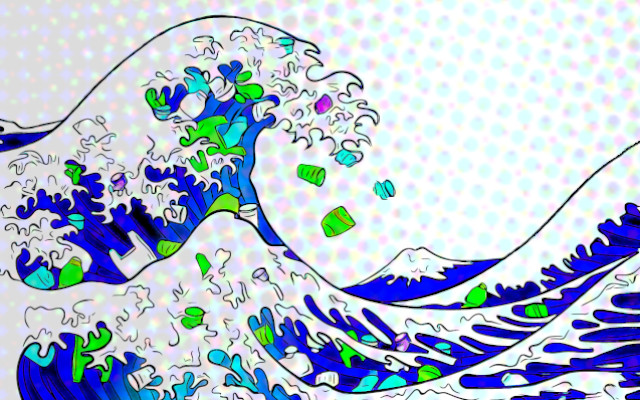
Greenpeace launches petition to get global agreement against plastic pollution. The environmental organization denounces the serious degradation afflicting our seas, as well as air and soil. And it proposes that governments make a joint commitment under the auspices of the United Nations. (1)
Greenpeace, a global agreement on plastics
‘Every minute, every day, the equivalent of a truck full of plastic ends up in the oceans, becoming a danger to turtles, birds, fish, whales and dolphins,’ Greenpeace reminds.
The pervasiveness of polymers has crossed all barriers. Microplastics, produced by the breakdown of plastic materials, have been found in human blood, lungs, even placenta. (2)
The measures taken so far are clearly insufficient:
– the restriction introduced on the sale of single-use plastic containers by the UAS Directive is too limited. (3) From food to detergents to hygiene products, in fact, most everyday products are made or packaged in plastic. At this rate, plastic production will double 2015 volumes by 2030-35 to triple by 2050.
– recycling is also insignificant. Of all plastics produced since the 1950s, only 10 percent have been properly recycled, Greenpeace says, recalling that 99 percent of plastics originate from petroleum, so they pollute throughout their life cycle. (4)
The petition
A global problem needs a global solution, clarifies the environmental organization. The way is to sign an agreement among states under the auspices of the UN.
The petition calls on governments to ‘develop a global agreement under the auspices of the United Nations that would reduce plastic pollution of the sea and oceans to zero.
In the agreement it is necessary:
- Establish legislative instruments, legally binding on companies and governments, that cover the entire life cycle of plastics, including the extraction and production of the raw materials from which they are made, but also their use and disposal
- Binding large multinational corporations to sell more and more products in bulk or with reusable packaging
- Make each country responsible for managing its own waste. Governments must also ensure a just transition for workers and the protection of the health of communities most affected by pollution‘.
The path set out by Greenpeace is in line with the resolution ‘End plastic pollution: Towards an international legally binding instrument,’ adopted in Nairobi on 2.3.22 with 175 countries signing on to end plastic pollution and establish a legally binding international agreement by 2024. (5)
Notes
(1) Greenpeace. Stop plastic. Saving the seas. https://bit.ly/3VKJkOj
(2) See previous articles:
Marta Strinati. Microplastics in the human placenta. The discovery of Italian researchers. FT (Food Times). 11.12.20
Marta Strinati. Microplastics in blood, first evidence in humans. FT (Food Times). 23.3.22
Marta Strinati. Microplastics even in our lungs. The British study. FT (Food Times). 12.4.22
(3) UAS Directive, Leg. 196/21. New rules on single-use plastic items from 14.1.22. FT (Food Times). 29.12.21
(4) Dario Dongo and Alessandra Mei. Plastics and greenhouse gas emissions, an emergency to be prevented. Scientific study. FT (Food Times). 9.2.20
(5) Isis Consuelo Sanlucar Chirinos. Historic United Nations agreement against plastic pollution. FT (Food Times). 5.3.22

Professional journalist since January 1995, he has worked for newspapers (Il Messaggero, Paese Sera, La Stampa) and periodicals (NumeroUno, Il Salvagente). She is the author of journalistic surveys on food, she has published the book "Reading labels to know what we eat".