
Thirty-six university professors, researchers and doctors specializing in epidemiology, endocrinology and diabetes, nutrition, pediatrics and psychology denounce Danone’s ‘nutrition and health claims’ on milk and yogurt-based drinks with added sugars in quantities similar and even higher than Coca-Cola. (1)
1) Danone, ‘health’ claims on drinks with added sugars
‘Actimel: the little gesture of immunity for good days. A delicious shot rich in vitamin D and a source of vitamin B6 to take care of your immune defenses every morning. Billions of L. casei ferments (…)’.
‘Activia: billions of probiotics, helps you digest lactose better in case of difficulty, takes care of your digestive well-being, source of calcium which contributes to the normal functioning of digestive enzymes (…)’.
Vitamins and health promises for everyone, including of course children and their naive parents. And so:
‘Danonino: Good fruits, milk, calcium and vitamin D for good normal bone growth in children’.
1.1) Actimel+ Triple action, one against all
Actimel+ Triple Action – launched on the market in September 2024, a few days after Danone announced that it would remove the Nutri-Score from the labels of its drinks (2) – even promises to help ‘stay fit through 3 actions:
- immune system support thanks to vitamin D;
- protection of cells from oxidative stress to provide antioxidant properties through vitamin C;
- reduce tiredness thanks to magnesium’.
Nothing more than a simple multi-vitamin and multi-mineral dietary supplement, except for the sky-high price compared to the recommended daily doses for the same micronutrients.
2) Coca-Cola-style added sugars
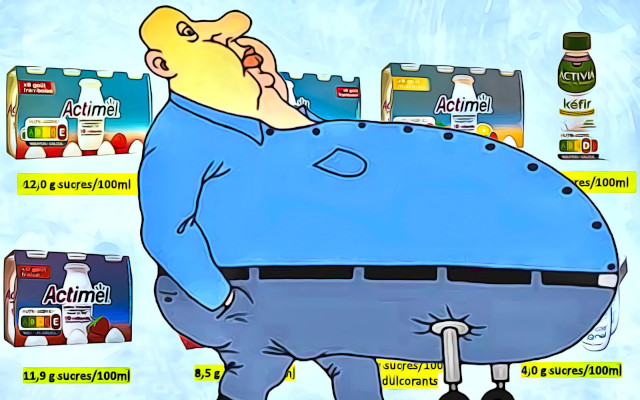
However the milk-based and yogurt-based bevereages advertised by Danone with the aforementioned ‘nutrition and health claims’ contain added sugars in very high quantities, the researchers note:
- between 8 and 12 g of sugar per 100 ml of drink. That is, a little less or a little more than
- 10 g sugar/100 ml classic Coca-Cola. (3)
Nothing less than sugary drinks, to whose consumption the largest study conducted in 184 countries worldwide attributes the direct cause of 2,2 million new cases of type 2 diabetes and 1,2 million cardiovascular diseases each year. (4)
3) Deceptive profiles, and nutritional profiles
Appearance is deceiving. ‘These products thus emphasize the recognized physiological properties of vitamins and minerals (without the health benefits heralded by the products containing them), while hiding the harmful effects of high sugar consumption that are, for their part, perfectly demonstrated,” the researchers observe.
Nutrition and Health Claims Regulation (EC) 1924/06, if you look closely, has introduced a specific criterion aimed at preventing these forms of misleading marketing:
– nutritional profiles that individual foods must comply with in order to be able to report ‘health claims’ and ‘nutrition claims’ other than the indications ‘reduced in (e.g. fat, saturated fat). (5)
4) Nutritional profiles, the (unfulfilled) duties of the European Commission
The Commission has been delegated by the European legislator to establish, by 19 January 2009:
– ‘the specific nutritional profiles including exemptions, which foods or certain categories of foods must comply with in order to bear nutritional or health claims, as well as
– the conditions concerning the use of nutrition or health claims for foods or categories of foods in relation to nutrient profiles’. (5)
4.1) EFSA scientific opinions
EFSA (European Food Safety Authority) has in fact published two scientific opinions on the nutritional profiles of foods:
– on February 26, 2008, on a charge received from the Commission on February 19, 2007, in view of the implementation of the Nutrition and Health Claims Regulation(NHCR) mentioned above; (6)
– on April 19, 2022, on behalf of the European Commission dated December 14, 2020, for the development of a mandatory nutrition labelling system on the front of labels and the implementation of the NHCR (7,8,9).
5) European Court of Auditors, the reprimand
European Court of Auditors (ECA) – in its report ‘Consumers can get lost in the maze of labels’, published on November 25, 2024 –harshly criticised the European Commission for numerous failures to comply with the delegations of authority it received for the implementation of the Food Information Regulation (EU) 1169/11, as seen. Also:
- 16 years of failure to comply with the duty to introduce the nutrient profiles established by the Nutrition and Health Claims Regulation
- 2 years delay in defining a FOPNL (Front-of-Pack Nutrition Labelling) system, as per the commitments made in the ‘Farm to Fork’ strategy of 19 May 2020. (10)
6) Provisional conclusions
The worst enemy of nutritional security – according to Serge Hercberg, a doctor and professor emeritus of nutrition at the Université Sorbonne Paris Nord – are the lobbies of the Big Food Corporations. Which, despite the false proclamations of ‘social’ responsibility in their sustainability reports, persist in:
– speculating on junk food, often ultra-processed, offered as the ‘cheaper’ alternative, thanks to the poor nutritional quality of the ingredients used
– promoting HFSS (High in Fats, Sugars and Sodium) products with invasive marketing, especially towards minors, as well as underhanded marketing (as in the cases in question)
– countering nutritional policies essential to mitigate the epidemic of NCDs (Non-Communicable Diseases) associated with unbalanced diets.
The facts above, unfortunately, confirm these statements.
Dario Dongo
Footnotes
(1) Serge Hercberg et al. When the « tree of allégations » cache the « forest of sucres »… Nutri-Score blog. 13.1.25 https://tinyurl.com/4dax3ya8
(2) Dario Dongo. Nutri-score, Danone backtracks. FT (Food Times).
(3) The ‘no added sugar’ versions only contain the sugar (lactose) naturally present in milk.
(4) Dario Dongo. Sugary drinks, type 2 diabetes and cardiovascular disease. FT (Food Times). January 11, 2025
(5) Nutrition and Health Claims Regulation (EC) 1924/06, Article 4. Products that do not comply with the nutritional profiles may only refer, in the commercial information, to:
– reduced content of fat, saturated fat, trans fatty acids, sugars and salt/sodium, in compliance with the conditions set out in Article 9 (comparative claims) and in the Annex to the Regulation;
– other ‘nutrition claims’, when the nutritional profile is exceeded by a single value (e.g. sugars), provided that the wording ‘high content of…’ (sugars, in the example cited) is reported in the same visual field as the nutritional claim
(6) EFSA Panel on Dietetic Products, Nutrition and Allergies, 2008. The setting of nutrient profiles for foods bearing nutrition and health claims pursuant to Article 4 of the Regulation (EC) No 1924/2006 – Scientific Opinion of the Panel on Dietetic Products , Nutrition and Allergies, EFSA Journal 2008; 6(2):644, 45 pp. doi:10.2903/j.efsa.2008.644
(7) DG Sante. Request for a scientific advice on the development of harmonized mandatory front-of-pack nutrition labeling and the setting of nutrient profiles for restricting nutrition and health claims on foods. European Commission letter to EFSA, 14.12.20 https://tinyurl.com/5459zzbc
(8) EFSA NDA Panel (EFSA Panel on Nutrition, Novel Foods and Food Allergens), 2022. Scientific Opinion on the scientific advice related to nutrient profiling for the development of harmonized mandatory front-of-pack nutrition labeling and the setting of nutrient profiles for restricting nutrition and health claims on foods. EFSA Journal 2022; 20(4):7259, 48 pp. https://doi.org/10.2903/j.efsa.2022.7259
(9) Dario Dongo, Andrea Adelmo Della Penna. Improving diet and public health with useful label news. EFSA opinion on nutrient profiles. FT (Food Times). April 23, 2022
(10) See paragraphs 4.4 (Nutrition and Health Claims) and 4.5 (Front-of-Pack Nutrition Labelling) in the previous article by Dario Dongo. Special – Food labels in the EU, the Court of Auditors report. November 27, 2024

Dario Dongo, lawyer and journalist, PhD in international food law, founder of WIISE (FARE - GIFT - Food Times) and Égalité.