

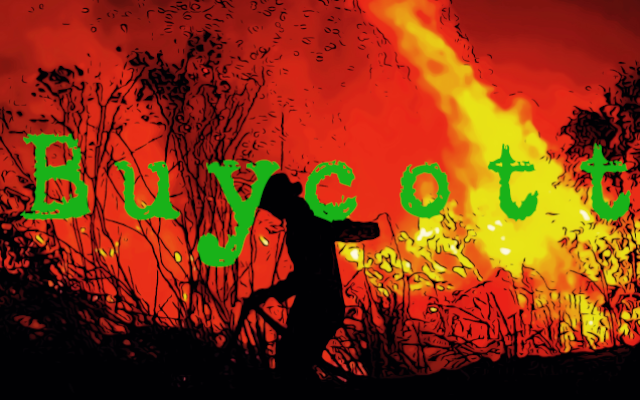
Burning down the house
. Greenpeace’s report, released on 8.11.19, updates us on the continuing pace of burning and deforestation in Indonesia. As always, to produce palm oil. Even that certified as ‘sustainable’ by RSPO, the screen used by palmocrats for greenwashing. #Buycott!
Indonesia. RSPO-branded fires, 2015-2019
The international spotlight last summer lingered and perhaps melted on the Amazon fires. However, the fire season continued at the other end of the world, in Indonesia. The once beautiful archipelago has been devoured by flames over the past two decades. So much has gone into consolidating the global lead in palm oil production, and achieving that in greenhouse gas emissions.
9,960 fires were recorded in October 2019 alone. 7,427 of these, or 75 percent, is attributed to companies and groups associated with RSPO(Roundtable for Sustainable Palm Oil). The same groups are blamed for 149,663 of the 204,514 fires recorded between 2015 and 2018. That is, 73% of the fires. (1) Some of these companies have been convicted by Indonesian courts or sanctioned by the government. And in many cases they have not even paid the compensation required to restore the burned areas.
Palm oil and wildfires, the responsibilities of Big Food
The 30 palm oil producers most implicated in the 10,000 October 2019 fires always supply at least one of several Big Food giants. Nestlé, Mondelēz, Unilever, Ferrero, Procter & Gamble (P&G). That is, the big traders Wilmar, GAR, Cargill, Musim Mas. 13 of the 30 palmocrats involved in the pyres even serve at least 8 of the giants mentioned. Who, moreover, continue to parade themselves behind RSPO’s pierced umbrella.
The serious responsibilities of the above-mentioned big brands are obvious to all who wish to overcome the thick blanket of smoke and greenwashing generated by them. Virgin forests constitute enormous carbon resources, and their burning causes greenhouse gas emissions that continue for 7-8 decades. In addition to asphyxiating populations, causing epidemics of respiratory diseases in the most at-risk categories (YOPI, Young, Old, Pregnant, Infant).
Biodiversity-which also distinguished these corners of paradise (not surprisingly contested for centuries among the various colonial powers) has in turn gone to hell. Along with hundreds of thousands of orangutans and the few specimens of those species already on the verge of extinction, such as tigers and small Sumatran elephants. In New Guinea alone-which in the western area belongs to Indonesia-20,000 plant species, 700 tree species and 2,000 birds are surveyed.
Palm oil and wildfires, Big Food‘s reactions
Crimes and disasters are not worth the effort to dent the POP(Profit Over People) ethos of the giants. Who do not even think of reducing their grip on primary forests and their inhabitants, unable to resist profit maximization. How to give up the cheapest and cheapest of oils to fatten the livers of the planet’s children with junk food?
Business as usual
. It is careful, Big Food, not to give up a few tenths of a point of profit to replace palm with fats of less impact on ‘people & planet‘. Rather, when the outcry over disasters reaches the level of ‘potential disruption’ to the group’s reputation, sourcing from a supplier is ‘suspended’. Thus P&G and Unilever vis-à-vis Austindo Nusantara Jaya (ANJ), Musim Mas and P&G vis-à-vis Salim. Cargill, Musim Mas and Unilever against Sungai Budi/Tunas Baru Lampung. (2)
Big Palm, Big Food, Big Fire. The podium of shame
Cargill is the trader that stands out for the greatest involvement in environmental disasters in recent years. In fact, the Greenpeace report credits Cargill’s supply chain interests with 88.3 percent of October 2019 fires (8,800 out of 9,960) and the largest areas burned between 2015 and 2018 (161,300 hectares). As well as the largest number of ties (19) with government-sanctioned or prosecuted producer groups and concession holders (17) blocked in 2019.
In contrast, Wilmar-the global industry leader, also made famous by Amnesty International in its 2016 report on slavery and child exploitation-supplies from producers responsible for burning more than 140,000 hectares, during 2015-2018, with 8,000 fires in 2019.
Nestlé, on the other hand, ranks first among food industry groups considered by Greenpeace in the Burning down the house report. Which again ‘curiously’ omits to consider Ferrero’s implications in Southeast Asia’s palm oil supply chains. Nestlé’s suppliers are implicated in 190,500 fires over the three-year period under review, 9,700 in the first 9 months of 2019.
Unilever in turn sources from producers responsible for nearly 180,000 hectares of forests burned between 2015 and 2018, 8,900 in the first 9 months of 2019 alone. Its suppliers include 8 plantation companies with court actions or penalties against them and 20 companies whose operations were halted as a result of 2019 fire investigations.
Repetita iuvant?
3.4 million hectares of land in Indonesia were burned at least once between 2015 and 2018. However, fires are also repeated-repeatita iuvant, even to devastators-to finish the devastation and optimize palm monocultures. The total extent of burned areas thus goes to increase by 10 percent, so as to exceed 3.7 million hectares in that same period. (4) To get an idea, this is an area equivalent to those of:
– Liguria + Piedmont + Aosta Valley,
– Lombardy + Trentino Alto Adige,
– twice as much as Veneto, slightly more than twice as much as Lazio,
– Tuscany + Umbria + Molise,
– Campania + Calabria + Abruzzo.
This data comes from fire mapping done by the Indonesian government and analyzed by Greenpeace. Mapping of fires in 2019 is not yet available. And it is not certain that it will be in the future, following the recent curtain raises and threats by the governments of Indonesia and Malaysia to European institutions.
RSPO, the punctured umbrella of palmocrats. #Buycott!
All food industry groups and business operators considered in the Burning down the house report are members of RSPO, some even sit on its board of directors. Three-quarters of the fires in Indonesia in 2019 are attributable to producer groups with RSPO-certified concessions.
The palmocrat coven’s lies have already been exposed by the Zoological Society of London, in 2017. And an international scientific study-published in 2018 in ‘Science of the Total Environment‘-has shown how RSPO-certified palm monocultures are manifestly unsustainable.
Buycott! Is the only real solution. Permanently stop the demand for palm, in foods as well as in biodiesel, which together absorb almost all the supply. Not to mention cosmetics and household products, where incendiary oil is also sometimes used.
The petition, which we urge everyone to sign and spread, can be found at https://www.egalite.org/buycott-petizione/.
Dario Dongo and Giulia Caddeo
Notes
(1) Cf. Greenpeace (2019). Burning down the house. Table 9
(2) See report cited in footnote 1, Table 1
(3) Idem c.s., Table 2
(4) Ibid, Table 4

Dario Dongo, lawyer and journalist, PhD in international food law, founder of WIISE (FARE - GIFT - Food Times) and Égalité.

Graduated in law, master in Food, Law & Finance. You have explored the theme of green procurement and urban food policies in the International Cooperation and Peace sector of the City of Turin.


