

Second class baby food, with plenty of added sugar, in low-income countries, and sugar-free in Switzerland where Nestlé is based. This was denounced by Public Eye and the International Baby Food Action Network (IBFAN), which analysed 150 baby foods. (1)
Baby food, Nestlé’s dirty business
Nestlé controls 20% of the baby food market, valued at almost $70 billion. And it has been known for at least half a century for its unscrupulous policies, in the name of profit and to the detriment of children:
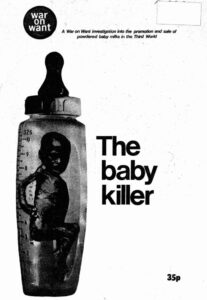
– in 1974 the report ‘The Baby Killer’ revealed Nestlé’s dirty business of promoting artificial milk to replace breast milk in developing countries, causing myriad illnesses and infant deaths. (2) And the boycott campaign was not enough to hinder its continuation.
– in 2024, half a century later, it is discovered that the multinational is marketing a baby food with added sugar in developing countries. In open contrast to health policies aimed at excluding the habit of sweet tastes in the first years of life, to prevent childhood obesity. (3)
Cerelac and Nido, Nestlé’s double standard
The two products examined, including by laboratory analysis, by Public Eye and IBFAN are Nestlé’s Cerelac cereal and Nido milk powder. Brands with global sales of more than USD 2.5 billion in 2022.
Cerelac and Nido branded products purchased in low-income countries almost always contain added sugar. In contrast, the same products are marketed as ‘sugar free’, with claims, in Switzerland and Nestlé’s main European markets.
Cerelac biscuit and sugar flavour
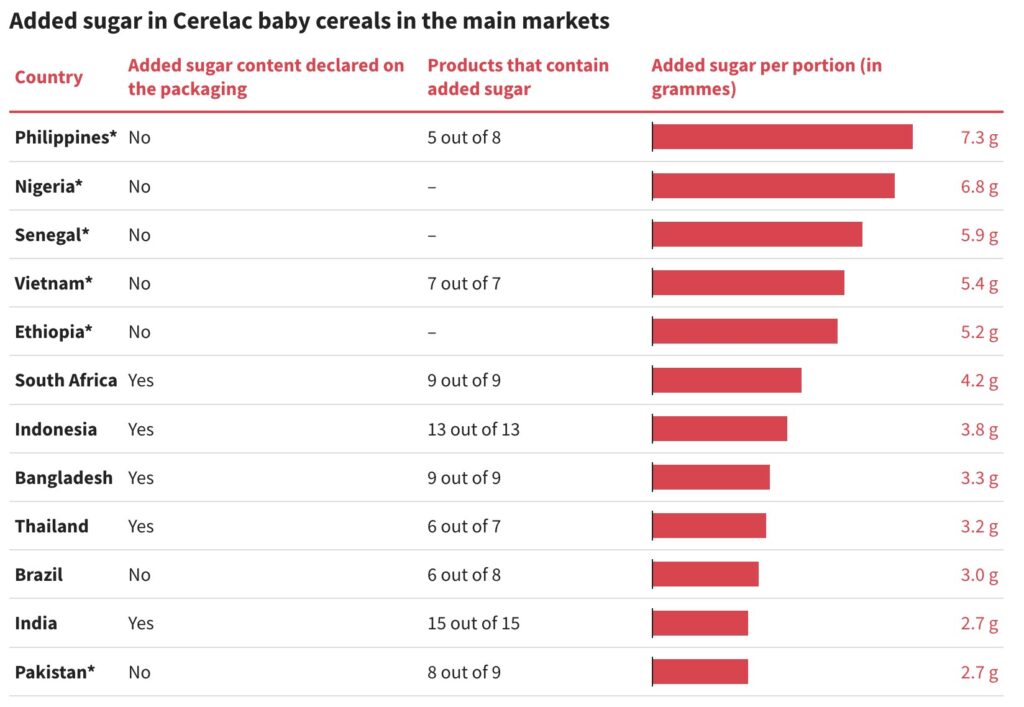
Cerelac is the world’s number one children’s cereal brand, with sales in excess of US$ 1 billion (Euromonitor, data 2022). An examination of 115 products sold in Nestlé’s main markets in Africa, Asia and Latin America shows that as many as 108 of them (94%) contain added sugar.
The average serving size – for children from 6 months of age – is almost 4 grams per serving, equivalent to about one sugar cube.
The highest amount (7.3 g per serving) was found in a product sold in the Philippines.
Nest milk powder, up to 5 grams of sugar per serving
72% (21 out of 29) of the Nest milk powders for children aged one to three years tested contained an average of almost two grams of sugar per serving.
The highest value (5.3 grams) was found in a product sold in Panama.
According to Euromonitor, global sales of Nido products for one- to three-year-olds exceeded USD 1 billion in 2022.
The harms of sugar, EFSA opinion
Sugar consumption should be minimised because it negatively affects health: tooth decay and chronic metabolic diseases.
The recommendation was reiterated by EFSA’s Panel on Nutrition, Novel Foods and Food Allergens (NDA) in its scientific opinion published on 28.2.22. (4)
Marta Strinati
Notes
(1) Sugar: for Nestlé, not all babies are equal. Press Release. Public Eye. 17.4.24 https://www.publiceye.ch/en/media-corner/press-releases/detail/sugar-for-nestle-not-all-babies-are-equal
(2) Mike Müller. The Baby Killer. War On Want. 1974 https://waronwant.org/sites/default/files/THE%20BABY%20KILLER%201974.pdf
(3) Sabrina Bergamini. The ‘pandemic’ of obesity affects one in eight. Égalité. 23.3.24
(4) Marta Strinati. The harmful role of sugars in the diet, EFSA opinion. Food Times. 1.3.22

Professional journalist since January 1995, he has worked for newspapers (Il Messaggero, Paese Sera, La Stampa) and periodicals (NumeroUno, Il Salvagente). She is the author of journalistic surveys on food, she has published the book "Reading labels to know what we eat".