


A question from the Strasbourg Parliament could open the big Pandora’s box, in relation to the controls that the European Commission should carry out to ensure transparency and ‘balanced representation of different interests‘, in the management of the Common Agricultural Policy (CAP), by member states.
The issue had been raised by the European Ombudsman, Irish national Emily O’Reilly, on 10.2.22. The European Commission, meanwhile, has intimated to Italy and France the substantial revision of the NSP (National Strategic Plan) for the implementation of the Common Agricultural Policy in the two leading agricultural countries in the EU (1,2).
CAP, issues of transparency and balance in the distribution of funding
Swedish MEP Peter Lundgren (ECR political group, European Conservatives and Reformists), in his question 2.3.22 to the European Commission, recalled the issues raised by the European Ombudsman:
– ‘How does the Commission ensure transparency and a balanced representation of different interest groups when it comes to the CAP?’
– ‘Will the Commission check whether the information that member states have on beneficiaries of CAP funding is correct?’
– ‘What transparency measures will be taken regarding the Commission’s discussions with member states on how they intend to achieve the goals set out in the CAP, including those of the European Green Deal?’
– ‘How does the Commission verify that CAP funds are being used properly?’ (3)
European Commission, commitments
The European Commission, as a matter of course, replied that it ‘will respond to the European Ombudsman in duecourse.’ Meanwhile, in its response to the question from the Honorable Peter Lundgren, the Brussels executive stated the following.
‘The Commission is committed to working in a transparent manner and strives to actively involve stakeholders in all policy areas, including the CAP. Stakeholder consultation under the Better Regulation Agenda and the transparency portal and registry are key tools for this effort.’ (4)
The Civil Dialogue Groups
The ‘balanced representation of the many stakeholders interested in agriculture‘ within the CAP, according to the European Commission, would be ensured by Civil Dialogue Groups (CDGs).
Organizations participating in the CDG were selected in 2014 for seven years. Their mandate was extended to the end of 2022, in line with the extension of the current CAP regulations (5,6).
‘Agendas, minutes, documents and presentations used in CDG meetings are made available to ensure transparency. A new commission decision is being prepared and will be followed by a new notice in 2022.’ (4)
Management and control of the CAP by member states.
‘In order to manage the CAP properly,’ the European Commission continues, in its response to the Europarliament, ‘member states must set up appropriate management and control systems, in particular the integrated administration and control system for the management of area and animal schemes.
Next, the Commission verifies that the funds are properly spent by conducting systems audits in the member states. This protects EU funds from irregular payments by returning unduly spent amounts to the EU budget due to deficiencies detected in their management and control systems. In addition, by revealing deficiencies to be remedied, audits have a corrective and preventive role.‘ (4)
Democracy in agriculture, the great farce
From words to deeds, democracy in agriculture today is a colossal farce. A few large agricultural confederations represent-in purely theoretical terms, as shown by Coldiretti’s (7) skewed membership numbers-millions of small farmers who are instead completely unaware of what is being decided over their heads.
Global agrochemical industry monopolists(Big 4) continue to dominate agricultural policy. On a European level-as is evident in the case of Copa-Cogeca (8)-and even more so on a national scale, where conflicts of interest are systemic.
This explains the inattention to pesticide and fertilizer reduction programs in the recent CAP (non-)reform.
Italian paradox
The PNRR already rejected by the European Commission (1) well expresses the Italian paradox, where resources earmarked for so-called sustainable agriculture have been diverted in favor of producers of photovoltaic solar panels, as well as vehicles and other amenities for logistics and the fateful agriculture 4.0. (9)
Italian farmers and ranchers, moreover-after investing in the ‘agrisolar park’ instead of soils, agroecology, and conversion to organic farming-will not even be able to put unused energy into the market. Unlike in neighboring France, where at least farmers will be able to support themselves even in this way. (10)
Dario Dongo
Cover design by Red Dessinateur
Notes
(1) Dario Dongo. CAP, European Commission rejects Italy’s National Strategic Plan. #CleanSpades. FT (Food Times). 4/14/22, https://www.greatitalianfoodtrade.it/mercati/pac-la-commissione-europea-boccia-il-piano-strategico-nazionale-dell-italia-vanghepulite
(2) Politique agricole commune: pour la Commission européenne le plan stratégique français n’est pas à la hauteur des enjeux environnementaux! Generations futures. 7.4.22, https://www.generations-futures.fr/actualites/pac-psn-commission/
(3) European Parliament Question E-000856/2022 to the Commission, signed by Hon. Peter Lundgren (ECR, Sweden). 2.3.22, https://www.europarl.europa.eu/doceo/document/E-9-2022-000856_EN.html
(4) Answer by Commissioner Janusz Wojciechowsk, on behalf of the European Commission, to Question E-000856/2022. 4/19/22, https://www.europarl.europa.eu/doceo/document/E-9-2022-000856-ASW_EN.html
(5) Commission Decision 2013/767/EU, establishing a framework for civil dialogue in the field of the common agricultural policy. Consolidated text as of 7/14/21 on Europa-Lex, https://bit.ly/3LmvFr5
(6) Lists of organizations participating in Civil Dialogue Groups (CDGs) related to CAP (or CAP, Common Agriculture Policy) and related matters can be found at https://ec.europa.eu/info/sites/default/files/food-farming-fisheries/key_policies/documents/cdg-decision-composition-annex_en.pdf
(7) Dario Dongo. Coldiretti, many members and some doubts. #CleanSpades. FT (Food Times). 4/15/21, https://www.greatitalianfoodtrade.it/idee/coldiretti-tanti-soci-e-alcuni-dubbi-vanghepulite
(8) Dario Dongo, Marta Strinati. Post-2020 CAP, environment and health at risk. Appeal to the EU Parliament. FT (Food Times). 10/16/20, https://www.greatitalianfoodtrade.it/consum-attori/pac-post-2020-ambiente-e-salute-a-rischio-appello-al-parlamento-ue
(9) Dario Dongo. National pesticide action plan, sustainable agriculture and NRP. #CleanSpades. FT (Food Times). 4.2.22, https://www.greatitalianfoodtrade.it/sicurezza/piano-di-azione-nazionale-pesticidi-agricoltura-sostenibile-e-pnrr-vanghepulite
(10) V. Investissement photovoltaïque agricole, comment le rentabiliser simplement? Colibri solar. 25.6.21, https://bit.ly/3kg3nm0
Dario Dongo, lawyer and journalist, PhD in international food law, founder of WIISE (FARE - GIFT - Food Times) and Égalité.


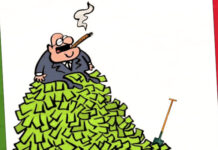

, by member states.)