

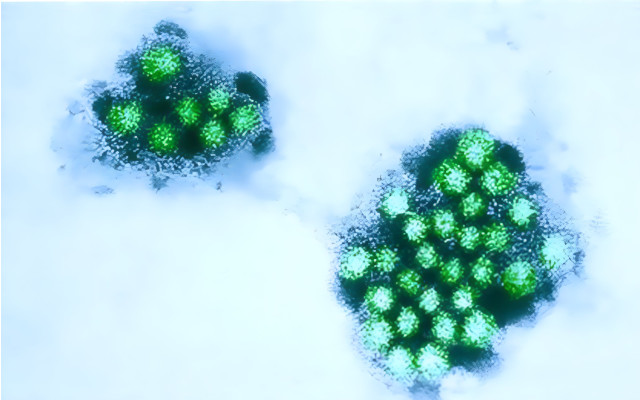
Seafood consumption is more common in summer. A danger, though not particularly serious, may be lurking, however. These are small viruses that can hide in the digestive system of bivalve mollusks (mussels, clams, oysters and many others), called Noroviruses.
Norovirus
Noroviruses belong to the family Caliciviridae, in which there are numerous viral groups infecting animals and humans. They are single-stranded RNA viruses, small in size (27-30 nanometers in diameter), lacking a glycolipid coating (the so-called “envelope“) and icosahedral in shape. The first to be discovered was called “Norwalk virus,” responsible for a large outbreak of gastroenteritis in Norwalk, Ohio, in 1968.
They are divided into seven genetic groups, of which the first, second and fourth (GI, GII and GIV) are capable of infecting humans. The other genogroups of Noroviruses infect dogs, cats, cattle, pigs, sheep, and mice, some exclusively (GIII, GV, GVI, and GVII), others in admixture with humans (GII and GIV).
Symptoms
Once ingested with food (or non-potable water), after about 48 hours Noroviruses cause intestinal symptoms characterized by nausea, vomiting and diarrhea, sometimes accompanied by fever and headache. The symptoms are short-lived and usually not particularly severe.
Only in high-risk individuals, such as very young children or very old and debilitated people, can the consequences be severe and even lead to death from dehydration.
Among the genogroups that can infect humans, symptoms of particular severity are associated with Norovirus GII, genotype 4.
Seafood and unwashed vegetables
Noroviruses are excreted fecally by infected humans and animals, and by this route contamination of various foods is possible, including unwashed vegetables and undrinkable water, as well as bivalve molluscs. Among the latter, the greatest danger of transmission to humans is from bivalves that are often eaten raw, such as mussels(Mytilus galloprovincialis) and oysters(Crassostrea edulis and Crassostrea gigas).
Bivalve mollusks, by their nature, filter the water in which they live to draw oxygen and nourishment from it, but in doing so they can retain viral particles, bacteria, heavy metals or other chemical pollutants in their internal organs.
How to Inactivate Noroviruses
Heat is the only means of inactivating the Noroviruses, protected as they are inside the hepatopancreas and therefore able to survive rapid pan cooking (a few dozen seconds, and exactly those needed for the valves to “open”).
The heat treatment, to be effective, should reach 80° C and should last no less than two minutes. These precautions would prevent many infections.
The role of labels
Another important caution concerns the purchase of “safe shellfish,” that is, packaged and labeled, carefully avoiding shellfish sold in bulk.
In fact, the packaging and labeling of bivalves is a guarantee of control, as it assumes that
- upstream a survey was made of the microbiological characteristics of the waters in which the shellfish grow and
- if necessary, shellfish have been purified in appropriate establishments or clean water.
EU Regulation no. 2019/627 stipulates, in fact, that official controls be carried out on the production and relaying areas of bivalve molluscs, distinguished into class A, B and C areas according to the increasing content of
Escherichia coli
contained in the shellfish growing there.
Only shellfish from class A waters can be intended for direct marketing, while in other cases a short period is required (class B) or long (class C) of purification.
The resistance of viruses
The effectiveness of purification, however, is less safe for viruses than for bacteria such as
Salmonella
and Escherichia coli, for example, which have the same fecal origin as Noroviruses.
In any case, the consumption of bivalve molluscs whose origin is unknown and on which the identification mark of the dispatch center and/or purification center is not affixed on the label with which they are provided should be avoided.
Only in this way can the consumer be assured that one or more manufacturers have taken responsibility for putting products on the market that are not harmful to human health.
Silvia Bonardi
Bibliography
Robilotti E, Deresinski S, Pinsky BA. 2015. Norovirus. Clin Microbiol Rev 28:134 -164. doi:10.1128/CMR.00075-14.
Commission Implementing Regulation (EU) 2019/627 of 15 March 2019 Establishing uniform practical arrangements for performing official controls on products of animal origin intended for human consumption in accordance with Regulation (EU) 2017/625 of the European Parliament and of the Council and amending Regulation (EC) No. 2074/2005 of the Commission regarding official controls. Official Journal of the European Union, 17.05.2019, no. L 131.
Regulation (EC) No. 853/2004 of the European Parliament and of the Council of April 29, 2004laying down specific hygiene rules for food of animal origin Doc. Official Journal of the European Union 30. 04.2004, n. L 139.

Graduated in Veterinary Medicine and Specialist in Inspection of Food of Animal Origin and in Veterinary Public Health, she is Professor of Inspection and Control of Food of Animal Origin at the University of Parma.



)