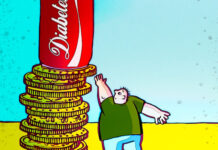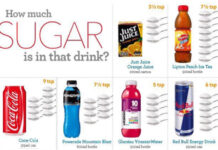


Nature Medicine updates the largest study ever conducted (Lara-Castor et al., 2025) on the correlations between the consumption of sugary drinks, type 2 diabetes and cardiovascular diseases. (1)
The analysis is based on data from the Global Dietary Database, stratified jointly by age, sex, education level and urbanization in 1990 and 2020 globally.
‘In 2020, 2,2 million new cases of type 2 diabetes and 1,2 million new cases of cardiovascular disease worldwide were attributable to sugar-sweetened beverages.’ Here’s why.
1) Sugar-sweetened beverages, SSB, concept
The research under examination defines ‘sugar-sweetened beverages’ (SSB) as:
– ‘all beverages with added sugars and ≥50 kcal per 8 oz [=237 ml] serving, including commercial or homemade beverages, soft drinks, energy drinks, fruit drinks, punch, lemonade and ‘aguas frescas’
– with the exception of the ‘100% fruit and vegetable juices, artificially sweetened non-caloric drinks, sweetened milk’ and alcoholic beverages (2,3).
2) Sugary drinks, obesity and disease
‘Sugary drinks (sugar-sweetened beverages SSB) contribute to excessive weight gain and cardiometabolic diseases such as type 2 diabetes (T2D) and cardiovascular disease (CVD), both directly and through weight gain’.
Obesity and overweight of children and adolescents have already been associated with the consumption of sugary drinks in a recent study conducted in 107 countries around the world (Hu et al., 2023), as seen. (4)
The previous study of the Global Burden of Diseases Nutrition and Chronic Diseases Expert Group (NutriCoDE) had in turn attributed the consumption of sugary drinks as the cause of 184,000 deaths, in 2010, at a global level. (5) The research in question deepens and updates the scenario.
3) Type 2 diabetes and cardiovascular disease. The study in 184 countries
A systematic review under examination (Lara-Castor et al., 2025) contributes to quantifying cardio-metabolic risks attributable to SSBs, identifying population subgroups at greatest risk and trends, to more accurately inform national strategies.
The analysis therefore disaggregates the results at national and subnational level according to:
– key demographic factors (e.g. age, gender, education level and urbanization)
– direct causal effects of SSBs, adjusted for age, on T2D, coronary ischemia and ischemic stroke (adjusted for BMI, Body Mass Index)
– impact of weight gain on T2D, coronary ischemia and ischemic stroke
– distribution of the overweight (BMI ≥ 25) and underweight (BMI < 18,5 kg) population
– incidence of type 2 diabetes, coronary ischemia and ischemic stroke, estimates of DALYs (Disability-adjusted life years) and mortality.
3.1) Methods
GDD consortium members (Global Dietary Database) first collected dietary intake surveys conducted between 1980 and 2018, including in LMIC (Low and Middle Income Countries) from publicly available sources. Following:
– in cases where representative surveys were not available, other national surveys were considered, followed by regional, urban or rural surveys. Or again
– large local cohorts, provided that selection and measurement biases did not lead to obvious limitations (e.g. studies focused on population groups selected for a specific disease or profession or diet);
– in countries with no identified surveys, other potential data sources were then considered, including the WHO Infobase, the STEP database and household budget survey data.
1,224 eligible data years from public and private sources were identified and selected (from a total of 1,634), checked, standardized and included in the GDD model. Among these, those relating to 450 surveys that provided estimates of SSB intake.
3.2) Population groups most affected
Globally, the impact of T2D and CVD associated with sugar-sweetened beverages is higher among:
– men, compared to women
– the younger ones, compared to the older ones
– people with a higher level of education, compared to lower ones, and
– residents of urban areas, compared to rural ones.
These data suggest that neither general education nor sugar tax are sufficient to mitigate consumption and the negative impacts on the health of the most educated citizens, without introducing rigorous limits on marketing of these drinks and other junk-food. (6)
3.3) Most affected macro-regions
Latin America and Sub-Saharan Africa are the macro-regions most affected by high consumption of sugary drinks which correspond to a greater cardiometabolic load:
– Latin America and Caribbean (T2D, 24,4%; CVD, 11,3%)
– Sub-Saharan Africa (T2D, 21,5%; CVD, 10,5%).
From the 1990 to the 2020, the largest proportional increases in T2D and CVD cases attributable to SSB occurred in sub-Saharan Africa (+8,8% and +4,4%, respectively). South Asia and Southeast Asia, on the other hand, recorded the lowest cardiometabolic loads attributable to SSB, consistent with much lower consumption.
‘As SSB intake has plateaued or begun to decline in high-income nations, the beverage industry has turned to emerging markets where populations are highly susceptible to the marketing appeal of ambitious “Western” lifestyles’.
3.4) Results
The overall impact of sugar-sweetened beverages on cardio-metabolic diseases is estimated as follows, in 2020, in 184 countries:
– type 2 diabetes. 2,2 million new cases (9,8% of total); 5 million disability-adjusted life years (DALYs); 80,278 deaths
– cardiovascular diseases. 1,2 million cases (3,1%); 7,6 million disability-adjusted life years; 257,962 deaths.
4) Provisional conclusions
The Atlas of Diabetes of the International Diabetes Federation (IDF, 2021) reports that 10,5% of the adult population (20-79 years) has diabetes, and nearly half are unaware of their condition. By 2045, IDF projections indicate that 1 in 8 adults, approximately 783 million people, will have diabetes, an increase of 46%. (7)
Cardiovascular diseases (heart attacks, strokes, heart failure, etc.) are the leading cause of death on the planet, killing 20,5 million people every year, equal to approximately 38% of all deaths from NCDs (Non-Communicable Diseases). (8) In Europe alone, deaths from CVDs are 1,7 million/year, with 60 million sufferers and € 282 billion/year in healthcare costs.
Time has come that policy makers, in the Old Continent as elsewhere, adopt as soon as possible suitable measures to reduce the consumption of sugary drinks and thus stimulate the reformulation of drinks. Fiscal policies, restrictions on marketing and sales, and above all synthetic nutritional labels such as Nutri-Score. (9)
Dario Dongo
Footnotes
(1) Lara-Castor, L., O’Hearn, M., Cudhea, F. et al. & Global Dietary Database. Burdens of type 2 diabetes and cardiovascular disease attributable to sugar-sweetened beverages in 184 countries. Nat Med (2025). https://doi.org/10.1038/s41591-024-03345-4
(2) Artificial sweeteners, while having no impact on type 2 diabetes, do pose serious health risks of their own. See previous articles by
– Marta Strinati. Artificial sweeteners increase cardiovascular risk. FT (Food Times). 7.2.23
– Dario Dongo, Camilla Fincardi. Intensive sweeteners, microbiome and health risks. Scientific study. FT (Food Times). 1.3.20
(3) Sugary milk-based drinks, although excluded from the research in question, have simple sugar contents similar to those of SSBs. See the previous article by Marta Strinati. Frùttolo and other milk snacks, 10 products compared. FT (Food Times). 25.9.21
(4) Marta Strinati. Soft drinks and obesity in adolescents, the study in 107 countries. FT (Food Times). 31.7.23
(5) Singh GM, Micha R, Khatibzadeh S, Lim S, Ezzati M, Mozaffarian D; Global Burden of Diseases Nutrition and Chronic Diseases Expert Group (NutriCoDE). Estimated Global, Regional, and National Disease Burdens Related to Sugar-Sweetened Beverage Consumption in 2010. Circulation. 2015 Aug 25;132(8):639-66. doi:10.1161 CIRCULATIONAHA.114.010636
(6) Dario Dongo, Andrea Adelmo Della Penna. ‘Audiovisual Media Services Directive’ and protection of minors from junk food marketing. FT (Food Times). November 25, 2023
(7) IDF, International Diabetes Federation. Facts and figures https://tinyurl.com/mr2vjsw7
(8) World Heart Report 2024. World Heart Federation https://tinyurl.com/3yrjn83p
(9) Dario Dongo. Public health, Nutri-Score and fiscal measures compared. FT (Food Times). December 27, 2024

Dario Dongo, lawyer and journalist, PhD in international food law, founder of WIISE (FARE - GIFT - Food Times) and Égalité.