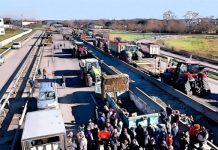


Four months of protest were not enough to get a brake on free trade agreements which cause unfair competition to the detriment of European farmers, through the importation of low-cost goods in conditions of dumping social, environmental and safety.
ECVC – the European Coordination Via Campesina, the only true representation of small and medium-sized agricultural companies – deplores the hypocrisy of a commercial policy that continues to benefit the agro-industrial and financial oligarchies, to the detriment of those who work the land. (1)
Via Campesina, #fairprice NO unfair competition
‘The Commissioner for Agriculture, Janusz Wojciechowski, and the agriculture ministers of the Agriculture and Fisheries Council seem to have quickly forgotten the demands and problems of farmers.
At the last AGRIFISH meeting (29-30 April 2024), the representatives continued to push for an export-oriented free trade policy, which for ECVC is incompatible with the main demand of the farmers‘ protests:
– ‘ensure fair prices that cover production costs through market regulation‘. (2)
The voice of farmers remains unheard
‘Despite the reassurances that farmers’ concerns are being taken into account, AGRIFISH board members fail to recognize that it is large agricultural businesses that profit from free trade agreements and the inclusion of agriculture in the WTO.
The real impacts of free trade for most farmers are misrepresented in this context, as politicians bend to the will of the agribusiness lobbies.
For farmers on the ground, free trade agreements and WTO rules serve only to reduce prices as much as possible, without regard to the costs to the well-being and health of farmers and citizens, nor to the impact on climate and biodiversity‘. (3)
Free trade agreements do not benefit farmers
‘Janusz Wojciechowski, for example, made extensive reference to the JRC (Joint Research Center, European Commission) study on the cumulative economic impact of trade to underline the importance of trade and support the assertion that ‘some agricultural sectors can benefit from the EU trade agenda.
The commissioner however, he did not recognize the purely economic approach of the study, which does not take into account the social and environmental aspects. There is a lack of focus on the groups most affected by these free trade agreements – farmers and agricultural workers – and the specific impact on farmers has not been studied in depth and is not present in the results.
It was not mentioned that, according to the report, the prices of goods included in free trade agreements are negatively affected and EU data shows that current agricultural policies based on the WTO agreement and free trade agreements have led to loss of jobs in the agricultural sector’.
Below-cost sales and pollution
‘The few concrete measures which have been introduced or proposed to address the root causes of farmers’ concerns (such as the price and cost observatory and the discussion on a potential revision of the Farming Directive unfair trading practices) cannot be successfully implemented within this free trade paradigm.
The position of farmers will not improve if EU policy continues to force them to produce at the lowest possible price to compete in global markets. (4)
Furthermore, in the face of the current climate and biodiversity crisis, it is absurd and inconsistent to see the EU institutions insisting that shipping food which could be produced locally from one side of the planet to the other is still a viable solution. This approach forces farmers to compete with each other and to enhance production as much as possible, in the most economical way possible, rather than aiming to reduce the environmental impact of the agricultural sector and to move towards agro-ecological models that are sustainable and respect our limited natural resources’. (5)
EU, hunger for raw materials ‘whatever it takes’
‘The Critical Raw Materials Act (CRMA) recently approved and the statements of decision makers related to the negotiations for the EU-Mercosur agreement show that in reality, instead of rethinking its consumption model, the EU is hungry for raw materials and is willing to do anything to obtain them: farmers, agricultural workers and local populations who defend their territories from environmental disasters linked to extractivism in Europe and elsewhere are simply second-class citizens whose rights do not matter’. (6)
European Coordination Via Campesina, stop unconditional free trade agreements
‘Via Campesina calls on civil society in Europe to join the broader movement against the current free trade paradigm. It is time to fundamentally reform agricultural trade to respect international law, including the United Nations Declaration on the Rights of Peasants and Other People Working in Rural Areas (UNDROP), climate objectives and the Convention on Biological Diversity, as well as international law on fundamental human rights.
The WTO agreement (World Trade Organization) and all free trade agreements including agriculture, signed or under negotiation in the EU, are in clear contradiction with these international instruments. The so-called mirror clause debate in food and agriculture trade is just an attempt to green the current unsustainable trade paradigm, while doing nothing.
European Coordination Via Campesina (ECVC) condemns the EU’s role in the WTO negotiations on food and agriculture and the inability of AGRIFISH ministers to understand the real reasons behind the protests. The AGRIFISH Council has the responsibility to implement measures to address the root causes of these problems, through the regulation of agricultural markets in order to facilitate the agroecological transition in EU food sectors, ensuring generational renewal and promoting a peace economy’.
Changing agri-food policies in the European Union
Changing policies of the agri-food sector in the European Union is possible and requires a great collective effort from farmers and citizens. We need to converge towards authentic representations of collective interests – such as ECVC for farmers and FoodWatch for consumers – and overcome reluctance towards the ballot box.
Dario Dongo, candidate in the North-East Constituency for the Peace, Land and Dignity movement in the European elections to be held in Italy on Saturday 8 and Sunday 9 June 2024, aspires to bring to the European Parliament these battles that he has been waging for years in the various editorial, political and judicial. (7)
#PaceTerraDignità
Dario Dongo and Alessandra Mei
Footnotes
(1) ECVC. ECVC rejects free trade narrative of AGRIFISH council and demands market regulation and an end to FTAs to address root causes of farmers’ issues. 2.5.24 https://www.eurovia.org/press-releases/ecvc-rejects-free-trade-narrative-of-agrifish-council-and-demands-market-regulation-and-an-end-to-ftas-to-address-root-causes-of-farmers-issues/
(2) Dario Dongo. Via Campesina, farmers’ priorities in the European elections. FT (Food Times). 24.4.24
(3) Dario Dongo. Green light for EU agreements with Chile and Kenya. FT (Food Times). 28.2.24
(4) Dario Dongo. Sales below costs, farmers protest in France. FT (Food Times).
(5) Dario Dongo. The tentacles of finance on food sovereignty and our food. FT (Food Times). 31.3.24
(6) Dario Dongo. Brazil, pesticide massacres are added to deforestation. Unsustainable EU-Mercosur agreement. FT (Food Times). 21.4.21
(7) Dario Dongo. Peace, Land and Dignity. Our movement in the 2024 European elections. FT (Food Times). 14.3.24

Dario Dongo, lawyer and journalist, PhD in international food law, founder of WIISE (FARE - GIFT - Food Times) and Égalité.

Graduated in Law from the University of Bologna, she attended the Master in Food Law at the same University. You participate in the WIISE srl benefit team by dedicating yourself to European and international research and innovation projects.