

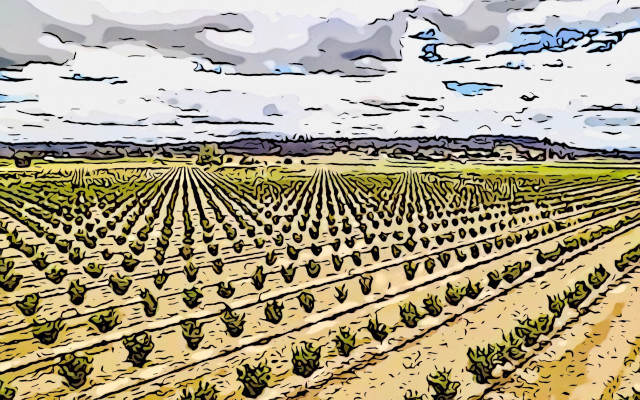
Ferrero’s recent marketing operation – Nutella’s ‘I Love You Italy,’ Special Edition (1) – was not appreciated by the Via Amerina and Forre Bio-district. Which denounces the environmental and health impacts of intensive hazelnut monocultures with extensive use of pesticides.
On the environmental impact of Italian hazelnut groves, meanwhile, the European Commission has initiated infringement proceedings against Italy over pollution caused by intensive farming at Lake Vico (also in Viterbo, Lazio). Conversion to organic is the only possible solution.
The invasion of hazelnut groves
The image of Civita di Bagnoregio, a small village in Lazio that represents the fragility of the balance between nature and the work of man, is exploited by Ferrero on some jars of Nutella. The reason is quickly stated. But the protagonists of peasant agriculture-committed for decades to safeguarding the environment, health and biodiversity-are fighting back. Ferrero has incited intensive hazelnut monoculture in entire areas of Tuscia without doing anything, in protocols and concrete action, to prevent agrotoxin poisoning of soil, water and air.
A similar scenario has now also disrupted the landscapes of the province of Orvieto.
‘It looks like a cemetery. And if it looks like a cemetery, we have to hold a funeral. But let it be a funeral full of life!‘ (Alice Rohrwacher, director)
‘Peasant Homily’ is the short film by Alice Rohrwacher and French artist JR, which premiered at the 77th Venice International Film Festival on 7.9.20. It is ‘a cinematic action‘ to support the struggle of small farmers and citizens of the Alfina Plateau–a border area between Lazio, Umbria and Tuscany–where the director herself, the daughter of a local beekeeper, comes from. So that people know how hazelnut monoculture, as far as the eye can see, is devastating and poisoning an area of high biodiversity. And not only that.
Hazelnut Brahma
Italy is the second largest producer of hazelnuts in the world, with 12 percent of global production, after Turkey. But child exploitation on Turkish plantations is bound to provoke a reaction from consumAtors and stakeholders sooner or later, hopefully at least.
Ferrero, the world’s leading user of hazelnuts, therefore needs access to alternative supplies. Not only in the former Yugoslavia, where it has also long invested, but also in Italy. Ferrero Hazelnut Company thus launched the ‘Hazelnut Italy Project’ in 2018. Looking mainly at Latium (where there is already a vocated area) and Umbria, but also at Lombardy, Basilicata and other Italian regions. The Alba-based giant’s goal is to reach 20,000 hectares of Italian hazelnut groves by 2025, committing to purchasing 75 percent of the production.
Environmental issues
The hazelnut is a typical product of some areas, such as the Viterbo area, but the extraordinary pressure of demand carries the risk of defacing landscapes and threatening biodiversity for balances in the name of intensive monoculture. With the added risk of having to force production with extensive use of agrochemicals in areas such as Umbria and Tuscany where land and climate may be naturally conducive to coriculture (the hazelnut crop).
The demand for high quantities of hazelnuts with certain requirements set unilaterally by the Alba giant, without defining good agricultural practices marked by the criteria ofagroecology, therefore, entails the serious risk of uncontrolled use of pesticides, fungicides and synthetic fertilizers.
Pesticides and other agrotoxics
The scientific literature on public health and environmental risks associated with the use of pesticides and other agrotoxics in agriculture is now overabundant. And it is therefore among other things that the Farm to Fork (f2f) strategy, presented by the European Commission on 20.5.20, indicates the goal of extending organic farming to 25 percent of the UAA (Utilized Agricultural Area) in the European Union.
The risks affect users, children, local communities and consumers. Monocultures moreover increase the risk of spreading pathogens (which are more easily spread between the same and neighboring plants), and the use of agrochemicals depletes the soil, damaging its humus.
Chemical weeding also deprives the soil of its natural protections from the weather. If it is too hot, the soil dries up; if it rains, furrows form along which rainwater flows, dragging harmful chemical residues toward rivers and reservoirs.
Artificial irrigation and loss of biodiversity
Intensive monoculture of hazelnut outside of naturally vocated soils-inland hilly areas with cool, humid climates-postulates the use of fertilizers but also artificial irrigation. With exploitation of water resources, from streams drying up and aquifers becoming depleted.
Hazelnut groves are then supplanting not only other crops, but also forests, chestnut groves, pastures or fallow fields. The landscape is changing, also affecting tourism whose attractions are often linked to bucolic and natural landscapes. With prejudice also to small local farms whose economy is based on the quality and typicality of products, in an ecological transition path oriented toward organic production.
Pollution of drinking water
Farmers and communities on the Alfina plateau are alarmed by the risk of pollution that may result from the hazelnut invasion. And they are right to do so, given what happened in nearby Lake Vico. In fact, intensive agriculture has triggered a phenomenon of eutrophication of the reservoir. The influx of excessive amounts of nutrients (nitrogen and phosphorus first and foremost) into the lake has resulted in the inordinate development of algae-particularly red algae, a cyanobacterium naturally found in lake waters-with serious detriment to the healthiness and potability of the water.
‘The Alfina Plateau is a water reservoir that supplies drinking water to several municipalities, including the town of Orvieto, and whose waters feed Lake Bolsena’ (Gabriele Antoniella, forestry graduate and doctoral student at the University of Tuscia, member of the associations Comunità Rurale Diffusa and Quattro Strade).
Lake Bolsena is itself threatened by intensive agriculture. Its health status has deteriorated in recent years, with its overall rating going from good to sufficient. Its further degradation, in the fragile balance of the ecosystem, thus also exposes the potability of the water at risk.
Lake Vico, EU infringement procedure
ISDE–the Association of Physicians for the Environment–of Viterbo released news on 9/25/20 of the infringement procedure initiated by the European Commission’s Directorate-General for Environment, Quality of Life, Water Quality against the Italian Republic. Precisely as a result of ISDE’s complaint about the pollution of Lake Vico and the quality of the water captured there, which supplies the Caprarola and Ronciglione aqueducts.
‘The European Commission is aware of the issues you have raised and the potential violation of EU law in relation to drinking water quality. An infringement procedure has been initiated to ensure compliance with EU law (procedure 2014/2015) and an assessment of the Italian authorities’ response to the reasoned opinion sent to them on January 25, 2019′ is currently underway.
Local communities, reactions
The Lazio municipalities of the Via Amerina and Forre Bio-district have adopted various ordinances to ensure respect for the environment and human health, prescribing compliance with regulations on pesticides, pesticides and irrigation. They call on Ferrero-to consider the environmental impact of the new plants and work to shift production toward organic, the only possible solution-and on the supervisory authorities to verify that the ordinances are actually being enforced.
Local communities, citizens and farmers in turn mobilize to protect the lands. The Diffuse Rural Community has been operating since 2017 in the wide border area between Lazio, Umbria and Tuscany. In synergy with, among others, Ripa (Interregional Network for Environmental Protection)-in Capranica, near Lake Vico-and the Quattro Strade association. Protection garrisons are also being activated in the Marche region with respect to intensive coriliculture in the Tolentino area.
What solutions?
Hazelnut production is profitable in itself, having relatively low planting costs (estimated at about 1,200-1,400 euros per hectare). Its environmental impact is potentially less than other fruit trees and the grapevine.
But the problem with this as with other monocultures is the absolute lack of a supply chain vision geared toward the organic system.
Data on pesticide consumption show their persistent abuse in Italy, compared to the European average. (2) The 2018 ISPRA report on water quality monitoring revealed the presence of pesticides in 67 percent of surface water samples and 33.5 percent of groundwater samples. It is imperative to reverse course.
Biodiversity must then be ensured by following the Swiss example. The Bio Suisse standard stipulates a minimum proportion of areas to be left to their natural wildness, which is 7 percent of the UAA. Awareness and sharing, training and monitoring, objective and verified guarantees are needed. And consumAtors, once again, can make a difference. Leaving unsustainable products on the shelf and putting only those in the cart that truly meet the strictest sustainability criteria. Responsible purchasing choices will perforce drive supply change. Palm oil-free.
Dario Dongo and Carolina Peciola
Notes
(1) Hazelnut Italy Project. The project launch by Ferrero Hazelnut Company, a division of the Ferrero Group, at https://www.progettonocciolaitalia.it/index.html
(2) Italy was the first to introduce, in theory, the obligation to apply integrated pest management in agriculture. However, without guaranteeing its implementation. V. https://www.greatitalianfoodtrade.it/progresso/agricoltura-sostenibile-l-abc

Dario Dongo, lawyer and journalist, PhD in international food law, founder of WIISE (FARE - GIFT - Food Times) and Égalité.

Related post
 Brazil, land grabbing and deforestation for Ferrero and Big Food’s ‘sustainable’ palm oil. Open letter
 Biodistricts, or organic districts. The Ministry of Agriculture defines the requirements. THE ABC’S
 Soil nutrition and crops, the integrated action plan in EU
 Soil protection, strategy 2030. THE ABC’S

