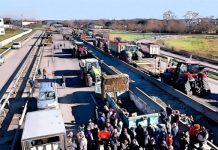


Farmers, breeders and fishermen in Italy have started and are participating in protests for the dignity of income – so for a fair price, with a strict ban on #underselling – and freedom of association, to free themselves from the slavery of the CAAs (agricultural assistance centres).
The ecological transition must be supported with direct aid to farmers, who are the first ones interested in reducing their dependence on the multinationals of GMO pesticides and seeds. Public funds earmarked for arms for Ukraine must be returned to our society.
The manifesto of the #UnitedFarmers, together with Italian citizens, to follow in preview.
FAIR PRICES, PROHIBITION OF UNDER-SELLING
The income crisis of Italian farmers must be resolved immediately with a decree law reforming legislative decree 198/21 on unfair commercial practices in the agri-food chain. This reform must provide for:
a) erga omnes application. The prohibitions on unfair commercial practices and sales below cost must apply to all supplies of agricultural and food products, including supplies to cooperatives, POs (producers‘ organisations) and AOPs (associations of producers’ organisations), (1)
b) production costs. Actual average production costs of agricultural and food commodities must be compiled and updated at least monthly, by ISMEA, at a regional level and also at a provincial level, where necessary. With specific regard to family and peasant farms, which still account for 94.8 percent of the total (Eurostat, 2020) and their informal costs because they are not accounted for (e.g. continuous commitment, 6-7 days a week, of the farmer and his family helpers), (2)
(c) reference price. Transparency in the formation of prices must be guaranteed by telematic commodity exchanges that must always take into account production costs and product specifications (quality, quantity, composition, origin) and supply chain specifications (certifications and quality regimes. e.g. PDO, PGI, organic). As well as, of course, price trends, which the European Commission (DG Agri) must in turn take into account and update punctually (3,4,5)
d) electronic invoicing. All contracts and sales invoices, even in the stages following the first transaction between farmers and their customers, must include an exact description of the products (quality, quantity, composition, origin, certification and quality schemes) and prices per unit of measurement, with evidence of production cost and reference price (6)
e) consumer information. Consumers must be able to know the prices paid to farmers and processing companies/industries. These prices must be displayed on the sales premises of loose foodstuffs (e.g. fruit and vegetables), on the labels of pre-packaged products (e.g. cheese) and on the labels of pre-packaged foodstuffs of first industrial processing (e.g. oils, vegetable preserves, pasta and bakery products, milk and dairy products, meat, meat preparations and products), (7)
f) public controls. Supervision and sanctions on unfair commercial practices and sales below cost are to be entrusted to the Finance Police, with autonomous powers of initiative and systematic controls on electronic invoices, as well as to the Competition and Market Authority (Antitrust Authority). ICQRF, as has been denounced at the time and the facts show, is in fact completely lacking the necessary resources (8,9)
(g) sanctions. The sanctions must be dissuasive and proportionate to the purchasers’ turnover, with regard to the national group turnover in the case of large-scale organised distribution.
FREEDOM OF ASSOCIATION, CONTRACTUAL AUTONOMY
The freedom of association and contractual autonomy of farmers, breeders and fishermen must be guaranteed immediately, in accordance with constitutional law and the Treaty on the Functioning of the European Union. The Ministry of Agriculture must therefore:
h) no reform of the CAA. The ministerial decree approved in the State-Regions Conference on 8 February 2024 for the reform of the agricultural assistance centres, tailor-made for Coldiretti, must be annulled immediately in self-defence. Italian farmers are not prepared to accept either the dictatorship of Coldiretti or the unjustified increase in costs for access to the EU subsidies to which they are entitled (10,11)
i) free competition. The Ministry of Agriculture must repeal AGEA Circular No. 41 of 9 August 2022, which excluded more than 2,500 freelancers from access to the SIAN (National Agricultural Information System) registers for the management of farm files relating to EU contributions in agriculture (12)
j) liberalisation of services. All public services that are currently delegated to agricultural confederations, bodies and companies belonging to them must be liberalised. Farmers, breeders, and fishermen must be able to decide to which bodies and freelancers they entrust the management of these services, including, for example, land lease contracts. The provision of services by agricultural confederations must be independent of farmers’ membership in these associations.
ECOLOGICAL TRANSITION, NO TO NEW GMOs
Italian farmers and breeders are the first to want to reduce the use of agrochemicals (herbicides, pesticides, fungicides), nitrogenous fertilisers and veterinary drugs (e.g. antibiotics, antimicrobials). Both because the costs of chemicals in agriculture are unsustainable and reduce soil fertility, because some toxic chemicals expose farmers themselves to health risks, and because consumers increasingly demand food without pesticide and antibiotic residues.
The ecological transition must, however, be supported by the public sector, with direct aid to farmers so that they can diversify production and its risks (from monocultures to polycultures) and meet market demand, but also effectively address threats to agricultural and livestock production. Adequate public investment should therefore also be directed towards field research into effective biological control tools.
The new GMOs must be subject to the same risk assessment criteria established for first-generation GMOs, since their deliberate release into the environment can cause damage to the biodiversity that characterises ‘Made in Italy’ agrifood production. In addition to aggravating farmers’ dependence on the four giants that control over 70% of the global seed market (and the herbicides they are designed to resist). (13)
PEACE, FOOD AND HEALTH
A ten-year agreement ‘on security’ between Italy and Ukraine was announced yesterday in Kiev by Prime Minister Giorgia Meloni, who ‘did not answer questions from journalists asking to quantify Italy’s financial commitment, but repeated that the government in Rome has already launched eight aid packages and will continue to do everything possible to help Kiev’. (14) In addition to the more than €130 billion in military ‘aid’ already disbursed by the European Union over the past two years, and the further €50 billion decided in Brussels on 1 February 2024.
The Italian population is not willing to make further sacrifices, let alone participate in the third world war ‘in pieces’, as described by Pope Francis. (15) Our schools and universities, hospitals and healthcare, public services and social welfare, and pensions are being mortgaged by Giorgia Meloni to fatten the arms industry, which will exacerbate everyone’s poverty. Minister Antonio Tajani should account for all this in Parliament, and the parties that sit there today should declare openly whether they want to buy more weapons or work for peace.
MANIFESTATION IN ROME, SATURDAY 2ND OF MARCH 2024
Citizens of all ages, together with #UnitedFarmers, are all invited to the peaceful demonstration organised in Rome in Piazza dei Santi Apostoli on Saturday 2 March at 12 noon. We demonstrate for good and fair food, respectful of the earth and animals, for the dignity and health of all. (16) Stop the speculation of the oligarchies in Italy and Europe, stop weapons and destruction.
#Clean Spades, #Égalité
Dario Dongo
Footnotes
(1) Legislative Decree 198/21 – in unlawful derogation from Directive (EU) No 2019/633 (Unfair Trading Practices, UTPs) – excludes from the notion of ‘contracts of sale’ the contributions of members to cooperatives and the transfers of agricultural products and foodstuffs to producer organisations (Legislative Decree 198/21 Art. 2.e). The consequences of this exclusion were analysed, in the Piedmontese milk sector, in the previous article by Dario Dongo. Unfair trade practices, Italy tries to exclude cooperatives and producers’ organisations. Food Times. 17.10.21
(2) ISMEA should introduce real-time production costing tools in all provinces of Italy and across all agricultural supply chains, based on the company’s cost structure according to accounting principles (to which should be added an assessment of unaccounted costs, for SMEs), using blockchain. A technology already available and in fact recommended by the FAO, as early as 2018, precisely to ensure a fair redistribution of the value chain to agricultural and food suppliers. See the previous article by Dario Dongo, Andrea Adelmo Della Penna. Blockchain, the opportunities for the agri-food and organic supply chain. Food Times. 1.11.20
(3) Dario Dongo. A telematic commodity exchange to foster transparency and fairness in the food supply chain. Food Times. 8.3.21
(4) Dario Dongo. Durum wheat, allegations of ‘scams’ ignored by Coldiretti and Filiera Italia. Food Times. 22.2.24
(5) Dario Dongo, Marina De Nobili. Transparency in the value chain, work in progress. Food Times. 23.3.19
(6) Dario Dongo. Which unit of measurement for the price of bulk and pre-packed food? FARE (Food and Agriculture Requirements). 8.9.22
(7) Only pre-packed food labels must show the average purchase price of the significant ingredient (>50%), in the reference period, through electronic labelling (QR-code). Food prices displayed on the sales premises must also show the prices per sales unit paid to producers, in reform of the Consumer Code
(8) Dario Dongo. Unfair commercial practices, the troubles of Legislative Decree 198/2021. Food Times. 4.12.21
(9) The report of the Ministry of Agriculture on the controls carried out by ICQRF in 2022, with regard to unfair trade practices, indicates that ‘during 2022, ICQRF investigated No. 3 complaints filed by interested parties, conducted No. 50 investigations on its own initiative, for a total of No. 53 investigations, and no. 48 investigations concluded in the same year, for a total number of no. 139 checks (no. 55 inspections and no. 84 internal documentary checks), through which no. 76 of operators were verified, at the conclusion of these activities no. 15 administrative charges were raised’. A total ineffectiveness, just as Coldiretti wanted.
(10) Dario Dongo. Italy, green light for CAA monopoly on EU aid in agriculture. Food Times. 12.2.24
(11) Dario Dongo. CAA reform, new costs and bureaucracy for farmers. Food Times. 18.2.24
(12) Dario Dongo. AGEA and MASAF ‘Coldiretti’. The suppression of freelancers in agriculture. Food Times. 30.9.23
(13) A further risk for farmers is being forced to pay royalties in cases of accidental contamination of their crops with the new GMOs. See paragraph 5 in the article by Dario Dongo, Alessandra Mei. New GMOs, NGTs. Green light from Strasbourg for deregulation. Food Times 9.2.24
(14) Massimo Maugeri. The G7 in Kiev. Meloni: ‘Ukraine is our home and we will defend it’. AGI. 25.2.24 http://tinyurl.com/rf844s7a
(15) Ty Roush. Russia Warns NATO Troops In Ukraine Will Cause ‘Inevitable’ Conflict-After France Doesn’t Rule It Out. Forbes. 27.2.24
(16) Dario Dongo. Rome, 2 March 2024. Farmers and citizens united in protest. Égalité. 26.2.24
(17) Farmers again blockade the European quarter in Brussels. After the double siege at the beginning and end of February to contest EU policies, about a hundred tractors are assembling this morning near the headquarters of the main EU institutions. Some fires were set in Place du Luxembourg, in front of the European Parliament buildings, already stormed on 1 February. Firecrackers were thrown in the vicinity of the headquarters of the European Commission and the EU Council, where the EU agriculture ministers are meeting. Burning tyres and bales of hay were also set on fire in front of the department responsible for the disbursement of Common Agricultural Policy (CAP) funds. There are currently about a hundred tractors assembled in Rue de la Loi, the main thoroughfare through the EU district. FUGEA and ECVC farmers return to Brussels.

Dario Dongo, lawyer and journalist, PhD in international food law, founder of WIISE (FARE - GIFT - Food Times) and Égalité.