
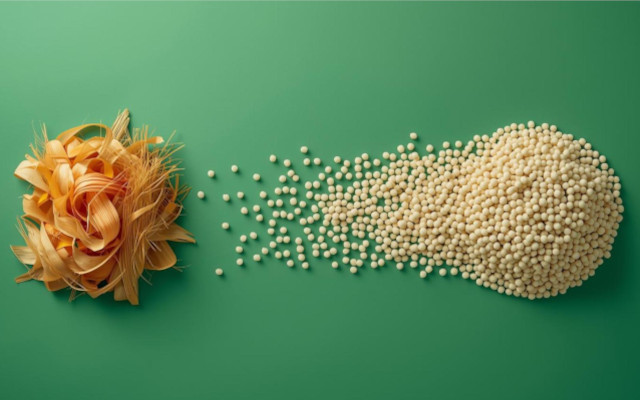
A comprehensive review published in Frontiers in Sustainable Food Systems examines the potential of converting lignocellulosic food waste into valuable bioplastics within the framework of a circular bioeconomy. The study by Vatieri, Cirillo and Esposito (2025) addresses the dual environmental challenges of food waste accumulation and plastic pollution, proposing an innovative approach that transforms food loss and waste (FLW) into biodegradable polymers. With approximately 1.3 billion tonnes of food waste generated globally each year, and plastic pollution reaching critical levels, this research offers timely insights into sustainable waste valorisation strategies.
The research employed a systematic literature review methodology, utilising three major academic databases: Google Scholar, PubMed and Scopus. The authors applied specific selection criteria, focusing on articles published between 2010 and 2024, restricted to English-language publications, and employing targeted keywords including ‘agro-industrial waste‘, ‘food waste‘, ‘bioplastics‘, ‘circular economy’ and ‘environmental sustainability’. Following initial identification of 800 potentially relevant articles, the researchers refined their selection through abstract screening and relevance assessment, ultimately including 83 peer-reviewed articles and 8 institutional reports. This methodological rigour ensured comprehensive coverage of current knowledge while maintaining focus on practical applications and environmental impact assessments.
Bioplastics: definitions, types and standards
The study provides crucial clarification on bioplastic terminology, noting that European Bioplastics defines bioplastics as materials that are either bio-based, biodegradable, or both (European Bioplastics, 2020). The review categorises bioplastics into three primary groups:
- bio-based and biodegradable (such as polylactic acid, PLA);
- bio-based but non-biodegradable; and
- fossil-based but biodegradable.
Key biopolymers examined include polyhydroxyalkanoates (PHA), polylactic acid (PLA), polyhydroxybutyrate (PHB) and poly(3-hydroxybutyrate-co-3-hydroxyvalerate) (PHBV), all derivable from lignocellulosic biomass through microbial fermentation processes (Bhatia et al., 2021).
Regarding standardisation, the authors highlight significant gaps in current regulatory frameworks for assessing biodegradability. The review identifies multiple international standards across different degradation environments: soil (ASTM D5988-18, ISO 17556:2019), composting (ISO 14855-1:2012, ASTM D5338-15) and aquatic environments (ISO 18830:2016, ASTM D6691-17). However, Vatieri et al. (2025) emphasise critical limitations in these standards, including the absence of realistic field conditions, lack of standardised methodologies for comparison, and insufficient ecotoxicological assessment. The study notes that these regulatory shortcomings create challenges for accurate product labelling and hinder the development of truly sustainable bioplastic solutions.
Major outcomes: environmental and economic considerations
The review presents compelling evidence for the environmental advantages of bioplastic production from food loss and waste. According to the synthesised literature, replacing conventional plastics with bio-based alternatives can reduce carbon dioxide emissions by approximately 80% and decrease energy consumption by 65% compared to traditional plastic manufacturing (Mehta et al., 2021). The study identifies lignocellulosic biomass, Earth’s most abundant renewable resource produced at 182 billion tonnes annually, as a particularly promising feedstock. Key lignocellulosic components – cellulose, hemicellulose and lignin – can be extracted from various agricultural residues, including fruit and vegetable waste, rice husks, sugar cane bagasse and wheat straw.
However, the authors acknowledge substantial economic barriers to widespread adoption. Through techno-economic assessment (TEA) analysis of existing production facilities, the study reveals that bioplastic manufacturing costs remain significantly higher than conventional plastics. For instance, polylactic acid production costs range from US$2–3 per kilogram, while polyhydroxybutyrate reaches even higher prices (Senila et al., 2024). The review attributes these elevated costs to expensive extraction techniques, energy-intensive processing requirements, limited production scale and technological constraints in biomass pre-treatment. Despite these challenges, the research suggests that utilising waste-derived feedstocks rather than virgin materials could substantially reduce production expenses.
Life cycle assessment and environmental impact
A critical component of the review examines life cycle assessment (LCA) methodologies applied to bioplastics. The authors analyse multiple LCA studies comparing fossil-based plastics with bio-based alternatives across various environmental indicators. The research by Senila et al. (2024) provides detailed insights into cradle-to-gate assessments for PLA and PHB production from lignocellulosic waste, revealing that PHB generally demonstrates lower environmental impact than PLA, particularly regarding global warming potential and non-renewable energy consumption. However, Vatieri et al. (2025) critically note that current LCA methodologies possess significant limitations, including incomplete analyses, insufficient primary data and failure to account for plastic dispersal in natural environments.
The review emphasises that environmental benefits depend heavily on end-of-life management strategies. While biodegradable plastics offer theoretical advantages, their actual environmental performance varies considerably based on disposal methods. The study identifies recycling as the most environmentally preferable option, followed by industrial composting, with landfill disposal representing the least sustainable approach due to methane emissions. Importantly, the authors highlight emerging concerns regarding microplastic formation from incomplete biodegradation, noting that even biodegradable materials require specific environmental conditions for proper decomposition (Qin et al., 2021).
Circular economy implementation: European and global perspectives
The review provides comprehensive analysis of circular economy implementation across different regions, with particular emphasis on European Union initiatives. The EU has emerged as a global leader in bioplastic promotion through legislative frameworks including the European Green Deal, Single-Use Plastics Directive (2019) and circular economy action plans. The study documents how Directive (EU) 2018/851 specifically encourages biodegradable and compostable plastics for organic waste management, while Germany’s National Research Strategy for the Bioeconomy 2030 and Spain’s BIOPLAT platform exemplify national-level commitment to bio-based economies (Federal Ministry of Education and Research, 2011).
Comparative analysis reveals varying approaches in non-European contexts. China‘s five-year plan (2020–2025) for bioeconomy development demonstrates significant governmental commitment, while India focuses on utilising agricultural waste for biofuel and chemical production through biotechnological pathways (Venkata Mohan et al., 2018). However, the authors note that despite growing global interest, substantial gaps remain in regulatory frameworks, particularly concerning standardised definitions, biodegradability certification and end-of-life management protocols. The review emphasises that successful transition to a circular bioeconomy requires coordinated international efforts addressing technical, economic and policy dimensions simultaneously.
Discussion: challenges and future directions
Vatieri et al. (2025) identify several critical challenges impeding widespread bioplastic adoption. Primary concerns include limited mechanical properties compared to conventional plastics, high water sensitivity, insufficient thermal stability and brittleness in certain biopolymer formulations. The study notes that whilst polysaccharide-based bioplastics (cellulose, starch, pectin) offer excellent biodegradability and film-forming properties, they frequently exhibit poor moisture resistance. Protein-based alternatives demonstrate superior oxygen barrier characteristics but suffer from inadequate mechanical strength (Coltelli et al., 2015). These performance limitations restrict current applications primarily to food packaging and single-use items.
The review proposes several promising research directions to overcome existing constraints. Composite formulations combining multiple biopolymers show potential for enhanced mechanical properties; for example, pectin-based films incorporating lignin nanocrystals demonstrate improved tensile strength and water resistance (Zhang et al., 2024). The authors advocate for increased investigation into underutilised plant resources and development of smart packaging incorporating pH sensors and active compounds. Furthermore, the study emphasises the necessity of expanding standardisation efforts, developing more comprehensive LCA methodologies that account for plastic environmental dispersal, and establishing economically viable large-scale production systems. The researchers conclude that achieving competitive bioplastic markets requires multidisciplinary collaboration between chemists, engineers, food technologists and policymakers.
Conclusions
This comprehensive review demonstrates that converting lignocellulosic food waste into bioplastics represents a viable strategy for simultaneously addressing waste management challenges and plastic pollution. The circular bioeconomy framework offers environmental benefits including reduced greenhouse gas emissions, decreased fossil fuel dependency and waste valorisation. However, successful implementation requires overcoming substantial technical and economic barriers, developing robust international standards for biodegradability assessment, and establishing comprehensive end-of-life management systems. The European Union’s proactive regulatory approach provides a valuable model, though global coordination remains essential. Future research must prioritise improving bioplastic performance characteristics, reducing production costs through technological innovation, and developing holistic environmental impact assessment methodologies that extend beyond traditional LCA frameworks to encompass real-world degradation scenarios.
#Wasteless
Dario Dongo
References
- Bhatia, S. K., Otari, S. V., Jeon, J., Gurav, M., Choi, R., Bhatia, Y. K., et al. (2021). Biowaste-to-bioplastic (polyhydroxyalkanoates): conversion technologies, strategies, challenges, and perspective. Bioresource Technology, 326, 124733. https://doi.org/10.1016/j.biortech.2021.124733
- Coltelli, M. B., Wild, F., Bugnicourt, E., Cinelli, P., Lindner, M., Schmid, M., et al. (2015). State of the art in the development and properties of protein-based films and coatings and their applicability to cellulose based products: an extensive review. Coatings, 6(1), 1. https://doi.org/10.3390/coatings6010001
- European Bioplastics. (2020). New circular economy action plan: circular economy needs bioeconomy to be successful. https://www.european-bioplastics.org/
- Federal Ministry of Education and Research. (2011). National research strategy bio economy 2030: our route towards a biobased economy. https://knowledge4policy.ec.europa.eu/sites/default/files/bioeconomy_2030_germany.pdf
- Mehta, N., Cunningham, E., Roy, D., Cathcart, A., Dempster, M., Berry, E., et al. (2021). Exploring the perceptions of environmental professionals, plastics processors, students and consumers of bio-based plastics: informing industry development. Sustainable Production and Consumption, 26, 574–587. https://doi.org/10.1016/j.spc.2020.12.015
- Qin, M., Chen, C., Biao, S., Shen, M., Cao, W., Yang, H., et al. (2021). A review from biodegradable plastics to biodegradable microplastics: another ecological threat to soil environments? Journal of Cleaner Production, 312, 127816. https://doi.org/10.1016/j.jclepro.2021.127816
- Senila, L., Kovacs, E., Resz, M. A., Senila, M., Becze, A., & Roman, C. (2024). Life cycle assessment (LCA) of bioplastics production from lignocellulosic waste (study case: PLA and PHB). Polymers, 16(23), 3330. https://doi.org/10.3390/polym16233330
- Vatieri, C., Cirillo, T., & Esposito, F. (2025). Waste to worth: bioplastic synthesis from lignocellulosic food waste in the age of the circular bioeconomy. Frontiers in Sustainable Food Systems, 9, 1698348. https://doi.org/10.3389/fsufs.2025.1698348
- Venkata Mohan, S., Chiranjeevi, P., Dahiya, S., & Naresh Kumar, A. (2018). Waste derived bioeconomy in India: a perspective. New Biotechnology, 40, 60–69. https://doi.org/10.1016/j.nbt.2017.06.006
- Zhang, S., Fu, Q., Li, H., Li, Y., Wu, P., & Ai, S. (2024). Polydopamine-coated lignin nanoparticles in polysaccharide-based films: a plasticizer, mechanical property enhancer, anti-ultraviolet agent and bioactive agent. Food Hydrocolloids, 147, 109325. https://doi.org/10.1016/j.foodhyd.2023.109325

Dario Dongo, lawyer and journalist, PhD in international food law, founder of WIISE (FARE - GIFT - Food Times) and Égalité.