
An Italian startup founded by three young women, recent graduates from the European Institute of Design (IED) in Milan, launches the project of a system of intelligent buoys to filter microplastics on the surfaces of seas and water basins. Jelter, from the portmanteau between ‘jelly-fish’ (jellyfish) and ‘filter’.
1) Microplastics, the planetary disaster
Pollution from microplastics and nanoplastics is an unsolved and continuously growing global problem, since no country has so far adopted suitable measures to reduce the use of plastic even in its most futile applications, from single-use packaging to pesticides (1,2).
Scientific literature has already highlighted:
a) the spread of microplastics, through wind and water, even in the most remote regions of the planet (3,4),
b) the presence of microplastics in drinking water (WHO, 2019), fruit and vegetables, other foods (5,6,7),
c) human exposure to microplastics, via air and diet. (8) Already starting from the prenatal phase, with greater risks for the infant population (9,10),
d) the consequent spread of microplastics in human tissues and organs, starting from blood and lungs (11,12),
e) the possible public health risks linked to the toxic and genotoxic chemical substances present there (13,14).
2) Jelter, the smart buoys to filter microplastics
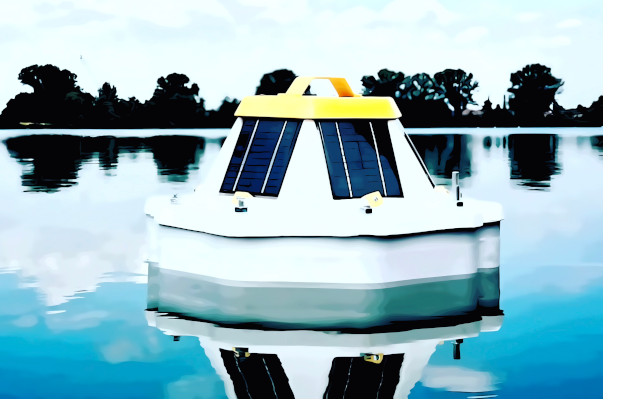
Jelter it is a large intelligent buoy inspired by the shape of a jellyfish, equipped with a pump to suck water – powered by various solar panels – and a filter to retain microplastics. (15) The startup of the same name was founded by three 22-year-old girls – Rebecca Raho, Emanuela Tarasco and Caterina Favella – who had conceived Jelter in their diploma thesis at the Product Design course at the IED (European Institute of Design).
The project was then developed with the help of expert technicians, to optimize flotation and drainage performance, after identifying materials compatible with the marine environment. Its presentation has already been received with enthusiasm – at the Festival of Sustainable Development in Milan and at the ‘Seafuture’ fair in La Spezia – and is now waiting for investors to move on to the industrial production phase.
3) Perspectives
The ‘sweepers of the sea’ have a well-established history of use, also in Italy and the Mediterranean. Small boats skirted the seaside tourist areas, in high season, to ‘fish’ for macroscopic waste with nets. The Australian ‘Seabin’ was the first to dedicate itself to microplastics, with its own ‘floating bucket’ already tested in the Tyrrhenian and Adriatic seas (16,17).
The proposal of Jelter appears interesting, in a system logic, at sea but
especially in water basins that supply drinking and mineral water – where microplastics have already been detected (18,19) – and in freshwater basins where aquaculture is practiced. Fleets of buoys can monitor surface pollution levels and the effectiveness of their filters, in areas not subject to variable sea currents.
Specific studies could confirm the potential of these solutions to at least partially reduce dietary exposure to microplastics. In the awareness that the ongoing environmental and public health disaster can only be contained at the source, with drastic reforms of consumption models and production systems, also through the replacement of hydrocarbon polymers with bioplastics.
Dario Dongo
Footnotes
(1) Marta Strinati. Packaging Regulation (PPWR), the European Parliament approves a softer version. FT (Food Times). 24.11.23
(2) Marta Strinati. Microplastics in pesticides, the CIEL report. FT (Food Times). 20.7.22
(3) Dario Dongo. Microplastics gone with the wind, contaminated even the air. FT (Food Times). 29.4.19
(4) Dario Dongo, Ylenia Desire and Patti Giammello. Plastics and microplastics in the Mediterranean, a cultural challenge. FT (Food Times). 30.8.19
(5) Marta Strinati. Microplastics in drinking water, WHO calls for risk assessment. FT (Food Times). 22.8.19
(6) Marta Strinati. Microplastics in fruit and vegetables. The Italian study. FT (Food Times). 21.6.20
(7) Sabrina Bergamini, Dario Dongo. Microplastics on the plate, two new studies and a petition. FT (Food Times). 13.6.19
(8) Paola Palestini, Dario Dongo. Microplastics and human health, the invisible evil. FT (Food Times). 28.6.19
(9) Marta Strinati. Microplastics in the human placenta. The discovery of Italian researchers. FT (Food Times). 11.12.20
(10) Marta Strinati. Microplastics, babies and children 10 times more exposed than adults. FT (Food Times). 2.11.21
(11) Marta Strinati. Microplastics in the blood, first evidence in humans. FT (Food Times). 25.3.22
(12) Marta Strinati, Dario Dongo. Microplastics in our lungs too. The British study. FT (Food Times). 12.4.22
(13) Giulia Pietrollini. Microplastics and damage to fertility. The EcoFoodFertility project. FT (Food Times). 12.3.23
(14) Marta Strinati. Microplastics, new evidence of genotoxicity on freshwater shrimp. FT (Food Times). 16.5.23
(15) Jelter https://www.jelter-startup.com/
(16) Dario Dongo, Marta Singed. Recycled plastic in packaging, the avant-garde of Coop Italia. FT (Food Times). 22.4.19
(17) Seabin Foundation https://seabinfoundation.com.au
(18) Dario Dongo, Sabrina Bergamini. Microplastics in the water of Italian lakes, the silent emergency. FT (Food Times). 5.7.20
(19) Marta Strinati. Microplastics in mineral water. The French report. FT (Food Times). 3.8.22

Dario Dongo, lawyer and journalist, PhD in international food law, founder of WIISE (FARE - GIFT - Food Times) and Égalité.