
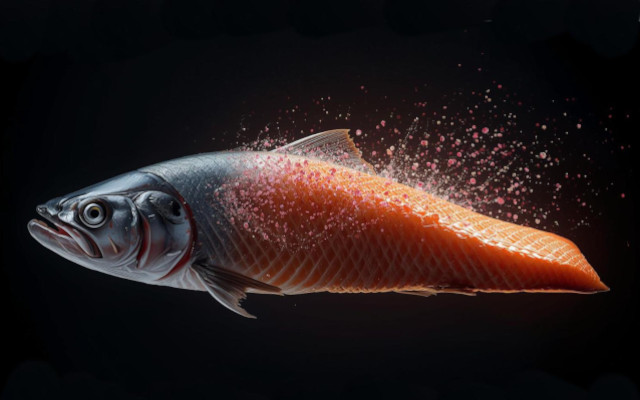
Salmon upcycling in Finland is emerging as one of the most innovative solutions to tackle food loss and waste reduction and improve resource efficiency in the global seafood industry. Currently, up to 70% of processed fish (35% in the case of salmon) is discarded for secondary uses, such as producing raw materials for animal feed, or is simply disposed of as waste.
The Finnish food technology company Hailia Nordic Oy has developed a patent-pending process that transforms salmon and other salmonid by-products — including heads, fins and bones — into high-quality food ingredients suitable for human consumption. This approach to circular economy in seafood ensures that valuable nutrients are retained in the human food chain rather than lost to low-value applications.
This article explores the technological innovation, the regulatory framework, the production methods and the commercial implementation of salmon upcycling in Finland. The technology aspires to raise the share of salmon used for direct human consumption from the current 65–80% to around 90%, representing a major step towards a more sustainable and efficient seafood industry.
Introduction
The seafood industry faces a critical sustainability challenge, as global consumption of seafood products is projected to rise by 50% by 2050 (Lindström, 2025). Traditional methods of fish processing generate substantial waste: after filleting, around half of the fish’s weight — including bones and fins — exits the human food chain. Although these by-products are rich in nutrients such as proteins, Omega-3 fatty acids, vitamins and minerals, they have historically been downgraded to animal feed, fish oil production or waste disposal.
The development of innovative upcycling technologies — such as those tested within the European research project EcoeFISHent, in which our team at Wiise benefit S.r.l. is also involved — represents a paradigm shift in the use of seafood resources. Converting by-products into feed or oil, which generates minimal returns, stands in stark contrast with their potential to be transformed into high-quality food ingredients. This innovation addresses both environmental sustainability concerns and new economic opportunities within the seafood value chain.
Regulatory framework and novel food status
A crucial element for the placing on the EU market of food ingredients derived from fish by-products concerns their classification as traditional foods rather than as novel foods, pursuant to Regulation (EU) 2015/2283.
The Finnish Food Authority (Ruokavirasto) has recognised that the food ingredients produced by Hailia Nordic Oy through the upcycling of salmon by-products do not qualify as novel foods for two essential reasons:
- the raw materials used are traditional fish components whose consumption has long been established in human diets in various forms (e.g. fish soups);
- the technology employed does not alter the molecular structure of the raw materials nor does it entail significant changes in the composition or structure of the food that would affect its nutritional value, metabolism, or levels of undesirable substances.
It is therefore traditional food processed with innovative tools, and as such is not subject to the complex authorisation procedure applicable to novel foods. The food products obtained from this innovation have thus already been placed on the market.
Production process and technology
Raw material utilisation
The technology developed by Hailia represents an integrated approach to the utilisation of fish. ‘We can transform the entire fish into “fillet”, from head to tail, including the backbone, naturally excluding viscera and blood,’ explains Michaela Lindström, CEO of Hailia.
The process is specifically dedicated to by-products of secondary processing, with the possibility of including bones, heads, and fins in the ingredients and final products (if desired).
Processing methodology
The core innovation lies in the transformation process itself. ‘We make a homogenised mass and then restructure it into a product that has a mouth feel that resembles cooked fish fillet’. This two-stage process involves:
- homogenisation phase. The selected fish parts undergo controlled homogenisation to create a uniform mass whilst preserving nutritional integrity. ‘We use the bone tissue but when you eat it, there’s no bones that you could feel’;
- restructuring phase. The homogenised material is then restructured using patent-pending technology to achieve the desired texture. ‘Our novel process allows us to achieve a texture and mouthfeel reminiscent of a cooked fillet of fish, without fishbones or other particles disturbing the mouthfeel’.
Product characteristics
Products obtained from the upcycling of salmon by-products appear to present several distinctive characteristics:
- the texture, which resembles that of a cooked fish fillet, provides a pleasant mouthfeel;
- the structural stability maintains both shape and texture even during further processing (e.g. canning, frying);
- the mineral content derived from the bones, needless to say, may add nutritional value. However, it should be balanced to avoid potential excess, in the author’s view.
Production capacity and scalability
Hailia operates a state-of-the-art facility in Karkkila, Finland, fully refurbished in 2022. The technology is designed for integration into existing fish processing facilities, with a minimum of 100 square meters of production space required for implementation.
The licensing model developed by the company enables fish processors to implement the technology on-site, as demonstrated by Kalavapriikki’s commitment to integrate the system at its Kuopio facility by early 2026.
Commercial implementation and partnerships
Strategic collaborations
The commercialisation strategy involves multiple partnerships across the value chain:
- Kalavapriikki partnership. As part of a licensing deal, Kalavapriikki will implement Hailia’s technology on-site at its production facility in Kuopio in central Finland – the first time this technology will be implemented outside Hailia’s own factory;
- Hätälä collaboration. The partnership with Hätälä, one of Finland’s largest fish processing companies handling approximately 18,000 tonnes of fish annually, focuses on Norwegian salmon side-streams for the food service industry;
- retail distribution. The collaboration with S Group, which holds a 48% share of the Finnish food market, enabled the launch of the product ‘Nyhtökirjolohi’ (shredded rainbow trout), achieving significant initial sales success.
Economic implications
The economic advantages of fish by-product upcycling are substantial. As highlighted by Kalavapriikki’s CEO, Jari Korhonen, converting side streams into food-grade ingredients for human consumption generates a 10–15 times higher market value compared to their use in low-return industrial applications such as feed or oil.
The payback period for large processing companies adopting this technology is remarkably short, potentially measured in months rather than years. This makes the investment opportunity especially compelling, combining rapid returns with innovative, sustainable food production.
Environmental impact and sustainability
The environmental credentials of the technology are particularly noteworthy. Hailia’s calculations using the cradle-to-gate scope tool provided by Biocode have determined the carbon footprint of farmed rainbow trout products made from side streams to be potentially as low as 0.6 kilograms of CO2 per kilogram of food. This represents a smaller carbon footprint than any primary animal protein and is comparable to plant-based proteins such as peas.
The technology addresses multiple sustainability objectives:
- reduction of food loss in the seafood industry
- improved resource efficiency without increasing fishing or aquaculture volumes
- lower carbon emissions compared to traditional protein sources
- improved circular economy performance (#Wasteless).
Applications and market positioning
Products derived from the upcycling of salmon by-products are designed to meet the growing demand for convenient, affordable, and sustainable seafood suitable for everyday consumption.
Hailia’s technology allows the production of various formats with different culinary applications (e.g., chunks, bites, strips, fishballs), while maintaining structural integrity during further processing.
The versatility of these products enables their use in industrial production, catering, and domestic kitchens, as ingredients for salads, fillings (e.g., ravioli), pasta sauces, or fish soups.
Future developments and international expansion
Hailia’s vision extends beyond the Nordic market. The company is actively negotiating with international fish processing companies for technology licensing. The company is already in talks with several global producers of salmonids, pelagic fish, and whitefish about licensing its technology.
The recent €1.75 million investment round, including strategic partnerships with Danish engineering company Dana Technology, positions the company for global expansion. Dana Technology’s involvement as a strategic technology provider brings additional engineering expertise to scale the technology internationally.
Interim conclusions
The development of salmon upcycling technology represents a significant advancement in sustainable seafood processing. By transforming previously underutilised side-streams into valuable food products without requiring novel food classification, this innovation addresses critical challenges in food security, environmental sustainability, and economic efficiency within the seafood industry.
The successful commercial implementation in Finland, coupled with regulatory approval and growing market acceptance, demonstrates the viability of this approach. As the technology expands internationally through licensing agreements, it has the potential to fundamentally reshape seafood processing practices, contributing to a more sustainable and efficient global food system.
The integration of this technology could enable the seafood industry to meet growing demand whilst operating within planetary boundaries, representing a crucial step towards achieving sustainable development goals in marine resource utilisation.
Dario Dongo
Cover art copyright © 2025 Dario Dongo (AI-assisted creation)
References
- Lindström, M. (2024, September 25). Upcycled fillet can boost value and sustainability of salmon. Fish Farming Expert. https://www.fishfarmingexpert.com/finland-hailia-upcycled-salmon-fillet/upcycled-fillet-can-boost-value-and-sustainability-of-salmon/1827047
- Lindström, M. (2024, December 12). Finnish fish processor commits to integrating upcycling technology. Fish Farming Expert. https://www.fishfarmingexpert.com/carbon-footprint-finland-hailia/finnish-fish-processor-commits-to-integrating-upcycling-technology/1865929
- Lindström, M. (2025, June 9). Fish-heads upcycler Hailia wins backing for expansion. Fish Farming Expert. https://www.fishfarmingexpert.com/dana-technology-fish-processing-hailia/fish-heads-upcycler-hailia-wins-backing-for-expansion/1950455
- Lindström, M., & Kaukonen, O. (2024, February 2). Hailia is fighting food waste by upcycling seafood side streams. FoodNavigator. https://www.foodnavigator.com/Article/2024/02/02/Hailia-is-fighting-food-waste-by-upcycling-seafood-side-streams/
- Hailia Nordic Oy. (2024). FAQ. https://hailia.fi/faq
- Hailia Nordic Oy. (2024). For Partners. https://hailia.fi/for-partners
- European Circular Economy Stakeholder Platform. (2024, September 3). Hailia: Making good use of fisheries sidestreams. https://circulareconomy.europa.eu/platform/en/good-practices/hailia-making-good-use-fisheries-sidestreams
- European Circular Economy Stakeholder Platform. (2025, April 3). Secondary raw materials: Upcycling fish sidestreams into food products. https://circulareconomy.europa.eu/platform/en/news-and-events/all-news/secondary-raw-materials-upcycling-fish-sidestreams-food-products
- SeafoodSource. (2024, September). Kalavapriikki, Hailia Nordic team up to launch pulled rainbow trout in S Group stores in Finland. https://www.seafoodsource.com/news/foodservice-retail/kalavapriikki-hailia-nordic-team-up-to-launch-pulled-rainbow-trout-in-s-group-stores-in-finland
- EU-Startups. (2025, June 20). Finnish startup Hailia raises €1.75 million to transform underutilised fish materials into new seafood dishes. https://www.eu-startups.com/2025/06/finnish-startup-hailia-raises-e1-75-million-to-transform-underutilised-fish-materials-into-new-seafood-dishes

Dario Dongo, lawyer and journalist, PhD in international food law, founder of WIISE (FARE - GIFT - Food Times) and Égalité.