

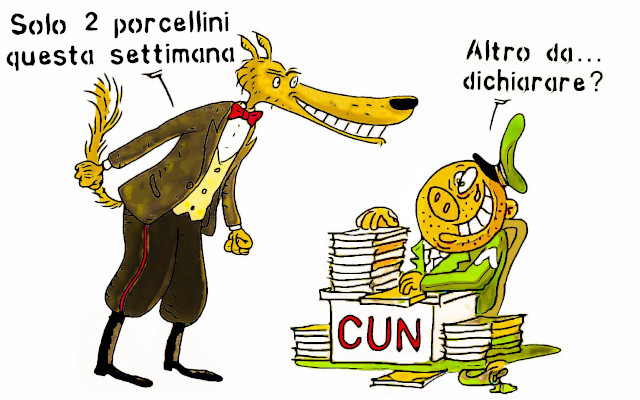
The Pork CUN–a body created to update national price lists, weekly, based on market trends–is being boycotted by Assica, the association representing butchers and cured meat industries.
In fact, on 6/30/21 Assica notified MiPAAF and the Italian Telematic Commodity Exchange-the guarantor and secretariat of the Commissione Unica Nazionale (CUN) pigs, respectively-the resignation of the commissioners and guarantors of the buying party (slaughterers).
The industrialists try to back down, combination, just when the Ministry of Agriculture, Food and Forestry (MiPAAF) has begun to do something to counter the systematic fraudulent price lowering (1,2).
Single National Commissions
MiPAAF Decree 31.3.17, no. 72 (3) – Regulations on provisions concerning the establishment and locations of the Single National Commissions (C.U.N.) for the most representative chains of the agricultural-food system – implemented Law 2.7.15 no. 91 on the Regulation of Agrifood Markets (Article 6-bis,paragraph 1).
The establishment of the Single National Commissions (U.N.) for the sector has made it possible to:
– suspend the listing activities of commodity exchanges (based on daily readings), and
– Establish a new system of formulating indicative prices for agricultural, agri-food and fish products, based on market trends (surveyed weekly).
CUN, the indicative prices
Therefore, the indicative prices that CUNs update on a weekly basis fulfill the public function of transparency in agrifood markets. To be used as a reference for purchase and sale and transfer contracts, concluded in accordance with current regulations (DM 31.3.17 No. 72, Art. 3.1).
‘In line with European Union guidelines on common market organization’ (Law 2.7.15 No. 91, Art. 6-bis).
The members of the C.U.N., commissioners and guarantors, are ‘appointed by professional organizations and trade associations representing agricultural producers, agricultural and agribusiness cooperation, processing industry, trade and distribution‘ (DM 31.3.17 No. 72, Art. 5). The aforementioned are required to sign and observe ‘a code of conduct that establishes the minimum duties of diligence, loyalty, impartiality and good conduct‘ (DM 31.3.17 No. 72, Art. 6.1.c).
CUN pigs
Therefore, the Single National Commission for Pigs for Slaughter (CUN pigs) is established and regulated by MiPAAF – MiSE decree, pursuant to DM 31.3.17, Art. 4.1. (5) And its founding regulation is categorical in defining the requirements for Phase 1, market data analysis:
– slaughterhouses operating in the PDO Pig system must upload slaughter data on dead weight and average meatiness to the ‘enterprise.gov’ portal, operating the classification of pig carcasses as required under reg. EC 1234/2007 (so-called Single CMO. See also following paragraph Carcass classification and DM 24.10.18, Article 17),
– control officers verify the systematic implementation of the information to be entered by the slaughterhouse in the said portal on classification and quotation, ‘in accordance with the instructions contained in this manual and in any case given by MiPAAF‘(Manual of controls on carcass classification, p. 28. See note 6).
Transparency (theoretical) of market data
Current regulations require slaughterhouses to provide data updated to the week immediately preceding the week in progress at the time of the inspection. Failing this, the controller must contest a noncompliance with appropriate notice to comply with updating the information and/or restoring the connection.
Failure to comply with the requirements, when verified during subsequent inspection activities, will result in the duty of appropriate reporting to the competent authority. Namely, to the Directorate General for the Promotion of Agribusiness Quality and Horseracing, within the Department of Competitive Policies on Agribusiness Quality, Fisheries and Horseracing of MiPAAF.
Carcass classification
Commission Delegated Regulations (EU) 2017/1182 and 2017/1184 supplement Reg. EU 1308/2013 (Single CMO) ‘regarding Union scales for the classification of beef, pig and sheep carcasses and the reporting of market prices of certain categories of carcasses and live animals’. In repeal of reg. EC 1249/08, still incorrectly cited on the MiPAAF website. (6)
The data obtained from the classification of carcasses – to be carried out in strict compliance with the aforementioned regulations – must be uploaded to the ‘enterprise.gov’ portal currently managed by IFCQ Certifications Ltd. a single member, certifying body for Prosciutto di San Daniele PDO, as well as various other PDOs and PGIs. Slaughter data are transmitted to the CUN to contribute in the most objective and transparent way to pig price formation.
Data altered to the detriment of farmers
The omertous reporting-biased and delayed-by slaughterhouses whose duty it is to provide data on pigs slaughtered each week adversely affects CUN’s formation of indicative prices. Previous articles on this topic have shown the extent and severity of this phenomenon as early as March 2020. (1) Also noted was MiPAAF’s intent to integrate slaughterhouse data with that of the RIFT portal, the database for pigs slaughtered for PDO productions. But even this was not enough, noting delays and deficiencies in the carcass classification database maintained by MiPAAF itself. (2)

The skewing of data in the exclusive favor of slaughterhouses occurred again, most recently in week 24 (June 14 to 20, 2021). Where slaughter data-entered by slaughterhouses in the ‘Impresa.Gov’ portal, published on the MIPAAF website and used by the Single National Commission to form the target price-were underestimated by 16.49 percent. That is, slaughterhouses concealed the purchase of 26,405 pigs, equivalent to 203 130-head trucks. More than twice the average weekly production of a large slaughterhouse (10-12,000 pigs).
CUN pigs. Assica’s boycott
On 25.6.21, the group of slaughterers united in Assica sent to MiPAAF a series of requests for amendments to the regulations on the management of the pig CUN, but without copying – to the best of our knowledge – the breeders’ representations.
The content of these requests is unknown, and instead the subsequent letter by which the association declares that it is exiting the CUN and disowning the indicative prices established by it is known. A boycott in full force and against all rules.
In fact, Assica communicated ‘that all CUN Slaughter Pigs Buyer Party Commissioners and Guarantors appointed by ASSICA have resigned from these roles and therefore withdrawn their availability to perform the related duties. As a result, we are unable to guarantee the presence of the buying party as early as the next meeting of the CUN pigs: therefore, we believe that any price publications with only the selling party present are not to be considered valid.’
The unresolved questions
The illicit management of the Swine CUN under the MiPAAF managements prior to the current Directorate General-which has instead committed itself to correcting the serious anomalies recorded-is there for all to see. Out of the Competition and Market Authority (AGCM, so-called Antitrust) and the Public Prosecutor’s Office at the Court of Rome.
MiPAAF, AGCM and the Public Prosecutor’s Office-in their dutiful investigations into the management of CUN pigs-should consider a number of unresolved questions:
– are there slaughterhouses in italy that, although they are required to do so, have never entered data on the ‘Impresa.Gov.’ portal?
– in a favorable hypothesis, do such slaughterhouses (even outside PDO pigs) classify carcasses?
– plethoric question, do the said slaughterhouses contribute to the price of carcasses? Evidently, yes, in all cases of live pig procurement on the domestic market.
Unresolved questions. What controls on MiPAAF data?
What tools are used by the ministry to ascertain the congruity of the data published weekly on its website with the actual data on pig slaughterings in Italy? How are controls carried out in Italy, now by IFCQ alone, on about half of the slaughterhouses operating in PDO pigs?
What action has the ministry taken against:
– Failure to classify carcasses,
– slaughterhouses that enter data with culpable delay, and more generally
– who for years has allowed blatantly different slaughter data to be entered on the MiPAAF(T) website than those declared by PDO certification bodies, always at fault?
Unresolved questions. Control institutions
Has the ministry ever received reports, from control institutes, about omissions or delays in data uploading by slaughterhouses (as prescribed in the Manual Operating Procedures and Control of Pork Carcass Classification Activity, under the chapter Linking to the “Impresa.gov” portal, page 28)?
Inspection institutions must perform periodic verification of the historical-statistical profile of grading(Manual Operating Procedures and Control of Pork Carcass Grading Activity, Section 2.8 – F). Has the ministry ever checked the fulfillment of these and the above duties of the institutes?
Parma, South-Italy
The IPQ (Parma Quality Institute) had also been suspended–following the ‘Prosciuttopoli’ scandal–for failures in carcass grading (point 5 of the order). After six months, the ministry declared that the matter had been resolved. Is this really the case? What action was taken against those who allowed the system of controls, entrusted to IPQ until 31.12.19, to be left to others for the period thereafter?
The fateful ‘Operating Procedures (…)‘ manual indicates that controls on carcass classifications in southern Italy would be entrusted to the Calabria Quality Institute. What measures have been taken against those who have failed to implement controls in the South?
The litmus test
It is sufficient to compare data from the National Livestock Registry with MIPAAF data, net of slaughterhouses that slaughter less than 200 pigs per week, to do the litmus test on discrepancies (8,9,10).

The question remains as to whether and what data are actually transmitted to Brussels. Does the 2020 data, for example, include pigs slaughtered in southern Italy and the islands?
Transparency in the pig market, the news that’s missing
First and foremost, the news that is missing is that which is already now accessible from the certifying bodies. Starting with the quantities, expressed in tons (dead weight), of PDO and PDO-excluded (due to unfitness) pigs slaughtered in the week, and the output raw materials suitable for PDO processing. How many tons of PDO hams were certified in 2020?
In fact, the CUN weekly report as well as RIFT only state the number of PDO and non-PDO pigs (7.8). But also not their weight, as if they were packaged products at constant unit ranges. Without even considering the raw materials coming out of slaughterhouses-suitable for the processing of PDO coppa, pancetta and cured meats-that also do not receive special consideration.
Transparency in the markets, preached so far in vain by the European Commission, should be ensured-at least at the national level-using tools in step with the times. In this regard, previous thoughts on the need to establish a telematic commodity exchange are recalled. (11)
Dario Dongo
Notes
(1) Marta Strinati, Dario Dongo. Pig market, serious anomalies on prices set by CUN. GIFT(Great Italian Food Trade). 13.2.21, https://www.greatitalianfoodtrade.it/mercati/mercato-suinicolo-gravi-anomalie-sui-prezzi-stabiliti-dalla-cun
(2) Dario Dongo. CUN pigs, the price is not (yet) right. GIFT(Great Italian Food Trade). 24.2.21, https://www.greatitalianfoodtrade.it/mercati/cun-suini-il-prezzo-non-è-ancora-giusto
(3) MiPAAF Decree 31.3.17, no. 72. https://www.normattiva.it/uri-res/N2Ls?urn:nir:ministero.politiche.agricole.alimentari.e.forestali:decreto:2017-03-31;72!vig= article 4.1
(4) Single National Commission – CUN PIGS. MiPAAF. 19.4.18. https://www.politicheagricole.it/flex/cm/pages/ServeBLOB.php/L/IT/IDPagina/5819
(5) Single National Commissions for the Swine Sector. CUN pigs. http://www.cunsuini.it/
(6) Classification of beef and pork carcasses. MiPAAF. https://www.politicheagricole.it/flex/cm/pages/ServeBLOB.php/L/IT/IDPagina/6501
(7) CSQA and IFCQ publish all data from the GI pork supply chain. Qualivita. 10/16/20, https://www.qualivita.it/news/csqa-e-ifcq-pubblicano-tutti-i-dati-della-filiera-suina-delle-ig/
(8) Reg Registro Italiano Filiera Tutelata (RIFT). Information report no. 12, December 2020. https://www.portalerift.it/documenti/2020/REPORT-FILIERA-12-2020.pdf
(9) Pig carcass classification data, year 2018. MiPAAF. https://www.politicheagricole.it/flex/cm/pages/ServeBLOB.php/L/IT/IDPagina/12107
(10) National Livestock Registry. Statistics. Veterinary Information System. Min. Health. https://www.vetinfo.it/j6_statistiche/#/report-pbi/68
(11) Dario Dongo. A telematic commodity exchange to promote transparency and fairness in the food supply chain. GIFT(Great Italian Food Trade). 8.3.21, https://www.greatitalianfoodtrade.it/idee/una-borsa-merci-telematica-per-favorire-trasparenza-ed-equità-nella-filiera-alimentare

Dario Dongo, lawyer and journalist, PhD in international food law, founder of WIISE (FARE - GIFT - Food Times) and Égalité.
Related post
 Bisphenol A toxicity, EFSA declares a public health alert
 Listeria alert on desserts, Müller recalls them 12 days after expiration date
 Honey, fruit juices, jams and marmalades, dehydrated milk. Proposals for reform of marketing standards in EU
 EFSA opinion on nitrosamines in food. The population is at risk

