

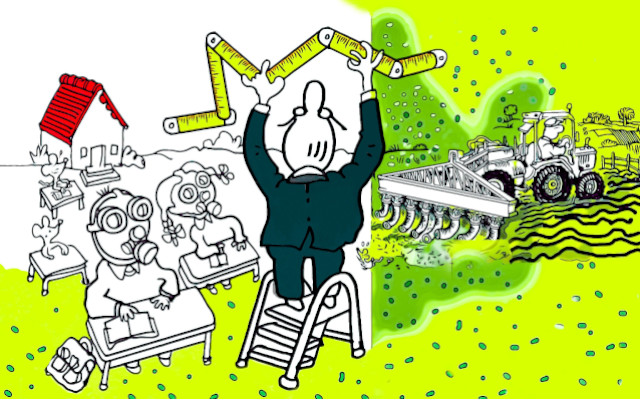
Exposure to the neurotoxic pesticide chlorpyrifos (or chlorpyrifos) damages children’s brains. Extensive scientific studies show its ability to reduce IQ to the point of causing mental disability, autism, attention disorders and hyperactivity. As well as hormonal and metabolic imbalances, which are also expressed in obesity due to its endocrine disrupting action. (1)
The EU banned the use of this insecticide after EFSA attested that it was impossible to establish a safe level of exposure because of its genotoxicity. That is, the ability to damage human DNA, in addition to the carcinogenicity and dangers mentioned above. (2) But the poison also enters the EU through imported foods, as the alert system shows.
From one side of the Atlantic to the other, after 14 years of legal battles, civil society is set to launch a class action, in California, for compensation for the immense public health damage caused by chlorpyrifos. While Italy grants a temporary exemption to its ban in the EU to allow its use in orchards. Still waiting for a suitable National Action Plan (NAP) to protect people from thedrift effect of pesticides.
Chlorpyrifos, half a century of planetary disaster
Chlorpyrifos is one of the most widely used organophosphate pesticides-on crops and animals, buildings and other environments-to kill a range of pests including insects. Organophosphates, it will be recalled, were developed as chemical weapons (nerve gas) in World War II and later ‘adapted’ for use in agriculture. Thus chlorpyrifos, patented in 1966 by the Dow Chemical Company (later merged into Corteva Agriscience, along with DuPont. V. notes 3,4), acts on the nervous system of insects and other living things by inhibiting the enzyme acetylcholinesterase.
The use of chlorpyrifos in agriculture-on corn, soybean, citrus, and other fruit trees. walnuts,alfalfa (alfalfa) etc. – has been very broad, for more than half a century. The U.S. Department of Agriculture estimates that 3-5 thousand tons of chlorpyrifos were used in the United States. But evidence of its dangers to public health led to its ban in California (which consumed about 600 tons/year) in late 2020, following a European ban earlier that year. (5)
Chlorpyrifos on table in EU, 12-month alert in RASFF system
The EU ‘sRapidAlertSystem on Food and Feed (RASFF) has collected 189 notifications of the presence of chlorpyrifos residues and its salt in a wide variety of food products over the past 12 months. The list of products reported in the past three months follows:
– fruit and vegetables. Turkey tops the list with 14 alerts on peppers, 9 on fresh grapes, and 2 among raisins and dried figs. Oranges from Egypt (8 notifications), Spain, and Morocco, which is also notable for its chlorpyrifos avocado, also stand out. Then vine leaves, from France and UAE (3 cases in all), green coffee from Cameroon (2 notifications), peppers and other vegetables from Uganda. Bananas from Ecuador and limes from Brazil. Celery from Thailand, dried mushrooms from Vietnam, and Chinese pears. Finally, the North Macedonian cabbage,
– grains and legumes. French gluten and wheat bran processed in Belgium, rice from Bangladesh, Indian wheat grains, Hungarian wheat bran, quinoa from Bolivia and Peru, Portuguese beans, spelt from Spain,
– herbs and spices. Anise from Lebanon, Indian cumin, dried parsley from Serbia, basil from Thailand and Israel, dill from Egypt and Iran, Egyptian mint,
– sesame seeds from India (3 cases, adding to numerous ethylene oxide alerts). (6)
EU. From Farm to Fork strategy to ‘political’ risk management
The food safety risk related to chlorpyrifos contamination was assessed as ‘serious’ in only 25 out of 189 cases, accounting for 13.2% of the notifications recorded on the RASFF in the past 12 months. Only, among others, by the authorities of 10 of the 27 member states:
– Bulgaria. 11 times on tangerines, oranges, peppers and pomegranates from Turkey,
– Holland. 4 times including 3 on Chinese pears and one on apples from Poland,
– Germany. 4 times, on dried mushrooms from Vietnam, dill from Hungary, chilies from Egypt, Chinese pears,
– Norway and Spain (on Egyptian oranges in both cases), Denmark (on basil from Thailand), Belgium (on pink grapefruit from Turkey), Italy, Estonia and Poland (on grapes from Turkey).
The ‘indecision’ on the level of risk – in relation to a substance declared by EFSA to have no safe exposure level, 31.7.19 (2) – shows its underestimation in some member states and the European Commission’s lack of coordination. The policy management of risk does not appear consistent with EFSA’s scientific assessment, which is also based on epidemiological data where it is shown that children are the category most at risk, already from the prenatal stage. What about the EU Farm to Fork strategy?
USA, chlorpyrifos disaster on children’s brains
‘The cohort of U.S. children born in 2010 lost 1.8 million IQ points and 7,500 children had their IQ shifted into the range of mental disability due to prenatal exposure to organophosphates‘ (Leonardo Trasande, NYU School of Medicine, Department of Pediatrics. Director of the Division of Environmental Pediatrics and Vice Chair for Research). (7)
The scientific community and civil society are loudly calling on the U.S. federal government for an immediate ban on the use of chlorpyrifos, which is still approved on more than 80 crops including soybeans and corn, oranges and other fruit trees( includingalmonds and walnuts), grapes and berries, etc. Following the example of California, which banned its sale last year and spraying from this year.
US, 14-year legal battle over ban on poison in food
Pesticide Action Network North America
(PANNA) and the Natural Resources Defense Council (NRDC) filed a petition back in 2007 asking the U.S.Environmental Protection Agency (EPA) to ban foods containing any residue of the insecticide chlorpyrifos. EPA-in this case as in others, dicamba first and foremost-has tergiversated a decade over the risk analysis, concluded in a pair of orders (2017, 2019) just now annulled by the judiciary.
On 4/29/21, the Ninth District Court of Appeal in San Francisco, California, finally ruled, ordering EPA to:
1) Accept the 2007 petition,
2) Adopt, within 60 days, a final regulation that
– Revoke any tolerance of chlorpyrifos residues in food, viz.
– review them, on the condition of certifying that, with the maximum residue levels set, ‘there is a reasonable certainty that no harm will result from aggregate exposure to the pesticide chemical residue, including all anticipated dietary exposures and all other exposures for which reliable information exists‘, including for ‘infants and children‘,
3) Promptly amend or cancel FIFRA(Federal Insecticide, Fungicide and Rodenticide Act) registrations related to the use of chlorpyrifos in food crops. (8)
California, environmental contamination by chlorpyrifos
California,-the largest, of the 50 states in the federation, by agricultural production-has been the largest user of chlorpyrifos, along with other agrotoxics such as neonicotinoid pesticides that also still cause bee extermination, as noted.
‘State records [of California, ed.] show that 61 million ounces [28 million tons, ed.] of pesticides were applied from 1974 to 2017 in the four counties [Fresno, Kings, Madera, Tulare] where the lawsuits were filed.’ (8)
Environmental contamination by chlorpyrifos in the Central Valley, after 55 years of its massive use, can still be measured in at least 100 thousand homes. At levels so high that they are also detected on children’s stuffed animals, carpets and rugs, and upholstered furniture.
California class action lawsuits ahead
New legal actions were brought in California–on 12.7.21, in the four counties mentioned above–against Dow Chemical and Corteva, for compensation for the serious health injuries of children suffering severe neurological injuries due to exposure to the chlorpyrifos In the prenatal and neonatal stages.
Other related lawsuits had been filed last fall on behalf of farm workers who allegedly ‘spent years marinating in the pesticide‘ and thus, unintentionally, contaminated even pregnant women and little ones at home. Thus, the entrenchment of class actions against Big Ag is on the horizon.
Italy, temporary authorization as an exception to the ban
In Italy, on the other hand, the Ministry of Health has succumbed to pressure from Big Ag and the same agricultural confederations that claim a monopoly on representing the organic system. (11) Authorizing the use of the insecticide with chlorpyrifos-methyl Sundek Bug 2021, as an exception to the EU ban, from 11.5.21 to 17.8.21. (12)
Apple, pear, peach, nectarine, walnut and hazelnut trees may be poisoned again this summer in Italy, outside only areas classified as Natura 2000 European ecological network sites. To counter the Asian bedbug epidemic, as could have been done with its natural antagonist-the samurai wasp-without side effects.
Interim conclusions
The poison business continues to win in the EU-where the banned agrotoxin is still produced (13)-and in Italy where it is even worse used. Two more reasons to:
– Join the European Citizens’ Initiative #SaveBees and Farmers now, by adding your signature and promoting others, at this LINK
– Make its voice heard so that the Italian government, two years overdue, adopts a National Pesticide Action Plan consistent with the risks identified, (14)
– choose local and organic foods whenever possible, to force the market to change supply. Agroecology is the only one that can save the brains and health of our children, the most important asset.
Dario Dongo and Marta Strinati
Notes
(1) Rauh V, Arunajadai S, Horton M, Perera F, Hoepner L, Barr DB, Whyatt R. (2011). Seven-year neurodevelopmental scores and prenatal exposure to chlorpyrifos, a common agricultural pesticide. Environ Health Perspect. 2011 Aug;119(8):1196-201. doi: 10.1289/ehp.1003160. Epub 2011 Apr 21. PMID: 21507777; PMCID: PMC3237355. https://pubmed.ncbi.nlm.nih.gov/21507777/
(2) EFSA. Statement on the available outcomes of the human health assessment in the context of the pesticides peer review of the active substance chlorpyrifos. EFSA Journal 2019;17(5):5809. doi: https://doi.org/10.2903/j.efsa.2019.5809
(3) Dario Dongo. Seeds, the 4 masters of the world. FT (Food Times). 14.1.19, https://www.greatitalianfoodtrade.it/idee/sementi-i-4-padroni-del-mondo
(4) Marta Strinati, Dario Dongo. Pesticides, we are all guinea pigs by Big 4. GIFT(Great Italian Food Trade) 23.8.19 https://www.greatitalianfoodtrade.it/consum-attori/pesticidi-siamo-tutti-cavie-di-big-4
(5) Britt E. Erickson. Life after chlorpyrifos. C & EN(Chemical and Engineering News). 10/18/20, https://cen.acs.org/environment/pesticides/Life-chlorpyrifos/98/i40
(7) Trasande L (2017). When data are not enough to implement policy: the failure to ban chlorpyrifos. PLoS Biol 15(12): e2003671. https://doi.org/10.1371/journal.pbio.2003671
(8) US Court of Appeals for the Ninth Circuit (San Francisco, CAL). Petition for Review of an Order of the Environmental Protection Agency. Opinion April 29, 2021. https://cdn.ca9.uscourts.gov/datastore/opinions/2021/04/29/19-71979.pdf
(9) Don Thompson. Pesticide caused kids’ brain damage, California lawsuits say. AP News 12.7.21 https://apnews.com/article/business-science-health-environment-and-nature-lawsuits-e032c7516dcf1404ad3f0b75e09bf743
(10) The other Corporation that merged with Corteva is DuPont, which for decades has been pouring PFOA (perfluorooctanoic), a highly toxic chemical used to manufacture Teflon, into the waters of Ohio and Virginia
(11) Dario Dongo. Italian organic law, our position. Égalité. 17.7.21, https://www.egalite.org/legge-italiana-sullagricoltura-biologica-la-nostra-posizione/
(12) Ministry of Health, DGISAN, Office 7(Safety and Regulation of Plant Protection Products). Decree 11.5.21. Exceptional authorization for plant health emergency situations for use on apple, pear, peach, nectarine, walnut and hazelnut trees, pursuant to Art. 53(1) of Regulation (EC) No. 1107/2009, of the plant protection product SUNDEK CIMICE 2021, reg. no. 17854, containing the active substance chlorpyrifos-methyl. https://www.fitosanitario.mo.it/files/5816/2125/4707/DD11.05.21AUTOR.SUNDEK_CIMICE2021.pdf
(13) The pesticide banned in the EU is produced in the EU itself. What has already been noted about another agrotoxic, paraquat, is repeated with chlorpyrifos. No longer produced by Corteva, but by Portugal’s Sapec Agrobusiness group, acquired in 2016 by European private equity fund Bridgepoint. Ethical finance has to come
(14) Dario Dongo. Pesticides, the danger of Peter Pan. Égalité. 5.10.19, https://www.egalite.org/pesticidi-il-pericolo-di-peter-pan/

Dario Dongo, lawyer and journalist, PhD in international food law, founder of WIISE (FARE - GIFT - Food Times) and Égalité.

Professional journalist since January 1995, he has worked for newspapers (Il Messaggero, Paese Sera, La Stampa) and periodicals (NumeroUno, Il Salvagente). She is the author of journalistic surveys on food, she has published the book "Reading labels to know what we eat".
Related post
 Bisphenol A toxicity, EFSA declares a public health alert
 Listeria alert on desserts, Müller recalls them 12 days after expiration date
 Honey, fruit juices, jams and marmalades, dehydrated milk. Proposals for reform of marketing standards in EU
 EFSA opinion on nitrosamines in food. The population is at risk

