

Italy’s Ministry of Enterprises and Made in Italy (Mimit) has published fifteen answers to frequently asked questions (FAQs) on Legislative Decree 30/2026, which implements in Italy Directive (EU) 2024/825 (Empowering Consumers for the Green Transition, ECGT or EMPCO) on environmental claims, applicable since 27 September 2026. What follows is an examination of that document, compared with the latest version of the questions and answers published by the European Commission and with the national authorities’ common understanding on the management of old stock.
Fifteen answers in three sections
The ministry’s page, updated on 1 October 2026, is maintained by Division IV, which is responsible for consumer policy and European administrative cooperation. The answers are divided into three sections:
- section A, the harmonised notice and label on guarantees, nine answers;
- section B, environmental claims and generic environmental claims, two answers;
- section C, products already placed on the market, four answers.
The introduction names as its sources the European Commission’s questions and answers, in the version of 22 September 2026, and the Common Understanding on old stock, ‘reached in June 2026 among the European consumer protection enforcement authorities’ (author’s translation, as for every quotation from the Italian text), which are gathered in the Consumer Protection Cooperation (CPC) Network. A further source is the same ministry’s circular of 27 August 2026, with first indications on the application of the decree.
The scope, the ministry recalls, is that of business-to-consumer (B2C) relationships.
The standing of the answers
The Commission’s document opens with a disclaimer: the answers are ‘preliminary views of the European Commission (EC) services’, since official interpretation lies with the Court of Justice of the European Union and enforcement with national authorities and courts. The CPC common understanding states in turn that it ‘does not constitute a formal position of the CPC network or a legally binding interpretation of the ECGT Directive’, and preserves the powers of national authorities and courts to act in specific cases.
The ministry’s FAQs contain no disclaimer of this kind, nor do they name the Competition and Market Authority (Autorità Garante della Concorrenza e del Mercato, AGCM), which in Italy has the power to establish unfair commercial practices and to impose the corresponding fines, from EUR 5,000 to EUR 10 million (Consumer Code, Articles 27.1 and 27.9). The ministry itself acknowledges that the existence of a misleading practice is assessed case by case, ‘in the light of the specific findings of the investigation’. The investigation, however, is not the ministry’s.
The FAQs are therefore administrative guidance: they may serve to demonstrate the good faith of a trader who has followed them, but they bind neither the AGCM nor the courts. The ministry also warns that the contents of the document may be amended and updated.
Durability guarantees, in brief
Section A concerns the harmonised notice on the legal guarantee of conformity and the harmonised label on the commercial guarantee of durability. The subject concerns above all the non-food goods that large-scale retailers sell alongside food, such as small appliances and utensils.
On placement the ministry follows the Commission’s answer No 21. The notice is mandatory and must be displayed at the point of sale, for example next to the checkout, or on the seller’s website. The label is voluntary for the producer, but it is the only means allowed for advertising a durability guarantee ‘that covers the entire good, lasts more than two years and entails no additional cost for the consumer’. The format made available by the Commission may not be altered, except for the fields reserved for brand, model and guarantee period. Other commercial guarantees remain possible, provided that the information given to the consumer is complete and correct.
Trade marks and company names that evoke the environment
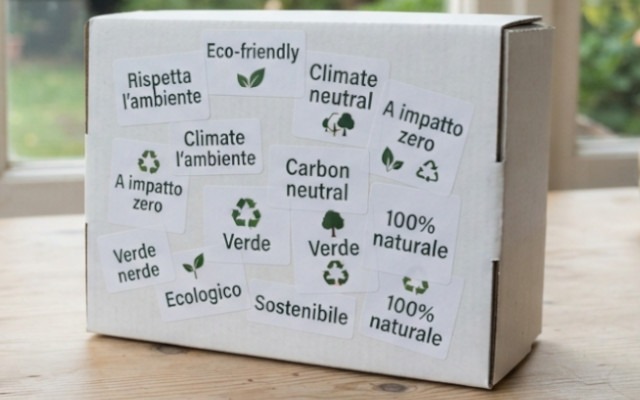
The first answer in section B addresses a widespread doubt: whether terms such as ‘natura‘ (nature) or ‘verde’ (green), included in a registered trade mark or in a company name, in themselves constitute a prohibited generic environmental claim (Consumer Code, Article 23.1, letter ‘d-bis’).
The ministry rules out any automatism and reproduces, in an almost literal translation, the Commission’s answer No 3: brand names and product names, regardless of their protection as intellectual property rights, may be assessed as environmental claims when they convey an environmental message, whether explicit or implicit. The assessment considers the overall commercial context, that is visual elements, packaging, marketing and the perception of the average consumer.
Two situations follow:
- words such as ‘green’ or ‘blue’, or the corresponding colours, are not environmental claims where, in the context in which they appear, they do not lead the average consumer to expect an environmental benefit;
- the same words, like ‘eco’, ‘natural’ or ‘climate neutral’, qualify as environmental claims when they suggest an association with the environment, even without any other advertising. The trader must then specify the claim in clear and prominent terms through the same medium. In the absence of specific information the claim is generic, and recognised excellent environmental performance must be demonstrated.
In substance there is nothing new compared with the Commission. Three remarks concern instead the drafting of the answer.
The first is a citation error. The footnote refers to the Commission’s ‘FAQ n. 21’, which deals with the harmonised notice and label. The passage reproduced is answer No 3.
The second concerns terminology. The answer quotes the Consumer Code correctly, then continues with ‘dichiarazioni ambientali’, ‘indicazione ambientale generica’, ‘eccellente prestazione ambientale riconosciuta’ and ‘stesso supporto’. The legal texts use ‘asserzione ambientale’, ‘asserzione ambientale generica’, ‘eccellenza riconosciuta delle prestazioni ambientali’ and ‘stesso mezzo di comunicazione’, which render environmental claim, generic environmental claim, recognised excellent environmental performance and same medium (dir. 2005/29/EC, Article 2, letters ‘o’ and ‘p’, and Annex I, point 4a). In a document intended to guide traders, inaccurate references to the legal definitions create uncertainty.
The third concerns what is missing. The question is about registered trade marks, yet the answer omits precisely the passages that the Commission devotes to trade mark law:
- a trade mark whose use may be prohibited under provisions other than trade mark law, including consumer protection rules, may be refused registration or declared invalid, where the Member State so provides (dir. EU 2015/2436, Article 4.3, letter ‘a’);
- Member States should ensure that their authorities are able to act against misleading names without being hindered by pre-existing intellectual property rights;
- certification marks can function as sustainability labels, the ‘marchi di sostenibilità’ of the Italian version of the directive, which the Consumer Code renders instead, incorrectly, as ‘etichette di sostenibilità’. In that case they must be based on a certification scheme or be established by public authorities.
Benefit companies and the impact report
The second answer in section B of the Mimit FAQs is the only one without a counterpart in the EU documents. The question is whether the mandatory publication of the impact report on the website of a benefit company (società benefit) in itself brings that document within the notion of B2C commercial communication subject to Legislative Decree 30/2026.
The ministry answers no, because ‘the legal regimes concerned operate in distinct fields and pursue different purposes’. It adds, however, that the relevance of each document published online requires a case-by-case assessment, which takes account ‘of the content and the specific features of the individual case, also in view of the informative purposes pursued’.
In answer No 1 the Commission follows a similar criterion for sustainability reports: as a rule they are out of scope, because they are often mandatory and addressed to investors. It specifies, however, that the information a company takes from them for voluntary advertising directed at consumers does fall within the scope of the ECGT or EMPCO directive.
The ministerial answer is less clear-cut than it appears, and leaves three issues open:
- the impact report must be annexed to the financial statements and published on the company’s website, where one exists (law 208/2015, Article 1, paragraphs 382 and 383). The law therefore requires it to be accessible to anyone, consumers included. The obligation moreover concerns the existence of the document, not the individual statements it contains: the definition of environmental claim excludes only messages that are mandatory in nature;
- the two regimes are not so distinct. The same law subjects a benefit company that does not pursue its common-benefit purposes to the rules on misleading advertising and to those of the Consumer Code on unfair commercial practices, which the AGCM enforces (law 208/2015, Article 1, paragraph 384);
- nothing is said about the use of the designation ‘Società benefit’ or the abbreviation ‘SB’ in communication to consumers (law 208/2015, Article 1, paragraph 379). The designation is a legal status provided for by law, not a trust mark awarded by third parties. Where it is used in advertising to suggest a lower environmental impact of the products, it falls under the ordinary assessment of claims. B Corp certification is a different case, a private certification scheme, to be assessed as a sustainability label (dir. 2005/29/EC, Article 2, letter ‘q’).
In practice an impact report published in the corporate section of a website does not, in itself, qualify as a commercial practice. Its excerpts reproduced on the website, in social media and in promotional materials are a different case, labels included where relevant.
Old stock, remedies and definitions
Section C of the Mimit FAQs concerns stock. The first answer clarifies what is meant by supplementary information at the point of sale: stickers, signs near the shelves and, for online sales, dedicated boxes or pop-ups.
In answer No 18 of its Q&A the Commission refers to stickers that cover or correct claims and to supplementary information in proximity of the products concerned. The CPC common understanding allows corrective information at the point of sale, including online, where appropriate and feasible. First of all, however, it calls for online claims to be removed or corrected, since they do not face the difficulties of those printed on packaging. A pop-up makes sense only for the image of a pack that has not yet been updated. The text of web pages must be corrected at once.
The question published by the ministry speaks of information serving ‘the amnesty of the generic claims on the packs’. The term is inappropriate. No amnesty is provided for: according to the Commission the new rules apply from 27 September 2026 to existing products as well, and according to the CPC Network ‘old stock situations do not exempt traders from complying with the new ECGT rules’.
The second answer introduces four definitions:
- shelf life: the period of conservation between production and the moment by which the product is intended to be consumed or used. For food it corresponds to the date of minimum durability or the ‘use by’ date;
- perishable good: ‘a product, whether food or non-food, with a shelf life not exceeding 30 days’;
- durable good: a product with a shelf life exceeding 30 days;
- existing products: a notion extended to products ‘already manufactured and packaged by that date, even if intended to be marketed subsequently’.
The 30-day threshold does not appear in the EU documents on the directive. It coincides with the one that defines perishable products in the rules on unfair trading practices in the agricultural and food supply chain, that is, products liable to become unfit for sale within 30 days after harvest, production or processing (dir. EU 2019/633, Article 2.5). Those are, moreover, rules on relationships between undertakings, with different aims.
The expression ‘bene durevole’, durable good, is in turn unfortunate when it is applied to the food sector. In the same document section A deals with the durability guarantee of goods meant to last more than two years, and here a yoghurt with a 35-day commercial life becomes ‘durable’.
The broader notion of existing products is instead consistent with the one proposed by the Commission, which relates old stock to ‘products or packaging already manufactured, ordered, distributed or placed on retailers’ shelves before the application date’.
Packaging and labels in stock, six months
The last two Mimit answers are a novelty compared with other interpretations. Products manufactured or packaged before 27 September 2026 may continue to be marketed after that date, according to Mimit ‘provided that their earlier production or packaging can be demonstrated, and without prejudice to every reasonable and proportionate effort to inform consumers correctly’.
Stocks of packaging and labels produced or purchased before that date are also treated as old stock. They may be used to pack new products ‘for both durable and perishable goods, provided that the time horizon for using up the products should remain within the indicative 6 months referred to in the circular of 27 August 2026’. The ministry refers to packaging cycles, stock volumes and production or purchase orders already placed, which the CPC common understanding lists among practical constraints.
Comparison with the EU sources brings out some critical points:
- the six-month period appears neither in the Commission’s answers nor in the CPC common understanding. The latter allows a phased approach ‘in the early stages of application’, where genuine and specific transitional difficulties arise, to be assessed case by case. The Commission, on sustainability labels, recalls that the directive ‘does not provide for a transition period’ beyond 27 September 2026. The ministry thus turns an assessment criterion into a general time horizon, albeit an indicative one;
- the reference to a 30-day shelf life to define perishable goods is in turn problematic. Among the checks that authorities may bring forward in the initial phase, the CPC Network lists ‘products with shorter shelf-life or faster stock rotation’, without giving exact periods, precisely because of the variety and the complexity of the situations;
- the use of stock remains conditional. The ministry states at the outset that every reasonable and proportionate step is in any case required for the correct information of the consumer, without however dwelling on the technical and economic feasibility of alternative solutions, such as applying stickers to the labels in stock;
- the practices listed in Annex I to directive 2005/29/EC are prohibited in all circumstances, with no need to prove their effect on consumer choices. A generic claim printed on a label in stock remains an infringement. Tolerance concerns the priorities and the extent of the authority’s intervention, as shown by the Commission’s references to proportionality, legal certainty and legitimate expectations.
Interim conclusions
The ministry’s FAQs add little on trade marks, where they translate the Commission with some inaccuracies, and a good deal on stock. The novelties compared with the EU sources come down to three:
- the answer on benefit companies, cautious and incomplete;
- the definitions of perishable and durable goods, with a 30-day threshold that is hardly realistic for the vast majority of food products;
- the indicative six-month horizon, extended to the stocks of packaging and labels, equally unrealistic once the supply cycles of those materials are taken into account.
Agri-food supply chain operators must in any case carry out at once an inventory and a compliance review of their commercial information, in order to correct websites and social networks without delay; adapt the new orders of labels and packaging, displays, printed advertising materials and unprinted materials; where necessary and possible, adopt transitional corrective solutions on the printed materials already in use or intended for use until stocks are exhausted; document the reasonable and proportionate efforts in a dedicated compliance programme.
Our team at FARE (Food and Agriculture Requirements), a division of WIISE S.r.l. Società Benefit, assists agri-food supply chain operators in reviewing their levels of compliance, in defining solutions that preserve as far as possible the marketing investments already made, and in setting up adaptation programmes. We also propose the construction of governance systems that serve to prevent the risk of unforeseen liabilities, including those arising from possible non-compliance of B2C and B2B commercial information.
Dario Dongo
References
European Union legislation
Commission Implementing Regulation (EU) 2025/1960 of 25 September 2025 on the design and content of the harmonised notice on the legal guarantee of conformity and of the harmonised label for the commercial guarantee of durability. http://data.europa.eu/eli/reg_impl/2025/1960/oj
Directive 2005/29/EC of the European Parliament and of the Council of 11 May 2005 concerning unfair business-to-consumer commercial practices in the internal market (Unfair Commercial Practices Directive). Consolidated text: 27/09/2026. http://data.europa.eu/eli/dir/2005/29/2026-09-27
Directive 2011/83/EU of the European Parliament and of the Council of 25 October 2011 on consumer rights. Consolidated text: 27/09/2026. http://data.europa.eu/eli/dir/2011/83/2026-09-27
Directive (EU) 2015/2436 of the European Parliament and of the Council of 16 December 2015 to approximate the laws of the Member States relating to trade marks (recast). OJ L 336, 23.12.2015. http://data.europa.eu/eli/dir/2015/2436/oj
Directive (EU) 2019/633 of the European Parliament and of the Council of 17 April 2019 on unfair trading practices in business-to-business relationships in the agricultural and food supply chain. OJ L 111, 25.4.2019, p. 59. http://data.europa.eu/eli/dir/2019/633/oj
Directive (EU) 2024/825 of the European Parliament and of the Council of 28 February 2024 amending Directives 2005/29/EC and 2011/83/EU as regards empowering consumers for the green transition through better protection against unfair practices and through better information. OJ L, 2024/825, 6.3.2024. http://data.europa.eu/eli/dir/2024/825/oj
Regulation (EU) 2017/2394 of the European Parliament and of the Council of 12 December 2017 on cooperation between national authorities responsible for the enforcement of consumer protection laws and repealing Regulation (EC) No 2006/2004. Consolidated text: 31/07/2026. http://data.europa.eu/eli/reg/2017/2394/2026-07-31
Italian legislation
Decreto legislativo 6 settembre 2005, n. 206, ‘Codice del consumo, a norma dell’articolo 7 della legge 29 luglio 2003, n. 229’. Normattiva. Ultima versione consolidata: 16/05/2026. https://www.normattiva.it/eli/id/2005/10/08/005G0232/CONSOLIDATED
Decreto legislativo 20 febbraio 2026, n. 30, ‘Attuazione della direttiva (UE) 2024/825 del Parlamento europeo e del Consiglio, del 28 febbraio 2024, che modifica le direttive 2005/29/CE e 2011/83/UE per quanto riguarda la responsabilizzazione dei consumatori per la transizione verde mediante il miglioramento della tutela dalle pratiche sleali e dell’informazione’. Normattiva. Ultima versione consolidata: 24/03/2026. https://www.normattiva.it/eli/id/2026/03/09/26G00047/CONSOLIDATED
Legge 28 dicembre 2015, n. 208, ‘Disposizioni per la formazione del bilancio annuale e pluriennale dello Stato (legge di stabilità 2016)’, articolo 1, commi 376-384. Normattiva. Ultimo aggiornamento all’atto: 06/08/2026. https://www.normattiva.it/eli/id/2015/12/30/15G00222/CONSOLIDATED
Institutional documents
Consumer Protection Cooperation Network. (2026, June 30). Common understanding on old stock situations under Directive (EU) 2024/825 on Empowering Consumers for the Green Transition. European Commission. https://commission.europa.eu/document/264d8c70-2f9a-4955-8e7b-154d55a9b684_en
European Commission, Directorate-General for Justice and Consumers. (2026, September 22). Questions & Answers – Directive on empowering consumers for the Green Transition. https://commission.europa.eu/document/download/3c257883-bb2a-4dd9-a6dc-501d587bb34f_en?filename=Q%26A%20ECGT_Directive_Sept%202026.pdf
Ministero delle Imprese e del Made in Italy. (2026, August 27). Circolare 27 agosto 2026 – Tutela dalle pratiche sleali e responsabilizzazione dei consumatori per la transizione verde. https://www.mimit.gov.it/it/normativa/circolari-note-direttive-e-atti-di-indirizzo/circolare-27-agosto-2026-tutela-dalle-pratiche-sleali-e-responsabilizzazione-dei-consumatori-per-la-transizione-verde
Ministero delle Imprese e del Made in Italy. (2026, October 1). Responsabilizzazione dei consumatori per la transizione verde – Risposte alle domande frequenti (FAQ). https://www.mimit.gov.it/it/assistenza/domande-frequenti/responsabilizzazione-dei-consumatori-per-la-transizione-verde-risposte-alle-domande-frequenti-faq
FARE and GIFT articles
Dongo, D. (2025, December 15). ‘Environmental claims’ su plastica riciclata. FARE (Food and Agriculture Requirements). https://fareagrifood.com/2025/12/15/green-claims-plastica-riciclata/
Dongo, D. (2026a, June 22). ‘Made Green in Italy’: il marchio di sostenibilità. GIFT (Great Italian Food Trade). https://www.greatitalianfoodtrade.it/certificazioni-e-analisi/made-green-in-italy-marchio-sostenibilita/
Dongo, D. (2026b, July 29). Marchio ‘Natura…’ e greenwashing. FARE (Food and Agriculture Requirements). https://fareagrifood.com/2026/07/29/marchio-natura-greenwashing-etichette-alimentari/
Dongo, D. (2026c, August 18). Modello 231, reati alimentari e greenwashing. FARE (Food and Agriculture Requirements). https://fareagrifood.com/2026/08/18/reati-alimentari-modello-231/
Dongo, D. (2026d, September 12). Certificazioni ambientali di alimenti e servizi. GIFT (Great Italian Food Trade). https://www.greatitalianfoodtrade.it/certificazioni-e-analisi/certificazioni-ambientali-alimenti-servizi-standard-schemi/

Dario Dongo, lawyer and journalist, PhD in international food law, founder of WIISE (FARE - GIFT - Food Times) and Égalité.