
In Cameroon-as in several other tropical latitude countries, from Southeast Asia to Central and South America via Central Africa (1)-the palmocrats continue land robbery and deforestation. Investigations by The Oakland Institute, Greenpeace, ReAct. #Buycott!
The true cost of palm oil
Palm oil is still the most widely used vegetable fat in the world. It is very inexpensive and its consistency is ideal for preparing ultra-processed foods, mostly
junk-food
. But also cosmetics, detergents and especially biodiesel.
The true cost of this tropical fat is not seen on the shelf. In Europe we can only note how palm oil is often found in junk food, which accounts for 68 percent of the food supply aimed at our young people. Its ‘invisible’ cost is therefore linked to obesity, which affects 1 in 4 children in Italy. And to related diseases, so-called Non-Communicable Diseases (NCDs), from diabetes to hepatic steatosis.
The most serious cost, however, is externalized-from the palmocrats and their colossal clients-to the countries of production, onto the populations that are violently wrested from their lands. The cost of basic human rights desecrated through land robbery, so-called land grabbing. That adds up with the cost of the climate emergency for which palm is primarily responsible, along with GMO soybeans. Due to devastation of primary forests, fires and greenhouse gas emissions. (2)
Cameroon, neocolonialism and deforestation. Herakles Farms (USA)
Herakles Farms-a Corporation owned by the Blackstond Investment Fund (U.S.A.) and dedicated to palm oil and timber production-has been operating in Cameroon since 2009. When it obtained, through its subsidiary SG Sustainable Oils Cameroon (one name, one program), a local government concession to exploit 73,000 hectares of primary forest in the Southwest of the country for 99 years. An area slightly smaller than the province of Lodi (78,299 ha), where numerous human settlements insist, would have been deforested for timber extraction and trade. And the subsequent planting of oil palm monocultures.
However, local people have complained that they have had their lands expropriated without being consulted in advance, nor having given their consent, nor having received any compensation. Following protests, which garnered the attention of the press and some international think-tanks, the concession was downsized to 20,000 ha in 2013, expiring in 2016. Also following the detection by the Independent Observer of Forestry Control (established in Cameroon with EU funding) of illegal deforestation activities by Herakles Farms.
Conflicts over land and incidents of violence suffered by villagers are exacerbated the secret agreements reached by Herakles Farm with some village leaders. Agreements reached through intimidation, violence and corruption, according to the February 2013 report by the Cameroonian Ministry of Forestry and Wildlife and the Programme for Sustainable Management of Natural Resources.
The report ‘Herakles exposed,’ by Greenpeace and The Oakland Institute, reveals the falsity of the data on which the concessions are based and the Corporation ‘s failure to meet its commitments to local people. (3) Indeed, the topographic surveys and studies produced by the researchers disproved the assumption that the areas were covered by secondary (i.e., already cleared) forest, as they were primary virgin forest instead. One of the world’s most important biodiversity havens. In fact, the rainforest in Cameroon is home to tens of thousands of species of trees, reptiles, birds and mammals. Some of these at serious risk of extinction, such as the Nigerian chimpanzee.
Intimidation and violence on populations have in turn led to numerous prosecutions and in some cases convictions and inhibitions of the Corporation ‘s subsidiary and its sub-contractors. Who by the way, in defiance of contractual commitments, have not even compensated for land expropriations by creating infrastructure and job opportunities.
Cameroon, neocolonialism and deforestation. Socfin (Bolloré Group, Luxembourg – France)
The French Bolloré group controls Socfin with 38.7 percent of the shares. A Luxembourg-based, RSPO-registered Corporation that manages about 200 thousand hectares of oil palm and rubber tree plantations between Central Africa and Asia. In May 2019, a series of demonstrations against its activities in Cameroon were conducted in the same country-by local communities represented by the NGOSynaparcam (Synergie Nationale des Paysans Et Riverains du Cameroun)-as well as in Luxembourg, France, and Belgium.
Socfin operates in Cameroon through two local companies. Safacam, founded in 1897 and acquired by Socfin in 2014, which holds a concession of more than 15,000 hectares. And Socapalm, established in 1968 by the government of Cameroon and acquired by Socfin in 2000 following privatization, which in turn has 58,000 hectares.
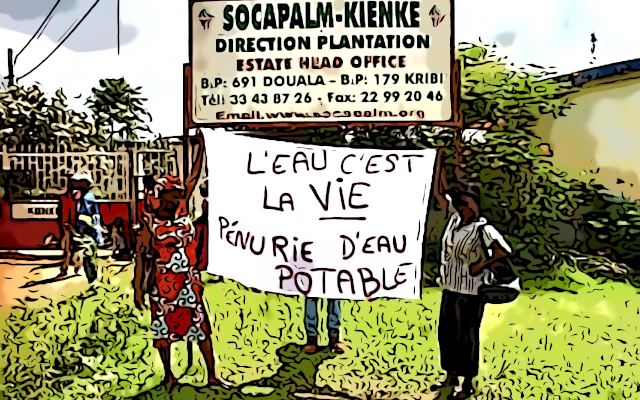
Cameroonian May demonstrations began because of the failure to return 20,000 hectares of land to citizens. But the problems are even more serious. Socfin diverted and diverted some waterways that provided water security as well as provided fish. It has polluted the watersheds with herbicides and pesticides-such as glyphosate and 2.4-D-without even respecting the boundaries between plantations and houses, so as to deprive the inhabitants of even the patches of land used to produce the food needed by the family.
Assault and violence, threats and intimidation against the women–by armed guards guarding the plantations on behalf of a sub-contractor of local Socfin group companies–have also been reported. So is the desecration of ancestral domains, the sacred places where ancestors are buried. And once again, ça va sans dir, non-compliance with commitments to support local communities with infrastructure, education and jobs. The situation is extensively described in ReAct’s ‘Développement insoutenable‘ report. (4)
1% vs. 99%, the palm oil supply chain
Palm oil equals abuses of basic human rights, murder and violence, land robbery and child slavery. In addition to ecocides, in the few oases of biodiversity that have survived the predator-man so far. With the complicity of governments and local governments in countries of the Global South, as well as the connivance of Northern politics and finance.
It is grotesque to attest that tycoon Bolloré’s companies even steal the land around the homes, as well as the villages and cemeteries, of human beings already below the poverty line. Thinking then that some of them-not out of thirst for wealth and hedonism but out of desperation and the need to feed their families-then decide to risk their lives to cross the Sahel, the Sahara and Africa. To be ‘branded’ not as victims of Western neocolonialism, but as ‘economic migrants’.
Reacting is necessary. To our readers, once again, the invitation to sign and promote the #Buycott petition! Palm oil, GMO soy, and meats from the Americas, following the link https://www.egalite.org/buycott-petizione/. #NotInOurName. It is essential to refrain from purchasing any food or cosmetic products that contain palm oil, to stop the demand for this unclean fat of blood, fire and poisons.
Dario Dongo and Alessandra Mei
Notes
(1) See previous articles on land grabbing and palm oil in Congo and Gabon.
(2) On land robbery and climate emergency, see also what is reported in IPCC(Intergovernmental Panel on Climate Change) report 8.8.19. Recent investigations into palm oil-related fires in Indonesia and Borneo, see articles https://www.greatitalianfoodtrade.it/consum-attori/indonesia-incendi-e-olio-di-palma-certificato-rspo-rapporto-greenpeace, https://www.greatitalianfoodtrade.it/consum-attori/borneo-in-fiamme-per-l-olio-di-palma-il-report-cnn-buycott
(3) See The Oakland Institute, Greenpeace (2019).
Herakles Exposed.
,
(4) https://www.projet-react.org/fr/rapport-de-developpement-insoutenable/
(5) More news about Bolloré’s abuses in Africa are also offered by the Financial Times. V. https://www.ft.com/content/afad0d44-4946-11e8-8ee8-cae73aab7ccb
Dario Dongo, lawyer and journalist, PhD in international food law, founder of WIISE (FARE - GIFT - Food Times) and Égalité.

Graduated in Law from the University of Bologna, she attended the Master in Food Law at the same University. You participate in the WIISE srl benefit team by dedicating yourself to European and international research and innovation projects.


