

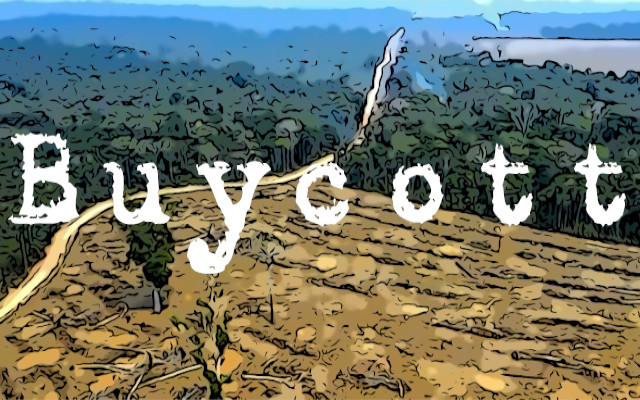
Stop imports of goods whose production causes deforestation. Greenpeace’s petition asks the European Union to establish strict rules to stop the import of meat and raw materials that come from land taken from primary forests.
Every three seconds around the world, an area of forest as large as a soccer field is bulldozed, the environmental organization warns. To make way – in 80 percent of cases – for monocultures of oil palm and GMO soybeans, i.e., cattle pastures ahead of the latter. Or again, to cocoa and other agribusiness commodities.
Deforestation and liability
Those responsible for the ecocides are the agro-industrial giants who produce and those who purchase the said goods. With the wilful connivance of governments like that of Jair Bolsonaro in Brazil and various others. And the unintentional or distracted complicity of consumers who do not mind the ingredients of ultra-processed foods (e.g., palm oil) or the
fair trade
(e.g., cocoa) and origin (e.g., soy, meats).
The Italian government, we add, is itself complicit. As it stubbornly persists in not introducing the mandatory origin of meat served by communities (restaurants and eateries, fast-food restaurants and diners, canteens and caterers). As GIFT(Great Italian Food Trade) has been asking for years, alongside the Italia Zootecnia Consortium. And this is how Italy finds itself as the leading importer of Brazilian meat to Europe (>25 thousand tons, between July 2019 and June 2020).
South American ecocide
The South American ecocide meanwhile proceeds, the Amazon and Cerrado also burning in the Covid-19 era at an unprecedented rate in the past 10 years. And the situation is bound to get even worse if and when EU member states ratify the toxic treaty between the European Union and the Mercosur countries (Brazil, Argentina, Paraguay and Uruguay).
The treaty would create‘a legal and economic framework designed to increase the trade in meat, feed and other products already strongly linked to the destruction of the Amazon, the ongoing climate crisis and the violation of human rights,’ Greenpeace stresses. And any attempt to protect the environment and human rights would be understood as a violation of the trade agreement, with economic repercussions for governments.
Greenpeace, the petition
Greenpeace urges support for the petition asking the European Union to introduce suitable rules to address three crucial points:
1) Ensure that all agricultural raw materials and their derivatives placed on the EU market are produced under strict socio-environmental sustainability criteria. Excluding food produced by companies responsible for deforestation and/or degradation of forests and other natural ecosystems, or human rights violations,
2) Require EU-based operators to have traceability and transparency on supply chains, to be subject to third-party verification,
3) Require financial players (banks, investors, insurers, and the public sector) to be transparent about underlying investments. To prevent the financial system from fueling deforestation and human rights violations.
Buycott! Palm oil, GMO soy, and American meats.
The boycott of palm oil, GMO soy, and U.S. meats remains front and center. Disrupting the demand for incendiary and bloodthirsty commodities, with no confidence in false attestations of hypothetical sustainability of some of their supply chains.
We renew our call to boycott these products and support the petition by Égalité and GIFT(Great Italian Food Trade), at https://www.egalite.org/buycott-petizione/. With support from Legambiente, Associazione Comuni Virtuosi, No Pesticides group, CALG(Coalition Against Land Grabbing), European Consumers, Humus network.
Dario Dongo and Marta Strinati

Dario Dongo, lawyer and journalist, PhD in international food law, founder of WIISE (FARE - GIFT - Food Times) and Égalité.

Professional journalist since January 1995, he has worked for newspapers (Il Messaggero, Paese Sera, La Stampa) and periodicals (NumeroUno, Il Salvagente). She is the author of journalistic surveys on food, she has published the book "Reading labels to know what we eat".


