
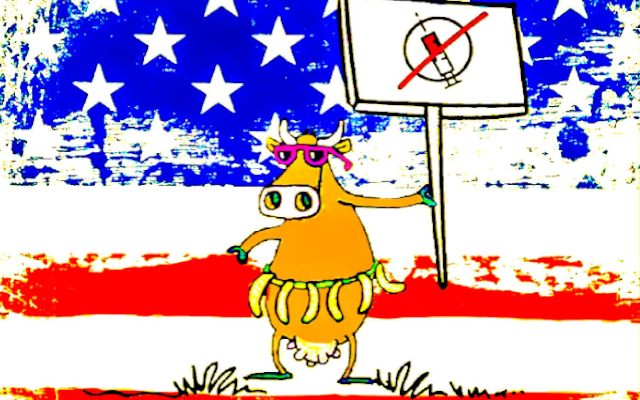
Agrotoxics and GMOs out of control, cloning, synthetic hormones, veterinary drugs banned in Europe, and cattle fed animal meal. The ‘American dream’ pursued by European political puppets with TTIP, CETA and Mercosur will bring this and more to our tables. Also contaminated milk. A confirmation from the recent study of Emory University (Georgia, USA). (1) The label of origin is urgently needed.
Milk, why and especially which one?
Milk consumption has finally been cleared by the international scientific community in the largest cohort study ever conducted. The c.d.
Worldwide Study
, published in The Lancet in 2018, was conducted in 21 countries on 5 continents, among 136,684 individuals aged 35-70 whose health conditions were followed for 9 years. (2)
Milk has been called a true ‘nutrient,’ with the dual advantages of providing a significant amount of nutrients (e.g., protein, minerals and vitamins and) with a relatively low energy intake. (3) Solid scientific literature associates its regular consumption with bone health due to calcium richness. Added to this are additional virtues, also related to the presence of protein and fat (including unsaturated), vitamin D and other micronutrients. It can therefore be a health ingredient as part of a healthy, balanced diet. But there is milk and milk.
Barn milk and organic ‘grass milk’ have substantial differences. Not only from the point of view of animal welfare, but also in terms of organoleptic and compositional qualities. A recent meta-analysis, published in 2016 in the British Journal of Nutrition, suggests substantial improvements in the fat composition of organic milk, which is significantly richer in polyunsaturated fatty acids (PUFAs). (4) More Omega 3, ideal ratio of Omega 3 to Omega 6, presence of CLA, higher amounts of antioxidants, vitamins and minerals.
Organically raised dairy cows take up more grass than those subjected to intensive farming. Like humans, those who eat better and move regularly enjoy better health. A simple and yet not obvious logic, otherwise conventional milk would have already disappeared from the shelves. It is all the more necessary to help consumers understand the value of real milk so that the exception can become the rule of supply on the mass market. Because health is everyone’s right-not to be reserved for the elites who frequent the ‘organic goldsmiths’-everyone must know where and how, with what foods the animal was raised. GMO soy, #buycott.
Conventional milk, the American nightmare.
The study from Emory University, carried out with the support of
The Organic Center
, analyzed 8 brands of milk, conventional and organic. Representativeness of the sample was ensured by collecting the same references (half-gallon, 1.9-liter packages) from supermarkets in the 9 U.S. regions. With the aim of investigating the differences between the two food categories. Analyzing, in particular, pesticide, antibiotic and hormone residues.
Antibiotic residues
were detected in 60 percent of the conventional product samples but in none of the biological ones. With a not insignificant aggravation, the detection of sulfamethazine and sulfatiazole–veterinary drugs also banned in the U.S. for several years–in 37 percent and 26 percent of barn milks, respectively. Reconfirming what the writer(Dongo) has always denounced, the inadequacy of overseas food law to guarantee public health and animal welfare. (5)
Pesticides-including chlorpyrifos, atrazine (banned in Italy for a quarter of a century!) and permethrin-have been found in quotas as high as 60 percent of conventional milk samples. Residues of the chlorinated pesticides were also found in 59% of the samples, although they were also subject to limits in the US. The source of the pollution is evidently to be traced to agrotoxics widely used in GMO soybeans and cereals fed to dairy cows. And it is useful to remember how the residue of such substances in foods can expose consumers to different levels of intoxication, including alterations in the microbiome. Organic milks, on the other hand, were found to be exempt.
Growth hormones were found to be 20 and 3 times higher in conventional milk compared with organic for bovine growth hormone (bGH) and insulin-like growth factor (IGF1), respectively. U.S. legislation, it should be noted, has no limit on hormone residues in meat and milk. While the scientific literature demonstrates its danger to human health, with sure endocrine disruption and risks including acromegaly (bGH) and breast cancer (IGF1). (6)

#Buycott and mandatory origin, meat origin
Italian and European ports have already been opened to cargoes of meats, milks and their derivatives that come from sick and unsustainable supply chains. Because of the toxic treaties already concluded by the Juncker Commission, with the endorsement of the Italian politicians of the last two governments. The #Buycott of GMO soy (even where used in the feed of our farm animals), palm oil and overseas meats is necessary but not sufficient. Contaminated U.S.-sourced meat and milk can in fact be imported, under conditions of socio-environmental dumping, and end up on our plates without consumersAre aware of it.
New rules are needed, to ensure transparency of information and thus the ability of consumers to make informed purchasing and nutrition choices:
– Mandatory labeling of all or food products of the origin and/or provenance of milk and meat used as ingredients in other foods. The Juncker Commission, it will be recalled, had already rejected such a hypothesis, garnering vibrant (yet vacuous) protests from the European Parliament, in the previous parliamentary term,
– Mandatory origin of meat served by communities (e.g. restaurants, eateries, fast food and take-away, canteens, catering). The substantial coincidence, in Italy, between the consumption of non-Italian meats and the consumption of meals outside the home is no coincidence. Italian consumers rightly trust Italian animal husbandry more and should always be able to know where the meat on their plates comes from.
The first rule must come from the European Commission, in response to the repeated demands of Parliament but also to the fears of citizens, as noted in the Efsa and Eurobarometer report 7.6.19. The second, on the other hand, is up to the national legislature, since it is referred by the ‘Food Information Regulation‘ to concurrent legislation. (7) We have already urged former agriculture ministers Maurizio Martina and Gian Maria Centinaio, to no avail. We will return to the charge and insist, relentlessly, until we see the decree in the Official Gazette. One only has to wonder what happened to the self-styled champions of the Italian agricultural supply chain and consumers, each perhaps too distracted to polish their own armchairs.
Food sovereignty. #Égalité!
Dario Dongo and Marta Strinati
Notes
(1) Jean A Welsh, Hayley Braun, Nicole Brown, Caroline Um, Karen Ehret, Janet Figueroa, Dana Boyd Barr. (2019). Production-related contaminants (pesticides, antibiotics and hormones) in organic and conventionally produced milk samples sold in the USA, Cambridge University Press https://doi.org/10.1017/S136898001900106X
(2) Dehghan M., Mente A., Rangarajan S., Sheridan P., Mohan V., et al., on behalf of the Prospective Urban Rural Epidemiology (PURE) study investigators. (2018). Association of dairy intake with cardiovascular disease and mortality in 21 countries from five continents (PURE): a prospective cohort study. Lancet 2018; 392: 2288-97. http://dx.doi.org/10.1016/S0140-6736(18)31812-9
(3) For pasteurized whole cow’s milk, 64 kcal / 100 g (whole), 46 kcal (semi-skimmed), 36 kcal (skimmed), respectively. 76 kcal goat’s milk, 103 sheep’s milk. Source: CREA database, formerly INRAN, from http://nut.entecra.it/646/tabelle_di_composizione_degli_alimenti.html?alimento=latte&nutriente=tutti&categoria=tutte&quant=100&submitted1=TRUE&sendbutton=Cerca
(4) Dominika Średnicka-Tober, Marcin Barański, […], and Carlo Leifert. (2016). Higher PUFA and n-3 PUFA, conjugated linoleic acid, α-tocopherol and iron, but lower iodine and selenium concentrations in organic milk: a systematic literature review and meta- and redundancy analyses. Br J Nutr. 2016 Mar 28; 115(6): 1043-1060. doi: 10.1017/S0007114516000349
(5) See also the appropriate chapter in the ebook ‘Food Safety, Mandatory Rules and Voluntary Standards,’ at https://www.greatitalianfoodtrade.it/libri/sicurezza-alimentare-regole-cogenti-e-norme-volontarie-il-nuovo-libro-di-dario-dongo
(6) Silvana Duran-Ortiz, Alison L. Brittain, and John J. Kopchick. (2017) The impact of growth hormone on proteomic profiles: a review of mouse and adult human studies. Clin Proteomics. 2017; 14: 24. doi: 10.1186/s12014-017-9160-2. Suren Sarkissyan, Marianna Sarkissyan, […], and Jaydutt V. Vadgama. (2014). IGF-1 Regulates Cyr61 Induced Breast Cancer Cell Proliferation and Invasion. PLoS One. 2014; 9(7): e103534. doi: 10.1371/journal.pone.0103534
(7) See reg. EU 1169/11, Article 44

Dario Dongo, lawyer and journalist, PhD in international food law, founder of WIISE (FARE - GIFT - Food Times) and Égalité.

Professional journalist since January 1995, he has worked for newspapers (Il Messaggero, Paese Sera, La Stampa) and periodicals (NumeroUno, Il Salvagente). She is the author of journalistic surveys on food, she has published the book "Reading labels to know what we eat".