
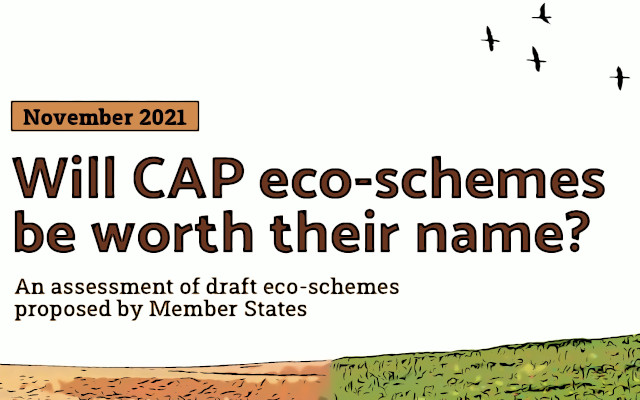
The post-2022 CAP’s eco-schemes, planned to reward farmers who strive for sustainability, disappoint expectations. So concludes the study by European environmental NGOs, including WWF and BirdLife, which analyzed drafts of 166 eco-schemes from 21 EU member states. Interventions worth about 48.5 billion euros of European funding over 5 years.
CAP post 2022, the eco-schemes
In the reform of the Common Agricultural Policy (CAP) in effect in 2023, the two most important changes are the CAP’s national strategic plans (CSPs), expected to be submitted to the Commission by the end of 2021, and the introduction of eco-schemes, harbingers of a new form of direct payment for environmentally friendly agriculture, according to the Green Deal European. (2)
However, expectations for the expected benefits are likely to be disappointed. According to the environmental NGO report, only 19 percent of the eco-schemes proposed by member states are suitable for meeting environmental goals.
41% are misaligned
The eco-schemes report is based on drafts provided by environmental NGOs and associations, such as CambiamoAgricoltura, partially informed by their respective governments. The final version may therefore vary, but the data collected are considered sufficient to analyze the potential (dis)alignment of eco-schemes with the goals of the EuropeanGreen Deal .
‘As things stand, the eco-schemes proposed by member states will fall far short of expectations. It is believed that only 19% of eco-schemes can meet their stated environmental goals, 40% would need significant improvement to be effective, and 41% are completely misaligned’, write the associations, which point to the 5 worst examples of eco-schemes.
1) Eco-schemes for precision agriculture.
In the absence of parameters or requirements for effective input reductions, ‘In addition to the uncertain environmental benefits of these schemes, the proposal to pay farmers a fixed rate per hectare for the use of precision farming technologies would benefit the largest farms, whose economies of scale already make this practice profitable, so government support is not justified‘, is the critique.
2) Eco-schemes for no-till farming.
The effectiveness of no-till farming technique – i.e., without plowing, which is considered destructive to soil organic matter and conducive to fertility loss and erosion-decades if guarantees on the exclusion of herbicides (e.g., glyphosate or glyphosate) and requirements to apply the other two ‘pillars’ of conservation agriculture, i.e., complex crop rotations and constant soil cover, are lacking. ‘Not only does no-till have limited benefits as a stand-alone practice (except in soil erosion hotspots), but these schemes could even lead to increased herbicide use as the most common alternative strategy to plowing for weed suppression‘.
3) Eco-schemes for end-of-pipe solutions in intensive livestock production.
Technologies end of pipe or end-of-cycle take action on the treatment of the pollution produced. In the case of intensive livestock production, they consist of feed additives for dairy cows, certified cattle feeding plans, or below-average or reduced antimicrobial use. ‘These eco-schemes do not address the underlying factors of pollution or overuse of antimicrobials and could become ‘polluter gets paid’ subsidies for intensive animal farming‘.
4) Eco-schemes for crop diversification.
The measure is a greening requirement in the current CAP but has been assessed to have very limited environmental benefits. ‘Crop diversification is part of the cross-compliance of the future CAP, and it is very unlikely that these ecological schemes will bring any real benefits, as they do not guarantee a real increase in crop diversity, nor do they address plot size; in other words, still allowing large monocultures‘.
5) Eco-schemes for standard prairie management.
They are unsuitable for the objectives if they do not include any limits on livestock density (in regions where it would be ecologically sound to do so) or appropriate management requirements to ensure that extensive mowing or grazing produces the desired biodiversity or climate benefits.
The analysis of the eco-schemes, in the authors’ intentions, should spur governments to improve their strategic plans and urge the European Commission to evaluate them very critically.
Marta Strinati
Notes
(1) WWF, European Environmental Bureau. Will CAP eco-schemes be worth their name?
(2) The agricultural goals of the European Green Deal to be achieved by 2030 according to the strategies of the
EU Farm to Fork
and Biodiversity are:
– At least 10 percent of the EU’s agricultural area has high diversity landscape features.
– At least 25 percent of the EU’s agricultural area is farmed organically.
– Reduce the overall use and risk of chemical pesticides by 50%; reduce the use of more hazardous pesticides by 50%.
– Reduce nutrient losses by at least 50%; reduce fertilizer by at least 20%.
– Reduce sales of antimicrobials for farm animals by 50%. In addition, the European Green Deal includes key commitments to achieve climate neutrality by 2050 and to preserve and restore ecosystems and biodiversity.

Professional journalist since January 1995, he has worked for newspapers (Il Messaggero, Paese Sera, La Stampa) and periodicals (NumeroUno, Il Salvagente). She is the author of journalistic surveys on food, she has published the book "Reading labels to know what we eat".