


A unique, multi-source critical analysis of EU poultry welfare is presented, synthesizing official conventional and organic regulations with NGO recommendations, voluntary standards, and scientific findings (including EFSA).
For conscious consumers, the clearest distinction impacting welfare is tangible: organic standards require birds to have substantial indoor space (no cages) and mandatory outdoor access, contrasting sharply with the higher-density, often exclusively indoor, conditions of conventional farming.
Examining the real-world outcomes in breeding, rearing, and antibiotic use highlights significant gaps and leads to an urgent call for specific EU reforms based on this comprehensive evidence.
Regulatory framework overview
Conventional poultry production in the EU is primarily governed by:
- Council Directive 98/58/EC concerning the protection of animals kept for farming purposes;
- Council Directive 1999/74/EC laying down minimum standards for the protection of laying hens;
- Council Directive 2007/43/EC laying down minimum rules for the protection of chickens kept for meat production;
- Regulation (EC) No 1/2005 on the protection of animals during transport;
- Regulation (EC) No 1099/2009 on the protection of animals at the time of killing.
Organic poultry production must comply with both the above regulations and the additional requirements of:
- Regulation (EU) 2018/848 on organic production and labelling of organic products;
- Commission Implementing Regulation (EU) 2020/464 laying down detailed rules for the application of Regulation (EU) 2018/848.
Breeding requirements
Conventional poultry breeding
EU legislation provides limited specific requirements regarding breeding methods for conventional poultry production. The general framework is established in Council Directive 98/58/EC, which states in Annex, paragraph 21:
‘No animal shall be kept for farming purposes unless it can reasonably be expected, on the basis of its genotype or phenotype, that it can be kept without detrimental effect on its health or welfare.’
This provision implies that breeding should not produce birds with traits that inherently compromise animal welfare, though it does not explicitly restrict any specific breeding practices or genetic selection criteria commonly used in conventional poultry production.
In practice, conventional breeding typically prioritizes production traits such as rapid growth rates, feed conversion efficiency, or egg production, which can lead to animal welfare concerns when pushed to extremes. For broiler chickens in particular, this has resulted in birds prone to leg disorders, cardiovascular problems, and metabolic diseases. As a core component of poultry livestock production, breeding practices significantly influence not only productivity but also the inherent animal welfare capacity of the birds throughout their lifecycle.
Organic poultry breeding
Organic poultry breeding is subject to more stringent requirements under Regulation (EU) 2018/848:
- ‘with regard to the origin of animals; organic livestock shall be born or hatched and raised on organic production units’ (Article 16, Annex II);
- ‘the choice of breeds shall take account of their capacity to adapt to local conditions, their vitality and their resistance to disease, without impairment of their welfare’ (Article 14.1.c.iv);
- ‘when choosing breeds or strains, operators shall consider giving preference to breeds or strains with high genetic diversity, the capacity to adapt to local conditions, breeding value, longevity, vitality and resistance to disease or health issues, all this without impairment of their welfare’ (Annex II, Part II, point 1.9.4.4).
These requirements place greater emphasis on selecting breeds for health, adaptation, and vitality rather than solely for production traits. Moreover, Implementing Regulation (EU) 2020/464 concerning organic poultry production stipulates that ‘poultry for meat production which are not of slow-growing strains shall not be slaughtered before the age of:
(a) 81 days for chickens;
(b) 150 days for capons;
(c) 49 days for Peking ducks;
(d) 70 days for female Muscovy ducks;
(e) 84 days for male Muscovy ducks;
(f) 92 days for Mallard ducks;
(g) 94 days for guinea fowl;
(h) 140 days for male turkeys and roasting geese;
(i) 100 days for female turkeys’ (Article 26.2).
This provision encourages the use of slower-growing breeds in organic production. Member States are responsible for defining criteria for slow-growing strains or establishing a list of such strains used in their territory. As a fundamental component of poultry livestock production, these breeding requirements recognize that genetic selection directly influences the birds’ ability to thrive in organic management systems throughout their production lifecycle.
Rearing requirements
Rearing requirements form a critical component of poultry livestock production, encompassing the daily management practices, housing conditions, and care protocols that directly impact bird welfare throughout their productive lives.
Conventional poultry rearing
Space allowances and housing systems
For laying hens, Directive 1999/74/EC defined three production systems for laying hens, although one is no longer permitted:
- (unenriched cage systems, banned since 2012);
- enriched cage systems;
- alternative (non-cage) systems.
For enriched cages, Article 6 of Directive 1999/74/EC requires:
‘At least 750 cm² of cage area per hen, 600 cm² of which shall be usable [slightly smaller than an A4 sheet of paper, which measures 623 cm², Ed. note]; the height of the cage other than that above the usable area shall be at least 20 cm at every point [slightly shorter than the short side of an A4 sheet, which measures 21 cm, Ed. note] and no cage shall have a total area that is less than 2000 cm² [roughly the size of a standard 15.6-inch laptop screen, Ed. note].
For alternative (non-cage) systems, Article 4 of the same directive stipulates that ‘the stocking density must not exceed nine laying hens per m² of usable area.’
For broiler chickens, Directive 2007/43/EC Article 3(2) sets the standard stocking density at ‘33 kg/m² maximum’. This can be increased to 39 kg/m² or 42 kg/m² under certain conditions if additional welfare requirements are met and documented.
Access to outdoors
Conventional poultry systems have no mandatory requirement for outdoor access. Barn systems (alternative systems without outdoor access) are permitted under EU legislation, provided they meet the space and enrichment requirements of Directive 1999/74/EC for laying hens or Directive 2007/43/EC for broilers.
Environmental enrichment
For laying hens in enriched cages, Directive 1999/74/EC Article 6 requires:
‘A nest, litter such that pecking and scratching are possible, and appropriate perches allowing at least 15 cm per hen [approximately the width of two standard smartphones placed side by side, Ed. note]’.
For alternative systems, Article 4 requires:
- ‘at least one nest for every seven hens. If group nests are used, there must be at least 1 m² of nest space [roughly the size of two standard sleeping cushions, each measuring about 50 cm × 50 cm, Ed. note] for a maximum of 120 hens’;
- ‘perches without sharp edges and providing at least 15 cm per hen. Perches must not be mounted above the litter and the horizontal distance between perches must be at least 30 cm and the horizontal distance between the perch and the wall must be at least 20 cm’;
- ‘at least 250 cm² of littered area per hen [roughly the size of a small notebook, which measures about 12 cm × 20 cm, Ed. note], the litter occupying at least one third of the ground surface’.
For broilers, Directive 2007/43/EC does not specifically mandate perches or nests but does require that ‘all chickens shall have permanent access to litter which is dry and friable on the surface’.
Beak trimming and other mutilations
Directive 1999/74/EC Article 8 permits beak trimming for laying hens under certain conditions:
‘Without prejudice to the provisions of point 19 of the Annex to Directive 98/58/EC, all mutilation shall be prohibited. In order to prevent feather pecking and cannibalism, however, the Member States may authorise beak trimming provided it is carried out by qualified staff on chickens that are less than 10 days old and intended for laying.’
For broilers, Directive 2007/43/EC does not contain specific provisions on beak trimming, but the general provisions of Directive 98/58/EC apply, which allow mutilations only for therapeutic or diagnostic purposes or for the identification of animals.
Organic poultry rearing
Space allowances and housing systems
Regulation (EU) 2018/848, Annex II, Part II, point 1.9.4 prohibits cage systems entirely for organic production.
Implementing Regulation (EU) 2020/464 Article 15 establishes specific space requirements for housing:
- for laying hens, ‘the stocking density shall not exceed six animals per m² of usable area for indoor poultry houses’;
- for meat birds in fixed housing, ‘the total usable area of poultry houses for meat production shall not exceed 1 600 m² per production unit [roughly the size of six standard tennis courts, each measuring about 23.77 m × 10.97 m, Ed. note]. The stocking density in poultry houses shall not exceed 21 kg of live weight per m² of usable area’ [half of the maximum permitted in conventional poultry farming, Ed. note].
In organic farming, ‘poultry houses shall be constructed in a manner that allows all birds easy access to an open air area’ (Article 15.2), a provision not required for conventionally raised birds, who do not have guaranteed access to such spaces.
Access to outdoors
Outdoor access is mandatory for organic poultry. Regulation (EU) 2018/848 states that:
- ‘poultry shall have access to an open air area for at least one third of their life. However,
- laying hens and finisher poultry shall have access to an open air area for at least one third of their life, except where temporary restrictions have been imposed on the basis of Union legislation.’ (Annex II, Part II, point 1.9.4.4.c).
Implementing Regulation (EU) 2020/464 further specifies requirements for open-air areas:
- ‘open air areas for poultry shall be mainly covered with vegetation composed of a diverse range of plants’; ‘open air areas shall provide poultry with easy access to adequate numbers of drinking troughs’;
- ‘for laying hens, the open air areas shall have a radius of no more than 150 m from the nearest pop-hole of the poultry house. However, an extension of up to 350 m from the nearest pop-hole of the poultry house is permissible provided that a sufficient number of shelters from adverse weather conditions and predators are evenly distributed in the whole open air area with a minimum of four shelters per hectare’;
- minimum space requirements. ‘For laying hens; 4 m² per bird’; ‘For broilers; 4 m² per bird’ (Article 16).
Environmental enrichment
Implementing Regulation (EU) 2020/464 provides that:
- ‘the buildings shall be equipped with perches of a size and number commensurate with the size of the group and of the birds as laid down in Annex I’ (Article 15.5);
- ‘in fixed poultry houses for laying hens; at least 18 cm of perch space per bird’ (Annex I);
- ‘poultry houses shall have exit/entry pop-holes of a size adequate for the birds, and those pop-holes shall have a combined length of at least 4 m per 100 m² of usable area’ (Article 15.6).
Beak trimming and other mutilations
Regulation (EU) 2018/848 states:
- ‘suffering, pain and distress shall be avoided and shall be kept to a minimum during the entire life of the animal, including at the time of slaughter. Mutilation such as clipping of wings, beak trimming and dehorning, including in the case of castration, shall be prohibited‘;
- ‘however, under certain conditions such operations may be allowed on a case-by-case basis by the competent authority for reasons of safety or if they are intended to improve the health, welfare or hygiene of the livestock’;
- ‘suffering of the animals shall be reduced to a minimum by applying adequate anaesthesia and/or analgesia and by carrying out the operation only at the appropriate age by qualified personnel’ (Annex II, Part II, point 1.7.8).
In practice, this means beak trimming is generally prohibited in organic production, with exceptions granted only in specific cases and under strict conditions.
Antibiotics and other medicines restrictions
Medical interventions, including antimicrobial use, represent an important aspect of poultry livestock production systems that significantly impacts both animal welfare and public health concerns.
Conventional poultry production
In conventional poultry production, Regulation (EU) 2019/6 on veterinary medicinal products governs the use of antibiotics and other medicines. Key provisions include that antimicrobial medicinal products:
- ‘shall not be applied routinely nor used to compensate for poor hygiene, inadequate animal husbandry or lack of care or to compensate for poor farm management’ (Article 107.1);
- ‘shall not be used for prophylaxis other than in exceptional cases, for the administration to an individual animal or a restricted number of animals when the risk of an infection or of an infectious disease is very high and the consequences are likely to be severe’ (Article 107.3);
- ‘shall only be used for metaphylaxis when the risk of spread of an infection or of an infectious disease in the group of animals is high and where no other appropriate alternatives are available. Such antimicrobial medicinal products shall be administered for a limited duration, to the minimal number of animals necessary and limited to the animals at risk’ (Article 107.4).
Additionally, Regulation (EU) 2019/6 stipulates that ‘antimicrobial medicinal products designated for use for humans only shall not be used on animals. Antimicrobials designated as being reserved for treatment of certain infections in humans shall not be used on animals.’ (Article 118).
While these regulations place restrictions on antibiotic use, there are no specific limits on the number of treatments allowed, provided they are administered in accordance with the above principles and under veterinary supervision.
Organic poultry production
Organic poultry production has more stringent restrictions on antibiotic and medicine use. Regulation (EU) 2018/848 establishes:
- a preference hierarchy. ‘Phytotherapeutic products [see for instance algae, microalgae, and tannins, in the Italian ‘antibiotic-free‘ poultry farming experience, Ed. note], homeopathic products, trace elements and products listed in Annex II, Part E, shall be used in preference to chemically-synthesised allopathic veterinary treatment, including antibiotics, provided that their therapeutic effect is effective for the species of animal and for the condition for which the treatment is intended’ (point 1.5.2.1);
- specific limitations on treatments. ‘With the exception of vaccinations, treatments for parasites and compulsory eradication schemes, where an animal or a group of animals receives more than three courses of treatments with chemically-synthesised allopathic veterinary medicinal products including antibiotics within 12 months, or more than one course of treatment if their productive lifecycle is less than one year, neither the livestock concerned nor produce derived from such livestock shall be sold as organic products, and the livestock shall be subject to the conversion periods referred to in point 1.2’ (point 1.5.2.4);
- ‘the withdrawal period between the last administration to an animal of a chemically-synthesised allopathic veterinary medicinal product, including of an antibiotic, under normal conditions of use, and the production of organically produced foodstuffs from that animal shall be twice the withdrawal period referred to in Article 11 of Directive 2001/82/EC, and at least 48 hours’ (point 1.5.2.5);
- in cases of illness or injury. ‘Where despite preventive measures to ensure animal health an animal becomes sick or injured it shall be treated immediately’ (Annex II, Part II, point 1.5).
These provisions effectively limit antibiotic use in organic systems to three courses of treatment per year (or one for animals with lifecycles less than one year), with longer withdrawal periods before products can be marketed as organic. As a key component of poultry livestock production, these medical treatment restrictions aim to balance immediate animal welfare needs with broader concerns about antimicrobial resistance and residues in food products.
CIWF recommendations for improved welfare
Compassion in World Farming (CIWF) has developed comprehensive recommendations to improve poultry welfare beyond current regulatory requirements. Their key recommendations address all three components of poultry livestock production — breeding, rearing, and general production practices.
Breeding recommendations
CIWF advocates for the use of slower-growing breeds for meat chickens, specifically recommending breeds that:
- grow at a rate of no more than 45g per day (compared to up to 60g per day in conventional fast-growing strains);
- have better leg health and natural activity levels;
- show lower mortality rates and fewer metabolic disorders.
For laying hens, CIWF recommends selecting breeds that:
- are less prone to osteoporosis and bone fractures;
- have reduced tendency toward feather pecking and cannibalism;
- maintain good productivity without extreme metabolic stress.
Rearing recommendations
CIWF recommends:
- eliminating all cage systems, including enriched cages for laying hens;
- reducing stocking densities to no more than 30 kg/m² for broilers and 6-8 birds/m² for laying hens;
- providing mandatory outdoor access for all poultry with a minimum of 4m² per bird (as already provided for in organic farms only);
- ensuring outdoor areas are attractive with natural and artificial shelter, diverse vegetation, and rotational management;
- providing elevated perches, appropriate litter substrates, and materials that encourage natural behaviors like dust bathing and foraging;
- avoiding routine beak trimming by addressing root causes of feather pecking through improved management, nutrition, and breeding.
Antibiotics recommendations
CIWF calls for:
- eliminating prophylactic use of antibiotics entirely;
- reducing therapeutic antibiotic use through improved husbandry practices;
- transparent reporting of antibiotic use data by producers;
- restricting the use of critically important antibiotics except where absolutely necessary based on sensitivity testing;
- developing national targets for antibiotic reduction in poultry production.
Voluntary standards
Several voluntary certification schemes exceed EU legal requirements for conventional and sometimes even organic production. These standards address various aspects of poultry livestock production, often providing more comprehensive approaches to animal welfare than regulatory minimums.
Beter Leven (Netherlands)
The Dutch Animal Protection Society’s Beter Leven (Better Life) scheme offers 1, 2, or 3 star ratings:
- three-star level requirements include; slower growing breeds with maximum daily growth of 45g (as recommended by CIWF);
- lower stocking densities (maximum 25 kg/m² for broilers, which is 20% higher than those allowed in organic farming);
- mandatory outdoor access with vegetation (minimum 1m² per broiler);
- enrichment including perches, pecking substrates, and natural light;
- prohibition of beak trimming;
- strict limitations on antibiotic use with documentation requirements.
Label Rouge (France)
Established French quality scheme for poultry products prohibits routine antibiotic use and requires:
- slower-growing breeds with minimum 81-day growing period (the same provided in organic poultry production);
- lower indoor stocking densities (a maximum of 11 birds/m², as recommended by the EFSA in its opinions on the matter);
- mandatory outdoor access (minimum 2m² per bird);
- feed containing at least 75% cereals.
RSPCA Assured (UK)
RSPCA welfare standards slight exceed UK and EU legal minimums:
- prohibits all cage systems for laying hens, which are currently banned only in organic poultry farming;
- requires enrichment including adequate perching space, litter, and pecking substrates;
- maximum stocking density of 30 kg/m² for broilers (only 10% lower than the standard for conventional farming), with continuous monitoring of welfare outcomes;
- permits beak trimming only under specific conditions and with proper monitoring.
KRAV (Sweden)
Swedish organic certification with requirements exceeding EU organic standards:
- requires breeds suited to outdoor production systems;
- lower stocking densities than EU organic requirements;
- more extensive outdoor access requirements;
- stricter limitations on medical treatments;
- prohibits beak trimming entirely.
Comparative analysis and welfare implications
Breeding comparisons
While conventional standards provide minimal restrictions on breeding choices, organic regulations promote slower-growing, more robust breeds better suited to outdoor systems. However, neither framework mandates detailed genetic selection criteria, as recently highlighted in the most comprehensive comparison of the two systems (Sanders et al., 2025).
The welfare implications are significant: fast-growing conventional broiler strains often suffer from:
- painful leg disorders (up to 30% of birds in some studies);
- cardiovascular issues leading to ascites and sudden death syndrome;
- compromised immune function.
Slower-growing breeds used in organic systems generally show;
- improved gait scores (a scientifically validated method for assessing mobility and detecting lameness), and better leg health;
- increased activity levels and expression of natural behaviors;
- lower mortality rates.
As a fundamental component of poultry livestock production, breeding selection significantly determines the welfare potential of birds throughout their productive lives, with current organic standards providing a better foundation for welfare than conventional requirements.
Rearing condition comparisons
Substantial differences exist between conventional and organic poultry production in terms of rearing requirements:

These differences significantly impact welfare outcomes. Studies consistently show that lower stocking densities and access to appropriate outdoor areas are associated with:
- reduced stress indicators;
- fewer injuries;
- lower incidence of footpad dermatitis;
- increased expression of natural behaviors such as foraging and dust bathing.
Antibiotics comparison
Organic standards impose stricter limitations on antibiotic use compared to conventional systems:
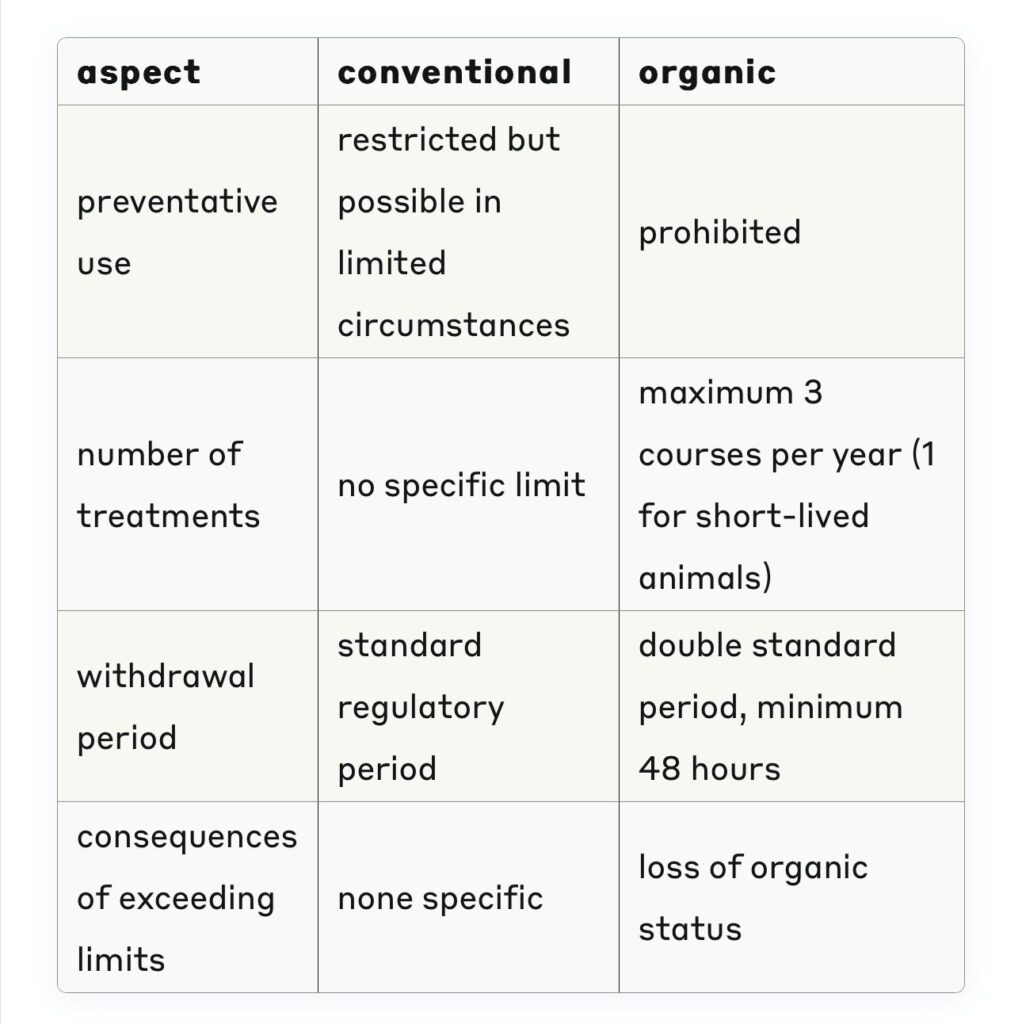
These differences may contribute to lower antimicrobial resistance development in organic systems. However, stricter limitations can create welfare dilemmas if producers delay necessary treatment to maintain organic status.
EFSA’s scientific opinions on poultry welfare
Recent European Food Safety Authority (EFSA) scientific opinions provide crucial insights into the welfare needs of poultry:
- for broilers, EFSA’s 2023 assessment (Nielsen et al., 2023) identifies genetic selection for fast growth as the primary welfare concern, resulting in skeletal disorders, cardiovascular problems, and reduced mobility. EFSA recommends maximum growth rates of 50g/day, significantly lower than current industry standards;
- for laying hens, EFSA’s parallel opinion highlights that enriched cages severely restrict natural behaviors such as foraging, dust bathing, and wing-flapping. The scientific body advocates for housing systems that ensure adequate space for movement, resting areas separated from activity zones, appropriate substrates, and sufficient environmental complexity to meet hens’ behavioral needs.
Both EFSA opinions emphasize that current minimum legal standards fail to address several severe animal welfare consequences identified through systematic scientific assessment, reinforcing the need for regulatory reform based on contemporary welfare science rather than decades-old compromises with industry.
Interim conclusions
The comparison between conventional and organic poultry production systems reveals several key findings across the primary components of poultry livestock production:
- EU organic standards generally provide enhanced animal welfare conditions compared to conventional requirements, particularly regarding space allowances, outdoor access, and restrictions on mutilations;
- conventional systems permit production methods (e.g., enriched cages) that restrict natural behaviors, while organic systems mandate conditions enabling behavioral expression;
- antibiotic use restrictions are more stringent in organic production, balancing welfare needs with antimicrobial resistance concerns;
- voluntary standards demonstrate market-driven potential for welfare improvements beyond legal requirements.
While these differences are established, there remains significant scope for improvement in the breeding selection requirements for organic poultry production.
Time for decisive EU action on animal welfare
The urgency for a comprehensive EU animal welfare Regulation can no longer be ignored. The European Commission’s long-delayed proposal is essential to address the demonstrable shortcomings in current legislation, as evidenced by successful European Citizens’ Initiatives like ‘End the Cage Age‘, which collected over 1.4 million verified signatures calling for the complete elimination of cage systems in animal farming. Despite this overwhelming public support, legal action has now been launched against the European Commission for failing to fulfill its promises to end caged farming. As the civil society has repeatedly emphasized, the Commission’s 2021 commitment to phase out cages by 2027 remains unfulfilled, with implementation timelines continuously postponed.
This regulatory overhaul must include financial support mechanisms for small farmers, enabling them to transition to higher-welfare systems without jeopardising their livelihoods. Equally critical is the reform of the Unfair Commercial Practices Directive (EU) 2019/633 to introduce an absolute ban on below-cost sales of agricultural products. As previously highlighted here, the current power imbalance between producers and retailers fuels a race to the bottom on prices, ultimately undermining animal welfare standards.
Coordinated regulatory and economic reform is essential if the EU is to honour its commitment to improving animal welfare and securing a just transition for all stakeholders in the food system. This must also address other pressing welfare concerns, such as the killing of day-old male chicks in the egg industry, where confusion over implementation dates and methods continues to hamper progress, demonstrating the slow pace of reform even on widely recognized ethical issues.
Dario Dongo
References
- Compassion in World Farming. (2022). Better Chicken Commitment: Technical information for food businesses. Retrieved from https://www.compassioninfoodbusiness.com/key-tools-for-success/better-chicken/
- Council Directive 1999/74/EC of 19 July 1999 laying down minimum standards for the protection of laying hens. Official Journal of the European Communities, L 203, 03/08/1999, p. 53–57.
- Council Directive 2007/43/EC of 28 June 2007 laying down minimum rules for the protection of chickens kept for meat production. Official Journal of the European Union, L 182, 12/07/2007, p. 19–28
- Council Directive 98/58/EC of 20 July 1998 concerning the protection of animals kept for farming purposes. Official Journal of the European Communities, L 221, 08/08/1998, p. 23–27
- European Commission Implementing Regulation (EU) 2020/464 of 26 March 2020 laying down certain rules for the application of Regulation (EU) 2018/848 (…) as regards the documents needed for the retroactive recognition of periods for the purpose of conversion, the production of organic products and information to be provided by Member States. Official Journal of the European Union, L 98, 31/03/2020, p. 2–25
- EFSA Panel on Animal Health and Animal Welfare (AHAW), Nielsen, S. S., et al. (2023). Welfare of broilers on farm. EFSA Journal, 21(2), 7788. https://doi.org/10.2903/
j.efsa.2023.7788 - EFSA Panel on Animal Health and Animal Welfare (AHAW), Nielsen, S. S., et al. (2023). Welfare of laying hens on farm. EFSA Journal, 21(2), 7789. https://doi.org/10.2903/
j.efsa.2023.7789 - Federation of Veterinarians of Europe. (2020). FVE position on antimicrobial use in food-producing animals. Retrieved from https://fve.org/publications/avma-fve-cvma-joint-statement-on-responsible-and-judicious-use-of-antimicrobials/
- KRAV. (2023). KRAV standards 2023: Livestock production. Retrieved from https://www.krav.se/en/
standards/download-krav- standards/ - Regulation (EC) No 1/2005 of 22 December 2004 on the protection of animals during transport and related operations. Official Journal of the European Union, L 3, 05/01/2005, p. 1–44
- Regulation (EC) No 1099/2009 of 24 September 2009 on the protection of animals at the time of killing. Official Journal of the European Union, L 303, 18/11/2009, p. 1–30
- Regulation (EU) 2018/848 of the European Parliament and of the Council of 30 May 2018 on organic production and labelling of organic products and repealing Council Regulation (EC) No 834/2007. Official Journal of the European Union, L 150, 14/06/2018, p. 1–92
- Regulation (EU) 2019/6 of the European Parliament and of the Council of 11 December 2018 on veterinary medicinal products and repealing Directive 2001/82/EC. Official Journal of the European Union, L 4, 07/01/2019, p. 43–167
- RSPCA. (2023). RSPCA welfare standards for meat chickens. Retrieved from https://science.rspca.
org.uk/sciencegroup/ farmanimals/standards/chickens - Sanders, J., Brinkmann, J., Chmelikova, L., Ebertseder, F., Freibauer, A., Gottwald, F., Haub, A., Hauschild, M., Hoppe, J., Hülsbergen, K.-J., Jung, R., Kusche, D., Levin, K., March, S., Schmidtke, K., Stein-Bachinger, K., Treu, H., Weckenbrock, P., Wiesinger, K., Gattinger, A., & Heß, J. (2025). Benefits of organic agriculture for environment and animal welfare in temperate climates. Organic Agriculture. https://doi.org/10.1007/s13165-025-00493-w
- Souillard, R., Répérant, J. M., Experton, C., Huneau-Salaün, A., Coton, J., Balaine, L., & Michel, V. (2021). Laying hen welfare in alternative housing systems – A comparative study across Europe. Veterinary and Animal Science, 13, 100196. https://doi.org/10.
1016/j.vas.2021.100196 - Welfare Quality®. (2009). Welfare Quality® assessment protocol for poultry. Welfare Quality® Consortium, Lelystad, Netherlands.

Dario Dongo, lawyer and journalist, PhD in international food law, founder of WIISE (FARE - GIFT - Food Times) and Égalité.
Related post
 Bisphenol A toxicity, EFSA declares a public health alert
 Listeria alert on desserts, Müller recalls them 12 days after expiration date
 Honey, fruit juices, jams and marmalades, dehydrated milk. Proposals for reform of marketing standards in EU
 EFSA opinion on nitrosamines in food. The population is at risk

