
Chia seeds – superfoods that date back to pre-Columbian civilizations – finally get the green light from Brussels, with no more need to report ‘maximum intake levels. Except to maintain some limits on use on grain-based foods subject to cooking, pending further evaluation by Efsa under the Novel Food Regulation.
Chia, history and production
Salvia Hispanica L., commonly known as chia (‘oily’, in Aztec language), belongs to the genus Salvia, family Lamiaceae. It is an annual herbaceous plant, a ‘pseudo-cereal,’ reaching about 2 meters in height. Native to south-central Mexico and Guatemala, it has been used for thousands of years for food and healing purposes. And it was in fact one of the four dietary staples in Mayan and Aztec civilizations (along with amaranth, quinoa and maize).
The rediscovery of this crop in recent decades is due to modern consumers’ growing interest in ancestral foods, from ancient grains to legumes, nuts and others. In search of the superfoods that are often indeed found in peoples’ own traditions.
Production is still concentrated in Mexico, but also takes place in Argentina, Bolivia, Colombia, Guatemala, Peru, Australia, Africa, and Asia. And also in Europe, southern Italy and Greece in particular, where the plant is grown in greenhouses. Because it requires less water than cereals and other oilseeds, its potential contribution to biodiversity and food security, among other things, has been assessed.
Possible uses of chia in the agribusiness supply chain
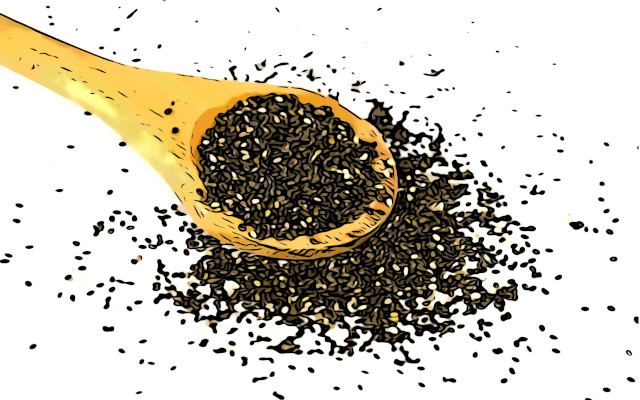
Chia seeds-about 1 mm in diameter-are used as is in baked goods, muesli and snacks, soups and ready meals, smoothies, etc. The hydrophilic properties of the seeds, which can absorb amounts of water more than 12 times their own mass, also contribute to increased satiety. And this is one reason why they are added to various foods, from salads to yogurt.
In bread, substitution of flour with chia seeds in 10% proportion was found to improve nutritional properties to an appreciable extent. With increased moisture, dietary fiber and phenols, due to which there is also a significant increase in antioxidant activity (+64%). The moderate reduction in carbohydrate content is then offset by the energy intake of polyunsaturated fatty acids (PUFAs).
In other bakery products (including confectionery) chia, even in gel form, can replace even partially other fat matrices (e.g., butter, eggs, various animal and vegetable fats), with the dual advantage of:
– Reduce calories and fat by providing omega-3 (ω-3) fatty acids,
– Improve texture, flavor and color. (1)
Flour can also be added into the dough of various matrices, including gluten-free, to increase its protein, PUFA, dietary fiber and micronutrient contents. The pasta shows excellent technological properties and high levels of enjoyment, even in the gluten-free version.
In animal feed, the use of seeds has been shown to help improve animal health and increase the Omega-3 content of products derived from it. Without compromising the organoleptic qualities of the meat and improving health. Also in the breeding of insects for food use, with surprising results. (2)
Nutritional and health properties
Scientific research on chia, which has more than tripled in the past decade, has brought into focus its high nutritional value and beneficial properties, yet still lacking health claims authorized in the EU. It was highlighted, in particular:
– A positive effect on the blood lipid profile through hypotensive, hypoglycemic, antimicrobial, and immunostimulatory effects, (3)
– The reduction in saturated fatty acid intakes, and the corresponding ω-3 fatty acid intake, linked to the introduction of this ingredient into the diet.
Nutritionally, chia seeds are favorably characterized in several aspects:
– ALA (αlpha-linolenic acid). Salvia Hispanica L. is considered one of the richest botanical sources of Omega-3 (even more so than flaxseed). With a tendentially ideal ratio of Omega-6 to Omega-3 (about 0.3:0.35),
– dietary fiber (approx. 30%) and protein (approx. 16-24%, depending on the growing environment). Analyses confirm the presence of ten exogenous amino acids (including arginine, leucine, phenylalanine, valine, and lysine) and endogenous amino acids (glutamic and aspartic acids, alanine, serine, and glycine especially),
– vitamins (B group, niacin in particular, as well as A and C) and minerals (manganese, phosphorus, magnesium, calcium, iron, and zinc), natural antioxidants.
Chia oil is composed mainly of triglycerides, with high polyunsaturated fatty acid (PUFA, α-linolenic acid) content. It is considered a valuable source of ω-3, on par withhemp oil, especially for vegetarians and people allergic to fish. The addition of chia oil (10-20% share) to sunflower oil also provides a useful balance of fatty acids. (4)
Chia and Novel Food, limits on food uses in EU
The placing on the EU market of foods containing chia seeds and their derivatives is still subject to certain restrictions. Although these are in fact foods with a millennia-old tradition of consumption in Central America, no evidence of their food use in the European Community was gathered before 15.5.07, when the first regulation on so-called Novel Food (EC Reg. 258/97) came into force. The related products are therefore subject to the centralized authorization regime established in the aforementioned framework (now EU reg. 2015/2283). And possibly comply with specific requirements, conditions of use and labeling.
The use of chia seeds in food in the EU has been allowed since 2009, in bread, to the maximum extent of 5 percent. The European Commission has since gradually extended its authorization for use, in the following food categories:
– baked goods, breakfast cereals, fruits, nuts and seed mixes , up to 10 percent, or as such. With certain limits and a maximum intake level of 15 g/day, to be indicated on the label (starting in 2013),
– fruit juices and fruit/vegetable-based mixed drinks, fruit-based spreads, yoghurt, sterilized ready-made places made from cereals, pseudocereals and/or dried legumes (from 2017). Again, with use limits and a requirement to state the 15 g daily threshold. (5)
The European Food Safety Authority (EFSA), on 14.3.19, published an assessment regarding the overall dietary exposure to this ‘novel food’. (6) By detecting the safety of its consumption, without the need to maintain maximum utilization levels. (7) However, the Authority deferred its evaluation about foods that require heat treatment at >120 °C in order to assess the possible formation of acrylamide. (8)
Chia seeds in food products, rules in effect
Finally, Regulation (EU) 2020/24 expanded the authorization for the use of chia seeds by removing the provisions on maximum quantities of use and the corresponding requirement to state a maximum daily intake level on the label. And therefore:
– the limits already provided for remain only on cereal products generally subjected to heat treatment above 120 °C: 5 percent maximum chia seeds on bakery products and 10 percent on baked goods, breakfast cereals, sterilized ready meals made from cereals, pseudocereals and/or dried legumes,
– no limit on chia seeds pre-packed or inserted in fruits, nuts and seed mixes, confectionery (including chocolate, excluding chewing gum), dairy products (including yogurt) and substitutes, food ice, fruit and vegetables (including fruit-based spreads, compotes with or without cereals, fruit preparations, fruit-based desserts, fruit mixed with coconut milk), soft drinks, puddings (not subjected to temperature >120 °C),
– the legal name to be reported on the label is ‘Chia seed(Salvia hispanica)’. (9)
Dario Dongo and Giulia Torre
Notes
(1) See Maria Herminia Ferrari Felisberto et al. (2015). Use of chia (Salvia hispanica L.) mucilage gel to reduce fat in pound cakes. Elsevier, LWT- Food science and technology, 2015, 63 2, 1049:1055. https://doi.org/10.1016/j.lwt.2015.03.114
(2) SEE A. M. Jamshidi et al. (2019). Chia (Salvia hispanica L.) as a novel forage and feed source: a review. Italian Journal of Agronomy 2019, volume 14:1297. doi : 10.4081/ija.2019.1297
(3) V. B. Kulczynski et al. (2019). The chemical composition and nutritional value of Chia Seeds – current State of knowledge. Nutriens, 2019, 11 1242. doi: 10.3390/nu11061242
(4) V.Zettel, B. Hitzmann. (2018). Applications of chia (Salvia hispanica L.) in food products. Trends in Food Science & Technology, vol. 80 2018, 43:50. https://doi.org/10.1016/j.tifs.2018.07.011
(5) See European Commission Decisions 13.10.09 and 22.10.13, Implementing Decision (EU) 2017/2354, Reg. EU 2017/2470
(6) EFSA. (2019). A Safety of chia seeds (Salvia hispanica L.) as a novel food for extended uses pursuant to Regulation (EU) 2015/2283. EFSA Journal 2019;17(4):5657. https://doi.org/10.2903/j.efsa.2019.5657
(7) EFSA has indicated two reports of allergic reactions to chia seed consumption to allergic reactions. Moreover, the episodicity and statistical insignificance compared to widespread consumption in the EU has led the Commission not to prescribe specific mandatory information in this regard.
(8) SEE https://www.efsa.europa.eu/en/consultations/call/call-data-relevant-safety-assessment-heat-treated-chia-seeds
(9) See reg. EU 2020/24, Annex

Dario Dongo, lawyer and journalist, PhD in international food law, founder of WIISE (FARE - GIFT - Food Times) and Égalité.

Graduated in law, master in European Food Law, she deals with agro-food, veterinary and agricultural legislation. She is a PhD in agrisystem.