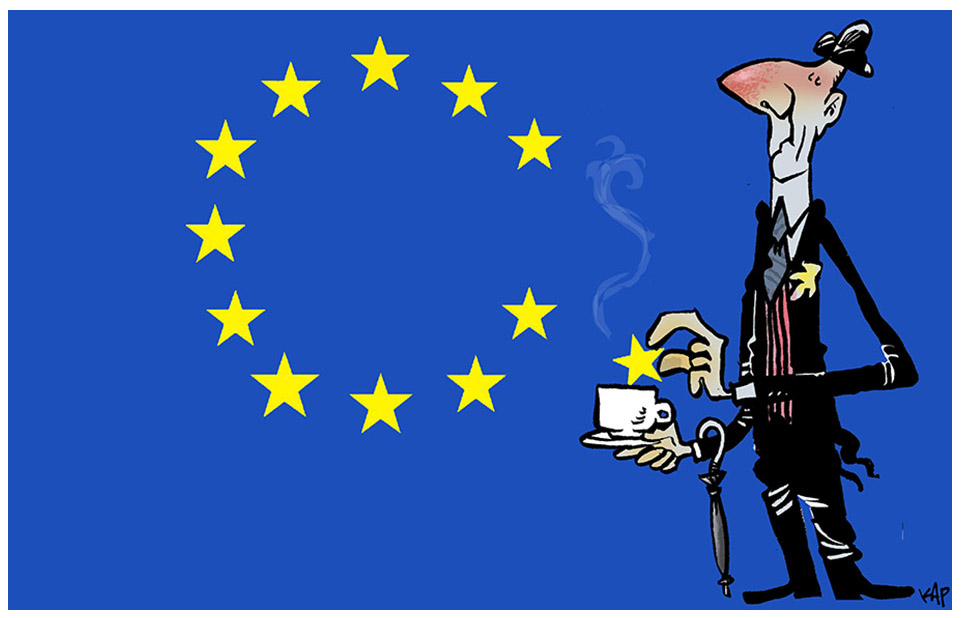

The Brexit is at the starting tape, officially effective 1.1.21. Import and export of food between the EU and UK are subject to new rules impacting, among other things, labeling and marketing standards. Details to follow.
Brexit, latest news
With the agreement to withdraw from the European Union, which came into effect on February 1, 2020, the United Kingdom became a third country. The transitional phase-during which EU provisions continue to apply in the UK, with no impact on customs and taxation-ends Dec. 31.20. As of the next day, England exits both the internal market and the customs union. (1)
Negotiations on the recognition of equivalence of the two legal systems and the simplification of rules to be applied to trade-whose total value is estimated at about 775 billion euros a year-were launched on 2.3.20. They were supposed to be concluded by Oct. 31.20, but negotiators are at loggerheads over fishing quotas and the rights of EU member state-flagged vessels over British waters. (2)
Import and export of food between UK and EU, 7 new features
The British legislature has implemented only some of the existing EU rules. The government guidelines thus explain the rules to be applied as of 1.1.21. (3) With specific regard to the marketing of various goods, as well as customs declarations and application of Value Added Tax (VAT).
The labeling of food and beverages is subject to some changes, specifically with regard to:
1) address of the responsible operator,
2) identification marks and health stamps,
3) Organic products, rules and logo,
4) Country of origin, ‘EU origin,
(5) olive oil blends, origin,
6) mix of fruits and vegetables, meats, eggs,
7) Geographical Indications (GIs, e.g., PDO, PGI, TSG). (4)
1) Address of the responsible operator
Guidelines issued on 14.10.20 by the London government indicate a transition phase to update the responsible operator’s address on labels of prepacked foods and caseins to be sold in the UK:
– from 1.1.21 to 30.9.22 you can continue to use an operator’s address in the EU, Great Britain and Northern Ireland,
– from 1.10.22 the address of an operator (or importer) based in Great Britain will have to come mandatory.
Already as of 1.2.21, pre-packaged foods in the UK must instead display on the label the address of an operator-or importer-based in the EU or Northern Ireland. UK-sourced products are subject to the requirements applied to those arriving from third countries.
2) Identification marks and health stamps.
New health stamps (for fresh meat) and identification marks (for other animal products) must be placed, as of 1.1.21, on animal products produced and placed on the market in Great Britain and Northern Ireland, or exported outside the United Kingdom.
Specific requirements on size and typeface of new marks and stamps are given in special Food Standard Agency (FSA) guideline 15.10.20. (5) And a proposal for a transitional scheme is still under discussion, to postpone for 21 months the updating of labels only for foods produced and intended to remain on the British market.
3) Organic productions
New rules for the production, processing and labeling of organic food and feed are introduced in the UK, effective 1.1.21. (6) Applying criteria apparently similar to those in the EU. Nonetheless:
– Britain recognizes the equivalence of European organic products to its own only until Dec. 31.21,
– the European Union has not yet decided whether to recognize food and feed registered in the UK as organic as of 1.1.21, and whether the EU organic logo may still come to be used on such products. (7)
The TRACES NT(TRAde Control and Export System New Technology) IT platform-used to facilitate data exchange for the import of organic animals, food and plants into the EU-is being replaced in the UK by an interim manual system.
4) Country of origin, ‘EU origin‘
Only products from Northern Ireland can continue to be designated as ‘EU origin‘ on the label. Those made in Great Britain (England, Scotland and Wales), on the other hand, will have to remove this marking-and will not be allowed to be referred to as such, even as ingredients in other foods-as of 1.1.21.
Instead, foods produced and sold in Britain will be able to retain the ‘EU origin‘ indication until 9/30/22.
5) Olive oil blends, origin
Blends of olive oils will only be allowed to report ‘EU‘ and/or ‘non-EU‘ origin when marketed in Northern Ireland. Instead, labels on products sold in Britain will have to report, as of 1.10.22:
– the words ‘blend of olive oils from several countries,’ or similar,
– The list of each country of origin, viz.
– the name of the trading bloc to which a regional trade agreement applies, (e.g., ‘blend of olive oils of European Union origin‘).
The novelty is thus, in effect, the elimination of the option to indicate ‘non-EU‘ and the consequent burden of specifying the individual countries of origin of non-EU oils (e.g., Turkey, Tunisia). An idea that also deserves consideration by the European legislature.
6) Mix of fruits and vegetables, meats, eggs.
The origin of fruit and vegetable mixes, if not specified with the names of individual countries, from 1.10.20 must be indicated as ‘UK‘ and/or ‘non-UK‘. The same is true for beef and ground beef. (4)
As for eggs, Great Britain has updated its standards on production and sale, most recently on 2.7.20. Nevertheless, British eggs have also been subject since 1.1.21 to the import requirements set in the EU for animal products arriving from third countries.
7) Geographical Indications (GIs)
A new system of GIs, in line with the rules stipulated by the WTO(World Trade Organization), is introduced in Britain. UK PDO, PGI and TSG labels are to be updated with new ‘Designated Origin‘, ‘Geographic Origin‘, ‘Traditional Speciality‘ – ‘UK-protected‘ logos. (8)
British GIs protection logos are to be inserted by 1.2.24, on products registered before 1.1.21, and from the beginning on new registrations. UK PDOs, PGIs and TSGs protected in the EU will in any case be able to retain the EU logo-in addition to the UK logo-even following the transitional period.
Marketing standards post Brexit
The exit of the United Kingdom from the European Union, under the conditions defined so far, brings to an end the application of the principle of mutual recognition. (9) This implies that foodstuffs arriving from England must meet both EU rules and any rules established in individual member states.
The London government in turn points out how the marketing standards may result in significant variations on foods whose regulation has so far been harmonized at the European level. (10) These include fruits and vegetables, wines, beef and veal, poultry meat, eggs, hatching eggs and chicks, and hops.
Dario Dongo and Giulia Torre
On the cover an image from Cartooning for Peace
Notes
(2) Jim Brundsen, Peter Foster, George Parker. Michel Barnier to signal lack of Brexit breakthrough on key issues. Financial Times. 3.11.20, https://www.ft.com/content/9913f4cd-3d4e-42dd-b35a-b08be5026c53
(3 ) See https://www.food.gov.uk/business-guidance/the-uk-transition and https://www.legislation.gov.uk/
(4) SEE https://www.gov.uk/guidance/food-and-drink-labelling-changes-from-1-january-2021
(5) Guidance on health and identification marks that applies from January 1, 2021. https://www.food.gov.uk/business-guidance/guidance-on-health-and-identification-marks-that-applies-from-1-january-2021
(6) Trading and labeling organic food from January 1, 2021, Guidance. SEE. https://www.gov.uk/guidance/trading-and-labelling-organic-food-from-1-january-2021
(7) UK organic food and feed producers will only be allowed to use the European logo if:
– control body is authorized by the EU to certify UK products for export to the EU,
– UK and EU will recognize mutual standards through equivalence agreement
(8) Protecting food and drink names from January 1, 2021, https://www.gov.uk/guidance/protecting-food-and-drink-names-from-1-january-2021
(9) According to the principle of mutual recognition, products that are legally sold in one European Economic Area (EEA) country can be marketed and sold in any other country. See ECJ Cassis De Dijon judgment (Case C 120/78), reg. EU 2019/515
(10)
Marketing standard
To apply in the UK:
– wine,
– eggs,
– hops,
– chicken meat.

Dario Dongo, lawyer and journalist, PhD in international food law, founder of WIISE (FARE - GIFT - Food Times) and Égalité.

Graduated in law, master in European Food Law, she deals with agro-food, veterinary and agricultural legislation. She is a PhD in agrisystem.
Related post
 Brexit Deal, import – export of food, feed, plants and animals. Some priority issues
 Brexit Deal. EU-UK imports and exports, rules in place and in the making
 Brexit just around the corner, updates from the Ministry of Health
 Production and labeling of organic products, starting reg. EU 2018/848. THE ABC’S