
On March 19, 2025, the Council of the European Union published document 7258/25, outlining its final compromise on the Waste Framework Directive 2008/98/EC reform proposal, with a strong focus on tackling food loss and waste (FLW).
This legislative initiative seeks to strengthen the environmental and social sustainability of the food sector within the EU, building upon the principles of the existing Waste Framework Directive and supporting both the European Green Deal and the Circular Economy Action Plan. Currently, this Council-Commission agreement is a draft and requires further negotiation and approval from the European Parliament through the trilogue process.
This analysis provides an in-depth look at the key elements of this compromise text, including the proposed legally binding national targets for food loss and waste reduction and the strategies for their implementation.
Legal and policy context
The Waste Framework Directive reform proposal seeks to ‘reinforce and accelerate Union and Member State action to ensure environmental and social sustainability of the textiles and food sectors’, with food being identified as the most resource-intensive sector, causing significant negative environmental externalities.
The food sector does not yet fully comply with the fundamental waste management principles of the Union, as outlined in the waste hierarchy (i.e. the Lansink’s scale), which prioritises the prevention of food loss and waste. Addressing this challenge requires a systemic solution based on a lifecycle approach, with particular focus on food products (Recitals 1-2).
Strategic background
The text recalls the commitments undertaken by Member States under the UN 2030 Agenda for Sustainable Development, in particular SDG Target 12.3, which aims to halve per capita global food waste by 2030 and reduce food losses along production and supply chains, including post-harvest losses. The Commission has followed up on the Conference on the Future of Europe by organizing a Citizens’ Panel (Dec 2022 – Feb 2023), which suggested three key actions:
- ‘enhancing cooperation across the food value chain;
- encouraging food business initiatives;
- promoting changes in consumer behaviour’ (Recitals 5-6).
The challenge: food loss and waste reduction
Despite growing awareness, food loss and waste levels have not declined fast enough to meet the SDG target. The Commission notes that Member States have launched several initiatives but that these ‘rarely lead to real behavioural change’.
Therefore, the revised directive lists areas of intervention where Member States should adapt or adopt measures for each stage of the food supply chain as appropriate. It calls for more structured, tailored, and integrated approaches, with a particular focus on households, restaurants, and food service.
‘Importance should also be given to dietary shifts, regional circular solutions, including public-private partnerships and citizen engagement as well adaptation to specific regional needs such as outermost regions or islands’ (Recitals 9-10).
Setting and structuring food waste reduction targets
To achieve early progress and provide long-term clarity for stakeholders, legally binding national targets for reducing food waste by 2030 should be introduced (Recital 11). These targets should be:
- proportionate, feasible, and tailored to the capacities of different food supply chain actors, especially small and micro enterprises (Recital 12);
- differentiated between the manufacturing stage on one hand, and the combined retail, food service, and household stages on the other (Recitals 15,16).
A single per capita target for retail, food services, and households is recommended to reduce complexity and ensure flexibility, considering their interlinkages and demographic factors, including tourism (Recital 16).
To ensure targets are based on accurate data, the baseline year should be an average of food waste levels between 2021 and 2023. Member States with reliable pre-2020 data (aligned with EU methodology) should also be allowed to use earlier baselines (Recital 18, Article 9).
Periodic review and revision of targets will be necessary to assess progress, consider production-level changes, and strengthen alignment with SDG 12.3. Filling knowledge gaps, especially concerning food loss at the production stage, is essential to support effective action (Recital 19).
The Waste Framework Directive reform proposal
By 31 December 2030, Member States must reduce food waste by:
- 10% in food processing and manufacturing;
- 30% in retail, food services, and households (Article 9),
These legally binding targets must account for demographic change and be corrected for tourism flows that affect consumption without being reflected in population statistics. The Commission is tasked with developing a correction factor to address these variations (Recital 17; Article 1, point 5).
By 31 December 2027, Member States must report their progress and the Commission shall review the 2030 targets, with a view to:
- potentially modifying and/or extending them to other stages of the supply chain (e.g., primary production);
- introducing new binding targets for 2035;
- assessing the impact of production-level changes on target achievability (Article 9a.7).
A step-wise early warning mechanism will be introduced to ensure timely corrective action if progress lags (Recital 20).
Infrastructure, monitoring tools and governance
Member States must ensure the necessary infrastructure is available to support separate waste collection, with adequate coverage in terms of materials and locations (Articles 11, 28).
Member States must implement systems to monitor food waste and track reduction progress, considering regional specificities (e.g. outermost regions and tourist areas). To ensure comparability, the Commission will provide a correction factor (Article 37).
Each Member State must designate a competent authority to coordinate actions, ensuring accountability, consistency, and effective governance of food waste prevention measures. This is essential in managing cross-sectoral responsibilities and ensuring national coherence (Recital 52).
Food loss and waste prevention programs
Member States must revise and expand their food waste prevention programs. These should involve stakeholders across the food value chain, including primary producers, processors, retailers, hospitality, social economy actors, NGOs, and consumer organisations.
Programs must address behavioural drivers of waste and focus on specific hotspots, drawing from the Citizens’ Panel on Food Waste, the European Consumer Food Waste Forum’s Compendium of tools, best practices, and recommendations, the EU Platform on Food Losses and Food Waste (Recital 51, Article 9a.7a).
Widespread education and communication campaigns will be expanded to target consumers, food service providers, and retailers. These initiatives aim to shift mindsets and reduce unnecessary waste through improved awareness and better practices (Recital 54).
Harmonization
To align food waste codes with the Combined Nomenclature of the EU customs system, the Commission is empowered to adopt delegated acts to update Annex IVc of Directive 2008/98/EC.
This process must comply with the Interinstitutional Agreement on Better Law-Making (2016), ensuring transparency, consultation at expert level, and equal participation of Parliament and Council (Recital 56).
Once the Directive will enter into force, Member States shall adopt and bring into force the necessary laws, regulations and administrative provisions to comply with it within the following 20 months (Article 2).
Interim conclusions
This proposal sets a clear path for reducing food waste across the EU through binding targets and concrete prevention measures. It reinforces the EU’s commitment to sustainability, food security, and climate goals, while supporting innovation in circular food systems.
EU-funded projects like EcoeFISHent, promoting upcycling and blue economy solutions in the fish supply chain, and Wasteless, advancing traceability and circularity through digital tools, demonstrate the potential of research and innovation to reduce food loss and waste.
Dario Dongo and Iudita Sampalean
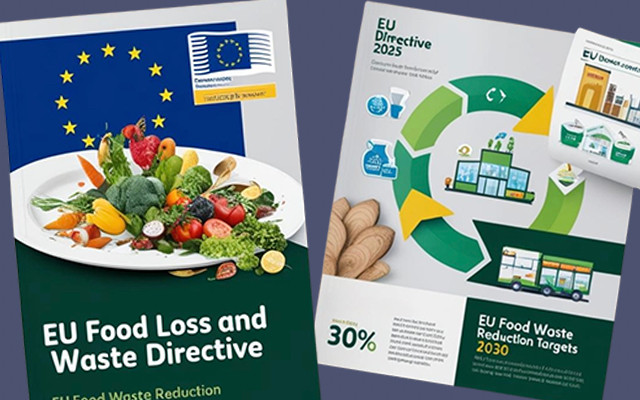
Cover art copyright © 2025 Dario Dongo (AI-assisted creation)
References
- Candeal, T., Brüggemann, N., Bruns, H., Casonato, C., Diercxsens, C., Garcia Herrero, L., Gil, J. M., Haglund, Y., Kaptan, G., Kasza, G., Mikkelsen, B. E., Obersteiner, G., Pires, I. M., Swannell, R., Vainioranta, J., Van Herpen, E., Vittuari, M., Watanabe, K., & Sala, S. (2023). Tools, best practices and recommendations to reduce consumer food waste – A compendium. Publications Office of the European Union. https:/doi.org/10.2760/967005
- Council of the European Union. (2025, March 19). Proposal for a Directive of the European Parliament and of the Council amending Directive 2008/98/EC on waste (Interinstitutional File 2023/0234(COD), Council doc. 7258/25). https:tinyurl.com/345f288x
- European Commission. (2020). Combined Nomenclature of the EU customs system. https://tinyurl.com/mr2xurxv
- European Parliament, Council of the European Union, & European Commission. (2016, April 13). Interinstitutional agreement on better law-making. Official Journal of the European Union, L 123, 1–14. https://tinyurl.com/yu54pjct

Dario Dongo, lawyer and journalist, PhD in international food law, founder of WIISE (FARE - GIFT - Food Times) and Égalité.

Researcher, Ph.D in Marketing and Economics of the Agrifood System