
The valorisation of agri-food by-products has emerged as one of the most dynamic research frontiers in food and nutritional science over the past decade. A comprehensive review recently published in Nutrients (Ingallina et al., 2025) synthesises the scientific advances achieved in recovering bioactive compounds from food processing waste, with a particular focus on their applications in human health, functional food development, nutraceutical formulation, pharmaceutical research, and sustainable packaging. The study, involving researchers from multiple Italian universities including Sapienza University of Rome, offers a timely and rigorous overview of both the opportunities and challenges in this rapidly evolving field.
The point of departure is the sheer magnitude of food loss and waste generated globally. According to data cited in the review, over 1.05 billion tonnes of food were lost and wasted worldwide in 2022, of which approximately 59.2 million tonnes originated at the European level. Fruits and vegetables account for the largest proportion of this waste — some 45% of the total — followed by fish and fishery products at 35%. Beyond the obvious environmental burden, the review frames this waste stream as a largely untapped reservoir of nutritionally and pharmacologically relevant molecules. Polyphenols, carotenoids, dietary fibres, essential oils, organic acids, and bioactive peptides have all been identified in agri-food by-products, underlining their potential across multiple application sectors (Ingallina et al., 2025; Saini et al., 2025).
Methodology: a narrative review across multiple databases
The authors conducted a structured search of PubMed and Scopus databases, restricting the selection to English-language, peer-reviewed articles published within the previous ten years. Boolean operators were used to combine keywords across specific thematic areas — extraction techniques, biological activities, functional food formulation, pharmaceutical applications, and packaging — with each section governed by its own tailored search strategy. The review explicitly excludes unverifiable claims and focuses on original research wherever possible, supplemented by reviews where necessary to contextualise emerging trends.
Green extraction technologies: efficiency meets sustainability
A central methodological theme of the review concerns the transition from conventional solvent-based extraction methods — such as maceration and Soxhlet extraction — towards innovative, lower-impact alternatives. Among the most extensively documented techniques are ultrasound-assisted extraction (UAE), microwave-assisted extraction (MAE), supercritical fluid extraction (SFE), pressurised liquid extraction (PLE), subcritical water extraction (SWE), high-hydrostatic-pressure extraction (HHPE), pulsed electric field extraction (PEF), and high-voltage electrical discharge extraction (HVED). Each method presents distinct advantages in terms of yield, selectivity, and environmental compatibility, with the choice depending on the target matrix and compound class. For instance, SFE using CO₂ has demonstrated recovery rates of up to 97% for lycopene from tomato processing waste, while UAE has yielded flavonoid-rich extracts from potato peel with notable antibacterial activity (Ingallina et al., 2025).
Biological activities: a multi-target profile
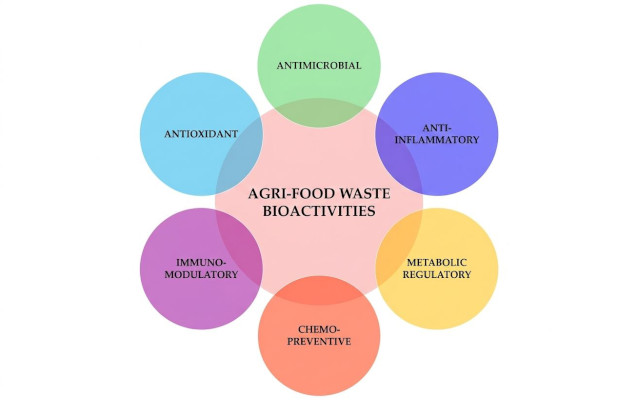
The review devotes considerable attention to the biological activities of phytocomplexes derived from agri-food waste, cataloguing evidence across six principal domains: antimicrobial, antioxidant, anti-inflammatory, immunomodulatory, chemopreventive, and metabolic regulatory effects. Among the most studied matrices are tomato, grape, apple, and pomegranate pomaces, citrus peels, cereal brans, and Brassicaceae by-products. The mechanistic discussion is notably detailed:
- antimicrobial effects are linked to membrane disruption and enzyme inhibition;
- antioxidant activity encompasses both direct mechanisms such as radical scavenging and indirect pathways including Nrf2 activation;
- anti-inflammatory properties are associated with the downregulation of NF-κB and MAPK signalling;
- metabolic regulatory effects include the inhibition of α-amylase and α-glucosidase, alongside improvements in insulin sensitivity.
Of particular note is the evidence for ellagic acid from pomegranate peel, which demonstrated capacity to inhibit biofilm formation, reduce bacterial resistance to β-lactam antibiotics, and exhibit antiviral activity against a broad range of pathogens (Ingallina et al., 2025; Sha et al., 2023).
Functional foods and nutraceuticals: from laboratory to prototype
The application of recovered bioactive compounds to functional food formulation represents one of the review’s most practically oriented sections. Documented applications range from bakery products and dairy alternatives enriched with grape pomace or hazelnut skin extract, to gluten-free pasta incorporating tomato processing waste and linseed meal. In one reported study, the inclusion of grape pomace in yogurt formulations delayed lipid oxidation and increased antioxidant capacity by up to 30%, while extending shelf life by three to five days. In the nutraceutical domain, the review documents a growing body of work on encapsulated formulations derived from citrus pomace, olive mill wastewater, almond skin, artichoke bracts, and avocado seed, often assessed through in vitro digestion models and, in a small number of cases, randomised clinical trials. The authors are candid about the limitations of this literature: most studies remain at the laboratory scale, with insufficient data on bioavailability, mechanistic pathways, and long-term consumer acceptance (Comunian et al., 2021; Ingallina et al., 2025).
Pharmaceutical and biomedical applications
Beyond food and nutrition, the review explores the use of agri-food waste in pharmaceutical formulations and biomedical research. Highlights include the development of solid lipid nanoparticles loaded with grape seed polyphenols to enhance blood–brain barrier permeability in Alzheimer’s disease models, chitosan-based wound dressings derived from crustacean shell waste, and scaffolds incorporating mango peel extract with demonstrated pro-angiogenic activity. The review also introduces the emerging field of plant-derived extracellular vesicles (PDEVs) as potential drug delivery systems, noting that whilst preclinical and early clinical data are promising, the lack of standardised isolation protocols remains a significant constraint. The potential of agri-food substrates for antibiotic production via solid-state fermentation — notably tetracycline from peanut shells and rifamycin B from corn husk — is also addressed, though the authors acknowledge that the transition from laboratory to industrial scale remains challenging (Ingallina et al., 2025).
Sustainable packaging: closing the circular economy loop
The final major thematic section addresses the incorporation of agri-food by-products into biodegradable packaging materials. The review surveys the principal categories of bio-based polymers — including starch, cellulose, chitosan, gelatin, and polyhydroxyalkanoates — and examines how the addition of bioactive extracts from citrus peel, spent coffee grounds, grape pomace, pomegranate peel, and olive waste can enhance their antimicrobial and antioxidant functionality. Among notable examples, chitosan films crosslinked with citrus-derived antifungal agents demonstrated significant post-harvest preservation of fruit, whilst pectin-based films incorporating pomegranate peel polyphenols exhibited low water vapour permeability and strong antioxidant activity. These developments reinforce the circular bioeconomy rationale underpinning the entire review: waste streams that might otherwise generate environmental liabilities can instead serve as functional inputs across multiple industrial sectors (Ingallina et al., 2025).
Conclusions and research priorities
The review concludes with a structured strategic roadmap, framed around a Technology Readiness Level (TRL) framework, identifying key barriers — including the lack of harmonised regulatory standards, limited industrial scalability, and variability in phytochemical composition — alongside priority actions. These include improving the clinical validation of recovered bioactives, optimising green extraction technologies for cost-efficient upscaling, and establishing interdisciplinary consortia to bridge the gap between laboratory research and market adoption. The overarching message is clear: agri-food by-product valorisation is no longer a peripheral concept but an essential pillar of sustainable food systems, public health strategy, and the broader transition to a regenerative bioeconomy.
#Wasteless
Dario Dongo
Credit cover: Ingallina et al. (2025)
References
- Comunian, T. A., Silva, M. P., & Souza, C. J. F. (2021). The use of food by-products as a novel for functional foods: Their use as ingredients and for the encapsulation process. Trends in Food Science & Technology, 108, 269–280. https://doi.org/10.1016/j.tifs.2021.01.003
- Ingallina, C., Spano, M., Prencipe, S. A., Vinci, G., Di Sotto, A., Ambroselli, D., Vergine, V., Crestoni, M. E., Di Meo, C., Zoratto, N., Izzo, L., Navarré, A., Adiletta, G., Russo, P., Di Matteo, G., Mannina, L., & Giusti, A. M. (2025). Enhancing human health through nutrient and bioactive compound recovery from agri-food by-products: A decade of progress. Nutrients, 17, 2528. https://doi.org/10.3390/nu17152528
- Saini, R. K., Khan, M. I., Kumar, V., Shang, X., Lee, J., & Ko, E. (2025). Bioactive compounds of agro-industrial by-products: Current trends, recovery, and possible utilization. Antioxidants, 14, 650. https://doi.org/10.3390/antiox14060650
- Sha, S. P., Modak, D., Sarkar, S., Roy, S. K., Sah, S. P., Ghatani, K., & Bhattacharjee, S. (2023). Fruit waste: A current perspective for the sustainable production of pharmacological, nutraceutical, and bioactive resources. Frontiers in Microbiology, 14, 1260071. https://doi.org/10.3389/fmicb.2023.1260071

Dario Dongo, lawyer and journalist, PhD in international food law, founder of WIISE (FARE - GIFT - Food Times) and Égalité.